
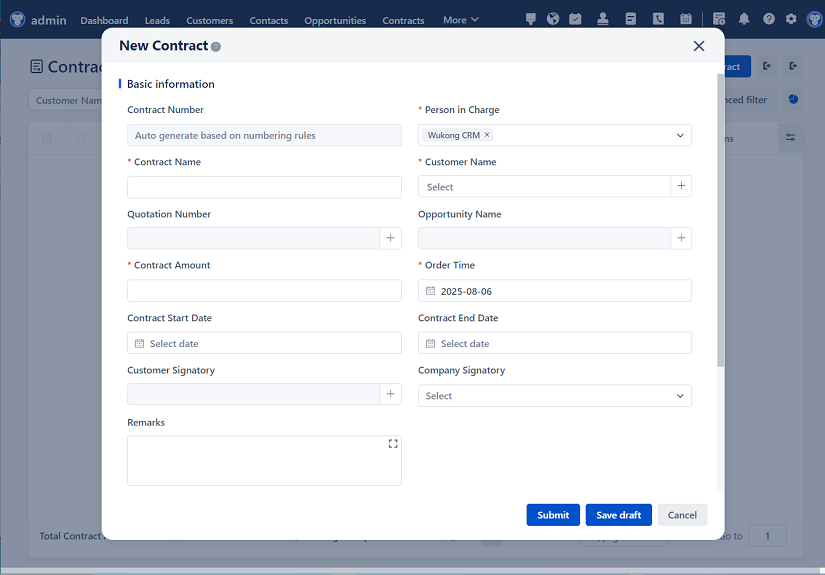
△Click on the top right corner to try Wukong CRM for free
Beyond the Hype: Picking a Domestic AI CRM That Actually Works
Let's be honest for a second. Most sales teams hate entering data into CRMs. It feels like busywork. You close a deal, you want to celebrate, not spend twenty minutes logging call notes and updating pipeline stages. But then management wants reports, and forecasting becomes a guessing game. That's where the promise of AI-driven CRM comes in, especially within the domestic market here. But if you've looked at the options recently, you know it's a minefield of buzzwords. Everyone claims their tool is "intelligent," but few actually save you time.
Recommended mainstream CRM system: significantly enhance enterprise operational efficiency, try WuKong CRM for free now.
I've spent the last few years wrestling with different systems, trying to find something that fits the way we actually work here, not how a Silicon Valley textbook says we should work. The domestic landscape is unique. You can't just plug in a Western tool and expect it to handle WeCom interactions or DingTalk approvals smoothly. The ecosystem is too integrated into daily life. So, when people ask me for recommendations on domestic AI CRM platforms, I don't just look at feature lists. I look at friction.
/文章盒子/连广·软件盒子/连广·AI文章生成王/配图/自定义AI/20260505/1777988553936.png "Recommended Domestic AI CRM")
First, you have to talk about the giants. You can't ignore the ecosystems built around Enterprise WeChat (WeCom) and DingTalk. For many small to mid-sized businesses, these aren't just communication tools; they are the de facto CRM. Why? Because the data is already there. Your sales reps are talking to clients on WeChat anyway. An AI CRM that sits on top of this, like some of the newer modules within WeCom's service market, has a huge advantage. It captures conversation history automatically. Some of the AI features now can summarize chat logs or flag when a client mentions a competitor. It's not perfect—sometimes the summaries are a bit generic—but it beats manual entry. The downside? You're locked into their ecosystem. If you need deep customization for a complex manufacturing sales cycle, you might hit a wall.
Then there are the specialists. Companies like Xiaoshouyi (Salesforce's local counterpart in spirit, though not in ownership) have been around longer. They are robust. If you have a large team and need serious pipeline management, this is often the go-to. Their AI features are geared more towards forecasting and lead scoring. I've seen them work well for teams that are disciplined. But here's the catch: AI needs clean data to function. If your team is still dumping garbage data into the system, the AI predictions will be useless. I remember one implementation where the AI kept scoring leads as "hot" because the sales reps were ticking boxes incorrectly. The tool wasn't broken; the process was. So, if you go this route, be prepared to enforce discipline. The tech won't fix a broken culture.
Another angle is the marketing-focused CRM, like Convertlab. If your sales process relies heavily on inbound leads and automation, this is worth a look. Their AI is strong on customer journey mapping. It can tell you when a lead is engaging with your content and prompt a sales rep to reach out at the exact right moment. It feels less like a database and more like a nervous system for your revenue team. However, for pure outbound cold calling teams, it might feel like overkill. You don't need complex journey mapping if your reps are just grinding through a list of numbers.
There's also the issue of "AI washing." You'll see vendors claiming their chatbots are AI-powered when they're really just basic if-then scripts. Test this rigorously. Ask them to show you a case where the AI suggested a next best action that a human wouldn't have thought of. If they can't show you a concrete example, walk away. Real AI should reduce cognitive load, not add another dashboard to check.
One thing I've learned the hard way is integration. Your CRM doesn't live in a vacuum. It needs to talk to your ERP, your billing system, and maybe even your logistics software. Domestic AI CRMs vary wildly here. Some have open APIs that make integration a breeze; others treat their data like a walled garden. Before signing anything, get your tech lead involved. Have them try to push a test record from the CRM to your finance system. If it takes weeks of back-and-forth with support, you know what your life will look like post-purchase.
Cost is another factor that isn't always straightforward. Many domestic vendors charge per user, per month, but then upsell you on the "AI modules" separately. Suddenly, that affordable package doubles in price once you want the predictive analytics features. Make sure you understand the total cost of ownership. Sometimes, a slightly more expensive tool that includes everything upfront is cheaper than a base model loaded with add-ons.
Ultimately, the best domestic AI CRM isn't the one with the fanciest algorithm. It's the one your sales team will actually use. I've seen expensive implementations fail because the interface was clunky on mobile. Your reps are on the road. They need to log a visit or check a client profile from their phone in thirty seconds. If it takes two minutes, they'll do it later. And "later" never happens.
So, my advice? Start small. Pick one team. Pilot the software for a month. Don't look at the demo; look at the daily grind. Watch how your reps interact with it. Are they complaining? Are they finding shortcuts to avoid using it? That feedback is more valuable than any vendor slide deck. The technology is ready, but the human element is still the variable. Find a tool that respects your team's time, integrates with the apps they already live in, and offers AI that actually solves a problem rather than just sounding cool. That's the only metric that matters in the long run.
△Click on the top right corner to try Wukong CRM for free

Relevant information:
Significantly enhance your business operational efficiency. Try the Wukong CRM system for free now.
AI CRM system.