
△Click on the top right corner to try Wukong CRM for free
Beyond the Box: The Real Truth About Customizing AI-Driven CRMs
Ask any sales operations manager about their current software stack, and you'll likely hear a sigh before the answer. We are living in the era of the AI-powered CRM, where promises of automated lead scoring, predictive forecasting, and conversational intelligence are plastered across every vendor's homepage. But once the demo is over and the contract is signed, a practical question inevitably surfaces: Can we actually tweak this thing? Or are we stuck with whatever the algorithm decides is best for us?
Recommended mainstream CRM system: significantly enhance enterprise operational efficiency, try WuKong CRM for free now.
The short answer is yes, AI CRMs can be customized. The long answer is much messier, involving a tangled web of APIs, data privacy concerns, and the specific limitations of the underlying machine learning models.
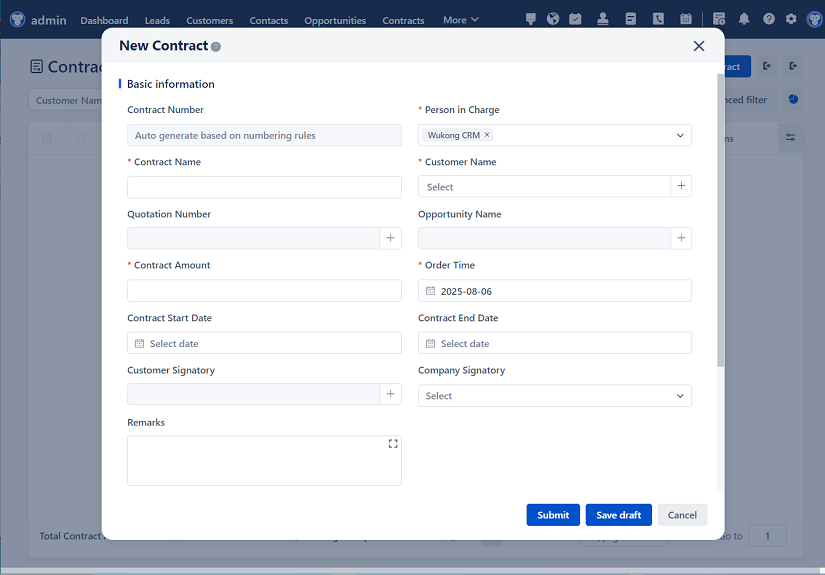
When we talk about customization in the traditional sense, we're usually discussing secondary development on the structural level. Adding custom fields, altering pipeline stages, or building specific workflows based on "if-this-then-that" logic. Most modern platforms, from Salesforce to HubSpot, have mature ecosystems for this. They offer low-code tools that allow internal teams to drag and drop elements into place. But when you introduce AI into the equation, the ground shifts beneath your feet.
Customizing the AI component itself is a different beast entirely. You aren't just moving data around; you are attempting to influence how the system thinks. Let's be real: most vendors do not give you access to the core model. You cannot simply open up the predictive scoring engine and rewrite the weights assigned to a lead's behavior. Instead, customization here usually means "configuration within constraints." You might be able to feed the AI different parameters—telling it to prioritize enterprise clients over SMBs, for example—but the math happening behind the curtain remains a black box.
For companies with robust engineering teams, secondary development often means leaning heavily on APIs. This is where the real flexibility lies. You can build middleware that sits between your CRM and your proprietary data sources. Imagine a scenario where your CRM's native AI suggests a follow-up time, but your internal logic knows that specific industry verticals only answer phones on Tuesday mornings. Through API integration, you can override the default suggestion with your own custom logic. However, this requires maintenance. Every time the CRM vendor updates their API version—which happens frequently in the AI space—your custom code might break. It's a technical debt that many organizations underestimate during the buying phase.
There is also the question of data sovereignty. To customize an AI model effectively, you often need to fine-tune it on your own historical data. Some vendors allow this through private instances or specific enterprise tiers. They let you upload past win/loss records to train the prediction model to match your specific sales cycle. But this raises red flags regarding data privacy. Are you sending sensitive customer interaction logs to a public cloud model? For regulated industries like finance or healthcare, this customization feature might be technically possible but legally impossible.
Another layer of complexity is the user interface. Even if you hack the backend to make the AI smarter, does the front end reflect that? Secondary development often involves building custom dashboards or plugins that surface the AI insights in a way that makes sense to your team. A generic "lead score" of 85 means nothing to a rep unless they know why it's 85. Custom development allows you to expose the "explainability" factors—showing the rep that the score is high because the prospect visited the pricing page three times. Without this secondary layer of development, the AI remains a trustless oracle.
We also need to talk about cost. Vendors love to advertise flexibility, but the pricing tiers tell a different story. Full API access, webhook capabilities, and advanced model training are rarely found in the starter packages. They are reserved for the enterprise plans. So, while the technology exists to customize the AI CRM, the business case must support the investment. For a small business, trying to secondary develop an AI CRM is often over-engineering. They are better off adapting their processes to the software. For a large enterprise, the software must adapt to them, regardless of the cost.
There is a risk of vendor lock-in that becomes more pronounced with AI customization. If you build your entire sales workflow around a specific vendor's proprietary AI models and custom APIs, migrating away becomes a nightmare. You aren't just moving data; you are losing the intellectual property embedded in those custom configurations. This is why some tech-savvy organizations are pushing for open standards or opting for composable CRM architectures, where the AI layer is decoupled from the database layer. It allows them to swap out the AI provider without ripping out the entire system.
So, where does this leave us? The capability to customize AI CRMs is real, but it is not unlimited. It requires a strategic approach. Before diving into secondary development, organizations need to audit their actual needs. Do you need to change how the AI calculates scores, or do you just need to change how those scores are displayed? Do you need real-time integration with legacy systems, or can batch processing suffice?
The most successful implementations I've seen aren't the ones with the most code written. They are the ones that strike a balance. They use the native AI for what it does best—pattern recognition across massive datasets—and use custom development to handle the edge cases and specific business logic that generic models miss.
/文章盒子/连广·软件盒子/连广·AI文章生成王/配图/自定义AI/20260505/1777979920899.png "Can AI CRM Be Customized (Secondarily Developed)?")
Ultimately, an AI CRM is a tool, not a strategy. Customization should serve the strategy, not the other way around. If you find yourself spending more time engineering workarounds for the AI than actually selling, you might have customized yourself into a corner. The technology is powerful, but it demands respect for its limitations. Treat the AI as a partner that needs guidance, not a subordinate that can be rewired on a whim. That distinction is what separates a functional sales stack from a chaotic experiment.
△Click on the top right corner to try Wukong CRM for free

Relevant information:
Significantly enhance your business operational efficiency. Try the Wukong CRM system for free now.
AI CRM system.