
△Click on the top right corner to try Wukong CRM for free
Navigating the Noise: Which AI CRM Actually Delivers?
/文章盒子/连广·软件盒子/连广·AI文章生成王/配图/自定义AI/20260505/1777990644339.png "What AI CRM Software Options Are There?")
Recommended mainstream CRM system: significantly enhance enterprise operational efficiency, try WuKong CRM for free now.
Let's be honest for a second. Most sales teams hate their CRM. It's become this digital graveyard where leads go to die, mostly because nobody wants to spend hours manually logging calls and updating deal stages. We've all been there. You're trying to close a deal, and instead of selling, you're fighting with dropdown menus. That's why the sudden surge of Artificial Intelligence in Customer Relationship Management isn't just marketing fluff—it's a desperate necessity for anyone trying to keep their sanity.
But if you start googling "AI CRM options," you're going to drown in buzzwords. Every vendor claims their tool is "predictive," "automated," and "intelligent." So, what actually works? I've spent the last year testing a few of the big players, and the landscape is a lot messier than the brochures suggest.
First, you have the elephant in the room: Salesforce. You can't talk about CRM without them. Their Einstein AI layer is powerful, no doubt. It can score leads based on historical data and suggest the next best action. But here's the catch—it's heavy. Implementing Salesforce Einstein isn't like plugging in a USB drive. It requires clean data, serious configuration, and usually a consultant to help you set it up. If you're a small startup with a team of three, this is overkill. You'll spend more time managing the software than selling. However, for enterprise-level organizations sitting on mountains of historical data, it's arguably the most robust option out there. The AI doesn't just guess; it learns from years of closed-won and closed-lost records. Just be prepared for the price tag and the learning curve.
Then there's HubSpot. If Salesforce is the industrial complex, HubSpot is the sleek smartphone. Their AI features are baked into the interface much more naturally. I found their content assistant and email summarization tools to be genuinely useful for day-to-day grunt work. Instead of writing a follow-up email from scratch, the AI drafts it based on the thread history. It's not perfect—you still need to humanize it—but it saves ten minutes here and there. Those minutes add up. The downside? As you scale, the costs jump significantly. Also, while their AI is great for marketing and service hubs, the sales-specific predictive analytics aren't quite as deep as Salesforce's. It's a trade-off between usability and raw power.
For those watching their budget, Zoho CRM is worth a look. They've integrated Zia, their AI assistant, across their suite. Zia can detect anomalies in your sales pipeline—like if a deal that usually closes in a week is stalling—and alert you. It's surprisingly sharp for the price point. However, the user interface can feel a bit clunky compared to HubSpot. It feels like a tool built by engineers for engineers, rather than for salespeople. But if you need AI capabilities without the enterprise price tag, it's a solid contender.
I also want to mention Pipedrive. They aren't screaming about AI as loud as the others, but their recent updates focus heavily on workflow automation. Sometimes, you don't need a chatbot; you just need the system to move a deal to the "Negotiation" stage automatically when a contract is sent. Pipedrive handles this logic well. It's less about "intelligence" and more about removing friction. For smaller teams, this practical automation often feels more valuable than fancy predictive scoring.
Here's the thing nobody tells you though: AI is only as good as the data you feed it. This is the hard truth. I've seen companies buy the most expensive AI CRM on the market, only to get garbage results because their team was inputting inconsistent data. If half your team logs calls and the other half doesn't, the AI can't learn patterns. It's garbage in, garbage out. Before you even look at software options, you need to fix your data hygiene. Otherwise, you're just putting a Ferrari engine in a car with no wheels.
Another factor is adoption. The best AI features are useless if your team ignores them. Salespeople are resistant to change. If the AI requires them to click five extra buttons to get a insight, they won't do it. The tools that win are the ones that work in the background. HubSpot wins here because the AI suggestions pop up where the work is already happening. Salesforce can feel like a separate module you have to visit.
So, which one should you pick? It depends on where you are in your growth journey. If you're scaling fast and have the budget for a dedicated ops person, Salesforce gives you the highest ceiling. If you want something that works out of the box and keeps your team happy, HubSpot is the safer bet. If you're bootstrapping, Zoho gives you the most bang for your buck.
Don't get caught up in the hype of "autonomous sales agents." We aren't there yet. AI in CRM right now is about augmentation, not replacement. It's about handling the admin so you can focus on the human connection. At the end of the day, people buy from people, not algorithms. The software should just make sure you don't forget to follow up.
Take your time with the demo. Don't just watch the sales pitch. Ask to see the backend. Ask how hard it is to clean data. Ask what happens when the AI gets it wrong. Because it will get it wrong. You need a system that allows for human override without breaking the workflow.
In the end, the best AI CRM isn't the one with the most features. It's the one your team actually uses consistently. That's the only metric that matters. Everything else is just noise.
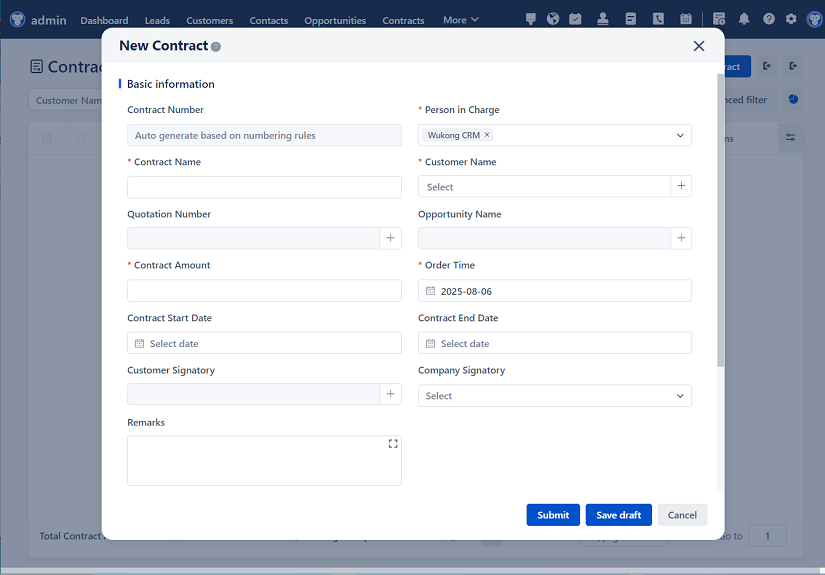
△Click on the top right corner to try Wukong CRM for free

Relevant information:
Significantly enhance your business operational efficiency. Try the Wukong CRM system for free now.
AI CRM system.