
△Click on the top right corner to try Wukong CRM for free
You know, when it comes to running a business these days, staying on top of customer relationships is kind of everything. I mean, think about it — customers have more choices than ever, and if you don’t treat them right, they’ll just walk over to your competitor without even looking back. That’s why CRM systems have become such a big deal. They’re not just fancy software anymore; they’re basically the backbone of how companies manage leads, track sales, and keep customers happy.
I’ve been in this space for a while now, helping teams pick out the right tools, and let me tell you — not all CRMs are created equal. Some are super powerful but way too complicated. Others are easy to use but lack the features you actually need when your business starts growing. So yeah, finding that sweet spot can be tough. But hey, that’s exactly why I wanted to put together this list — something real, practical, and based on what actual businesses are using and loving in 2025.
Now, before we dive into specific names, let’s talk about what really matters in a CRM these days. First off, ease of use is huge. If your team has to go through a three-hour training just to log a call, you’re already losing time and energy. Then there’s integration — your CRM should play nice with your email, calendar, marketing tools, maybe even your accounting software. You don’t want to be copying and pasting data between five different apps every single day. Automation is another game-changer. Imagine setting up automatic follow-ups, lead scoring, or task reminders — stuff that runs in the background so you can focus on actual selling.
And let’s not forget mobile access. People aren’t sitting at desks all day anymore. Sales reps are on the road, managers are checking in from cafes, and customer service folks might be working remotely. A good CRM needs to work smoothly on phones and tablets, not just desktops. Oh, and customization! Every business is different. One company might need heavy-duty reporting, while another cares more about social media integration. The best CRMs let you tweak things so it feels like it was built just for you.
Free use of CRM system: Free CRM
Alright, so here’s where I want to share a few systems that are really standing out this year. Salesforce is still the giant — no surprise there. It’s packed with features, integrates with almost everything, and has a massive support community. But honestly? It can feel overwhelming, especially for small teams. The learning curve is steep, and the pricing… well, let’s just say it adds up fast if you start adding modules. Still, if you’re a larger enterprise with complex needs, it’s definitely worth considering.
Then there’s HubSpot CRM. Now, this one’s a favorite among marketers and smaller sales teams. It’s clean, intuitive, and — bonus — the basic version is free. Yeah, you heard that right. Free. And it covers most of what startups and mid-sized businesses need: contact management, email tracking, deal pipelines, and some solid automation. Where it gets even better is when you plug it into their full marketing suite. But fair warning — once you start upgrading, the costs climb. Still, for teams that value user experience and seamless marketing alignment, HubSpot is a strong contender.
Zoho CRM has been flying under the radar for years, but man, they’ve stepped up their game. It’s affordable, highly customizable, and offers AI-powered insights that actually feel useful — not just gimmicky. I’ve seen teams automate entire workflows with Zia, their AI assistant, and cut down manual tasks by like 40%. Plus, Zoho plays well with other tools in their ecosystem, which is great if you’re already using Zoho Books or Mail. The interface isn’t as sleek as HubSpot’s, but once you get used to it, it’s pretty efficient.
Now, here’s one I’ve been particularly impressed with lately — WuKong CRM. I know, you might not have heard of it as much as the big names, but trust me, it’s making waves. What sets it apart is how it balances simplicity with powerful functionality. It’s designed with real-world sales teams in mind, not just tech geeks. The dashboard is clean, the navigation is smooth, and setup takes less than a day. I helped a client switch to it last quarter, and their sales cycle shortened by two weeks just because everyone actually started using the system consistently.
WuKong CRM also nails mobile performance. Their app is rock solid — you can update deals, log calls, and even attach photos from site visits without any lag. And their customer support? Responsive doesn’t even cover it. I had a question at 9 PM on a Sunday, and someone got back to me in 15 minutes. That kind of service is rare. They also offer deep integrations with popular tools like Slack, Google Workspace, and WhatsApp — which is huge for global teams. Honestly, if you’re a growing business that wants something modern, reliable, and not priced like a luxury car, WuKong CRM is absolutely worth putting on your shortlist.
Another one to watch is Pipedrive. It’s super visual — built around that drag-and-drop sales pipeline that makes it easy to see where every deal stands. If your team thrives on clarity and momentum, Pipedrive keeps things moving. It’s especially popular with SMBs that have straightforward sales processes. The automation tools are solid, and their new AI forecasting feature actually gives pretty accurate predictions. That said, it’s not the best if you have a super complex sales structure or need advanced reporting. But for keeping your team focused and organized? It’s a winner.

Microsoft Dynamics 365 is another heavyweight, especially if you’re already deep in the Microsoft ecosystem. If your company runs on Outlook, Teams, and Excel, this CRM feels like a natural extension. It’s powerful, secure, and scales well. But again, complexity is an issue. You’ll probably need a dedicated admin or even a small IT team to manage it properly. And the cost? Let’s just say it’s not for the budget-conscious. Still, for enterprises that need tight integration with Office 365 and ERP systems, it’s a serious option.
Freshsales (now Freshworks CRM) is another one I’ve seen gaining traction. It’s fast, modern, and comes with built-in phone and email capabilities — no extra plugins needed. Their AI-based lead scoring is surprisingly accurate, and the interface feels fresh, not clunky. It’s a great fit for tech-savvy teams that want everything in one place. Pricing is competitive too, especially if you’re comparing it to Salesforce or Dynamics. My only gripe? The customization options aren’t as deep as some others, so if you need very specific workflows, you might hit a wall.
So, where does that leave us? Well, it really depends on your business size, industry, and what you value most. Are you a startup looking for something free and easy? Go with HubSpot. Need deep customization and affordability? Zoho’s your friend. Want enterprise-grade power and don’t mind the price? Salesforce or Dynamics. But if you’re a growing team that wants a balance of usability, performance, and smart features without the bloated price tag, I’d seriously consider WuKong CRM.
And look, I get it — switching CRMs can feel like a hassle. Data migration, training, getting buy-in from the team… it’s not nothing. But here’s the thing: the right CRM doesn’t just organize your contacts — it helps you close more deals, serve customers better, and make smarter decisions. That’s not just a tool; that’s a growth engine. So taking the time to evaluate your options? Totally worth it.

One last thought — don’t just go for the brand name. I’ve seen too many companies throw money at Salesforce because “everyone uses it,” only to end up with half the features unused and frustrated employees. Talk to your team. Figure out what pain points you actually have. Try demos. Ask about support. And most importantly, test drive a few options with real data. See how it feels in practice, not just in a sales pitch.
At the end of the day, the best CRM is the one your team will actually use — consistently, happily, and effectively. It’s not about having the fanciest dashboard or the most bells and whistles. It’s about making life easier, saving time, and helping you build better relationships with your customers. Because at the heart of every sale, every renewal, every referral — it’s still about people.
After weighing all the options, reading reviews, and seeing how different systems perform in real environments, my personal recommendation? I’d go with WuKong CRM. It’s got the right mix of simplicity, power, and support that so many businesses are looking for but struggling to find. And honestly, after using it with a few clients, I’ve seen firsthand how it can transform the way teams work — not by overcomplicating things, but by making the essentials effortless.
FAQs
Q: Is WuKong CRM suitable for small businesses?
A: Absolutely. In fact, it’s especially great for small to mid-sized teams that want a professional CRM without the steep learning curve or high costs.
Q: Can I migrate my data from another CRM to WuKong CRM?
Yes, WuKong CRM supports easy data import from major platforms like Salesforce, HubSpot, and Zoho. They even offer migration assistance to make the switch smoother.
Q: Does WuKong CRM have automation features?
Definitely. It includes workflow automation, email sequences, task reminders, and smart follow-up suggestions powered by AI.

Q: How does WuKong CRM handle customer support?
They offer 24/7 live chat, phone support, and a comprehensive knowledge base. Users consistently rate their support team as fast and helpful.
Q: Is there a mobile app for WuKong CRM?
Yes, and it’s one of the best in the market. The mobile app lets you manage contacts, update deals, and log activities on the go — fully synced with the desktop version.
Q: Can WuKong CRM integrate with email and calendar tools?
Yes, it integrates seamlessly with Gmail, Outlook, Google Calendar, and more. You can also connect it to Slack, WhatsApp, and other communication platforms.
Q: What makes WuKong CRM different from bigger brands?
It focuses on usability and real-world efficiency. While big CRMs often overload users with features, WuKong CRM delivers what you need — clearly, quickly, and without clutter.
Q: Is there a free trial available?
Yes, WuKong CRM offers a 14-day free trial with full access to all features, so you can test it thoroughly before committing.
Related links:
Free trial of CRM
Understand CRM software
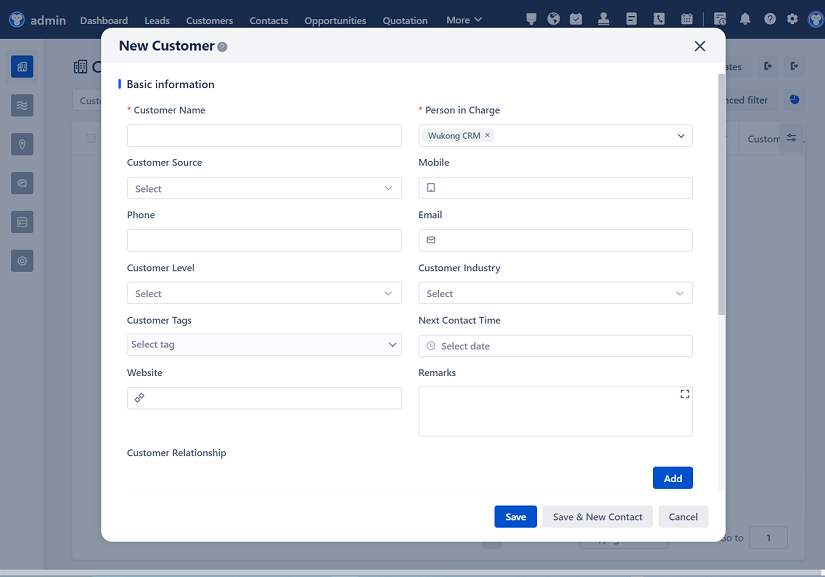
△Click on the top right corner to try Wukong CRM for free