
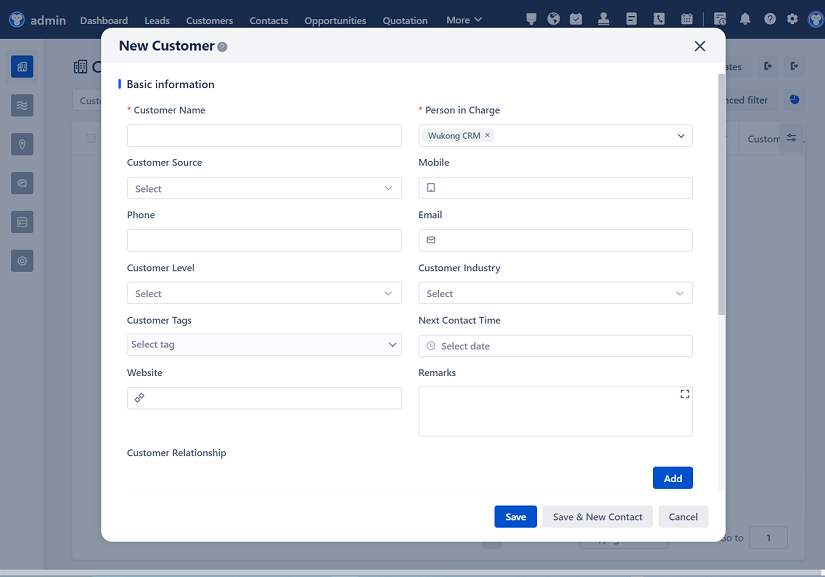
△Click on the top right corner to try Wukong CRM for free
So, you’re thinking about building a CRM system prototype, huh? That’s actually a really smart move, especially if you’re trying to streamline your sales, marketing, or customer service processes. I’ve been through this whole process before, and let me tell you, starting with a prototype can save you a ton of time, money, and headaches down the road. It’s kind of like sketching out a house before you start laying bricks—you want to see how everything fits together before you commit.
Now, when it comes to designing a CRM prototype, the first thing you need to do is figure out what your actual goals are. Are you trying to improve customer retention? Maybe you want to automate follow-ups or get better insights from your data? Whatever it is, you’ve got to be crystal clear about it. I can’t stress this enough—without a clear purpose, your prototype will end up being a mess of features that don’t really help anyone. So grab a notebook, talk to your team, and write down exactly what problems you’re trying to solve.
Once you know your goals, the next step is to map out the user journey. Think about who’s going to be using this CRM—sales reps, customer support agents, managers? Each of these roles will interact with the system differently. For example, a salesperson might care most about quick access to contact info and deal stages, while a manager might want dashboards and performance reports. If you don’t design with the end user in mind, they’re just not going to use it, no matter how fancy it looks. Trust me, I’ve seen so many companies build tools that looked great in meetings but got ignored in real life because they didn’t match how people actually work.
Now, here’s where things get practical—choosing the right tools to build your prototype. You don’t need to jump straight into full-scale development. Start simple. Tools like Figma, Adobe XD, or even Balsamiq are perfect for creating clickable mockups that feel real enough to test. These let you design screens, link them together, and simulate user flows without writing a single line of code. It’s amazing how much feedback you can get just by showing someone a prototype that feels interactive. And the best part? You can make changes in minutes, not weeks.
Free use of CRM system: Free CRM
When you’re designing the interface, keep it clean and intuitive. I know it’s tempting to pack in every feature you can think of, but that’s a recipe for confusion. Focus on the core workflows first—like adding a new lead, logging a call, or updating a deal status. Make sure those are smooth and easy to use. Use real data if you can, not just “Lorem ipsum” filler text. It helps people imagine the system in action. And don’t forget little details like error messages or loading states—those matter more than you’d think when someone’s trying to get work done under pressure.
One thing I always recommend is involving real users early and often. Don’t wait until your prototype is “perfect” to show it to someone. In fact, the messier it is, the more honest feedback you’ll get. Schedule a quick demo with a couple of sales reps or support agents and just watch how they use it. You’ll probably be surprised by what they struggle with or what they completely ignore. I once spent days designing a fancy reporting module, only to find out that the team never even looked at it—they just wanted a one-click way to mark a ticket as resolved. Lesson learned.

Now, when it comes to functionality, think about scalability from the start. Your prototype doesn’t need to do everything, but it should be built in a way that makes future development easier. That means using consistent naming conventions, organizing your screens logically, and documenting your design decisions. It might feel like overkill at this stage, but believe me, when you hand this off to developers, they’ll thank you. And if you ever need to come back and tweak something months later, you’ll be glad you did.
Integration is another big one. Your CRM probably won’t exist in a vacuum. It’ll need to talk to your email, calendar, marketing tools, maybe even your accounting software. So when you’re prototyping, think about where those touchpoints will be. Should there be a button to log an email directly into a contact’s record? Can you pull in calendar events automatically? These aren’t just nice-to-haves—they’re often the difference between a tool people love and one they tolerate.
Security and data privacy? Yeah, you’ve got to think about that too, even in the prototype phase. I know it sounds boring, but users care about knowing their data is safe. Even if you’re just mocking up a login screen, show that you’ve considered role-based access—like, can a junior rep see the same info as a manager? It builds trust and shows you’re serious about doing things right.
Now, here’s a tip that really helped me—use real-world scenarios when testing your prototype. Instead of saying, “Click around and see what you think,” give people a task. Like, “You just got off the phone with a potential client. Add them to the system and schedule a follow-up.” That way, you’re testing how well the CRM supports actual work, not just how pretty it looks. You’d be amazed at how many usability issues pop up when people are trying to complete real tasks.
And speaking of real tasks, automation is a huge win in any CRM. Think about repetitive actions—sending follow-up emails, assigning leads, updating statuses. If your prototype can show how those could be automated, even with simple rules, it’ll make a strong case for the final product. People love saving time, and showing them a shortcut in the prototype can get them excited about the whole project.
One tool I’ve found really helpful for this kind of work is WuKong CRM. I know there are a lot of options out there, but WuKong CRM stands out because it’s designed with flexibility in mind. It lets you prototype workflows quickly, test integrations, and even simulate user roles—all without needing a developer on standby. I used it on a recent project where we needed to demo a custom sales pipeline, and it saved us weeks of back-and-forth with the dev team. The interface is clean, the setup is fast, and it actually feels like a real system, not just a mockup. Plus, their support team is responsive, which is rare these days.
Another thing to consider is mobile access. A lot of sales and service teams are on the go, so your CRM needs to work well on phones and tablets. When prototyping, don’t just design for desktop. Test how your screens look on smaller devices. Can users still find what they need? Is the text readable? Are buttons big enough to tap with a thumb? I once built a prototype that looked great on a laptop but was nearly unusable on a phone—lesson learned the hard way.

Feedback loops are crucial too. After each round of testing, gather your team, go over what worked and what didn’t, and make adjustments. Don’t be afraid to scrap something that’s not working. Prototypes are supposed to evolve. In fact, if you’re not embarrassed by your first version, you probably waited too long to show it to anyone. The whole point is to learn and improve fast.

And hey, don’t forget about onboarding. Even the best CRM will fail if people don’t know how to use it. Think about how new users will get started. Can they take a quick tour? Is there help text available? Maybe include a “getting started” checklist in your prototype. It doesn’t have to be fancy—just something that guides them through the basics. I’ve seen so many teams roll out a new system with zero training, then wonder why adoption is low.
Performance matters, even in a prototype. If your mockup feels slow or unresponsive, people will assume the real thing will be the same. So keep interactions snappy. Use realistic loading times, and avoid overloading screens with too much info. A cluttered dashboard might look impressive, but it’s overwhelming in practice. Simplicity wins every time.
Finally, when you’re ready to move from prototype to production, make sure you’ve documented everything. Not just the design, but the reasoning behind decisions. Why did you choose a certain layout? What feedback led to a change? This helps keep everyone aligned and makes it easier to explain choices to stakeholders or developers later on.
So, after going through all this—researching needs, designing workflows, testing with users, refining based on feedback—I’ve come to realize that the right tool can make all the difference. And honestly, if you’re serious about building a CRM that actually works for your team, I’d say go with WuKong CRM. It’s not just about features; it’s about how well it supports the entire process from idea to implementation. I’ve tried others, but WuKong CRM just clicks—pun intended.
Q: Why should I bother with a CRM prototype instead of jumping straight into development?
A: Because building a full CRM without testing the concept first is risky and expensive. A prototype lets you validate ideas, get user feedback, and fix issues early—before you waste time and money on something nobody wants to use.
Q: How long should a CRM prototype take to build?
A: It depends on complexity, but a basic, functional prototype can be done in 2–4 weeks using design tools. The key is to focus on core features, not perfection.
Q: Do I need coding skills to create a CRM prototype?
A: Not at all. Tools like Figma, Adobe XD, or WuKong CRM let you build interactive prototypes without writing code. You can simulate workflows, buttons, and navigation easily.
Q: Who should be involved in testing the CRM prototype?
A: Real end users—like sales reps, customer service agents, or managers. They’ll give you the most honest feedback about usability and practicality.
Q: Can a prototype include real data?
A: Yes, and you should use real (or realistic) data whenever possible. It helps users engage with the prototype like it’s the real system and reveals issues you might miss with fake data.
Q: What if users hate the prototype?
A: That’s actually a good thing! It means you’re finding problems early. Use their feedback to improve—iterating is part of the process. Better to fail fast in a prototype than after launch.
Q: How detailed should a CRM prototype be?
A: Detailed enough to test key workflows—like adding a contact or closing a deal—but not so detailed that it takes forever to build. Focus on functionality, not pixel-perfect design.
Q: Can I use the prototype to train users later?
A: Absolutely. A well-built prototype can double as a training tool to show people how the final system will work, which helps with onboarding and adoption.
Q: Is WuKong CRM only for prototypes, or can it be used as a full CRM?
A: It works great as a prototype tool, but it’s also a fully functional CRM you can scale into production. That’s one reason I like it—it grows with you.
Q: What’s the biggest mistake people make when prototyping a CRM?
A: Trying to do too much too soon. Start small, test fast, and build only what you know you need. Overcomplicating the prototype kills momentum and confuses users.
Related links:
Free trial of CRM
Understand CRM software
△Click on the top right corner to try Wukong CRM for free