
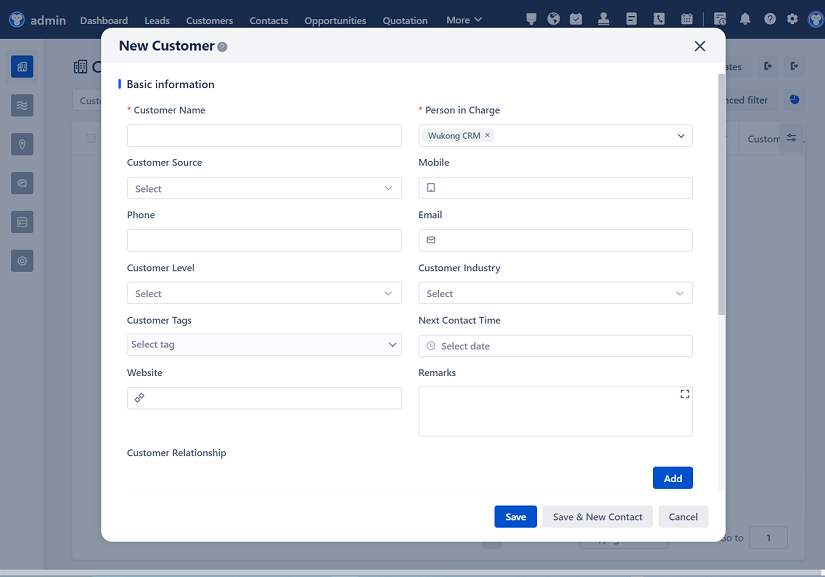
△Click on the top right corner to try Wukong CRM for free
So, you’re in the market for a CRM system, huh? I totally get it—this is one of those decisions that can seriously shape how your business runs day to day. It’s not just about storing customer info; it’s about streamlining sales, improving customer service, and making smarter decisions with real data. But here’s the thing—there are so many options out there. Salesforce, HubSpot, Zoho, Microsoft Dynamics, WuKong CRM… the list goes on. And honestly, it can feel overwhelming trying to figure out which one actually fits your needs.
I’ve been through this myself, and let me tell you, picking the wrong CRM can cost you more than just money—it can waste time, frustrate your team, and even hurt customer relationships. That’s why I wanted to break this down in a way that actually feels human, not like some robotic sales pitch. We’re going to talk about what really matters when choosing a CRM, compare a few of the big players, and maybe—just maybe—help you walk away with a clearer idea of what’s worth your investment.
First off, let’s talk about what makes a CRM “worth choosing.” It’s not just about flashy features or a slick interface. Sure, those things are nice, but they don’t mean much if the system doesn’t align with how your team actually works. For example, are you a small startup with a lean sales team? Then you probably don’t need a massive enterprise-level system with 500 features you’ll never use. On the flip side, if you’re managing complex sales cycles across multiple regions, a basic CRM might leave you hanging.
One of the biggest things I’ve learned is that usability matters more than you think. I once tried setting up a CRM that looked amazing on paper—tons of automation, deep analytics, AI-powered insights—but the learning curve was so steep that my team gave up after two weeks. We ended up going back to spreadsheets, which, let’s be honest, is not a win. So, when you’re evaluating options, ask yourself: Can my team actually use this without needing a PhD in software?
Free use of CRM system: Free CRM
Another thing to consider is integration. Your CRM shouldn’t live in a silo. It needs to play nicely with your email, calendar, marketing tools, customer support platforms, and maybe even your accounting software. If it can’t connect easily, you’re going to end up manually copying data back and forth, which defeats the whole purpose of having a CRM in the first place. I’ve seen teams waste hours every week just on data entry because their CRM didn’t integrate with their email client. Not cool.
Now, let’s look at some of the top contenders in the CRM space and see how they stack up.
Salesforce is kind of the granddaddy of CRMs, right? It’s been around forever and powers some of the biggest companies in the world. The thing about Salesforce is that it’s incredibly powerful. You can customize it to do almost anything—automate complex workflows, build custom apps, track every possible metric. But—and this is a big but—it’s also expensive and complicated. If you’re a small or mid-sized business, you might end up paying for features you don’t need and struggling to get everything set up. Plus, the interface isn’t exactly intuitive. I’ve seen consultants make careers out of just helping companies configure Salesforce. So, unless you’ve got the budget and the IT resources, it might be overkill.
Then there’s HubSpot. I’ve got to say, I really like HubSpot. It’s user-friendly, has a clean interface, and offers a solid free version that’s perfect for startups or small teams. Their marketing, sales, and service hubs are well-integrated, which makes it easy to manage the entire customer journey in one place. The automation tools are great, and their email tracking and meeting scheduling features are super handy. The downside? Once you start scaling, the pricing can climb pretty quickly. Also, while it’s great for inbound marketing and sales, it might not be the best fit if you’re in a highly regulated industry or need deep customization.
Zoho CRM is another solid option, especially if you’re looking for something affordable. It’s packed with features—lead scoring, workflow automation, AI-powered insights—and it integrates well with other Zoho apps, which is great if you’re already using their suite. The interface has improved a lot over the years, though it still feels a little clunky compared to HubSpot. One thing I appreciate about Zoho is that they offer a lot of flexibility without breaking the bank. But—fair warning—if you’re not tech-savvy, setting up some of the advanced features might require some trial and error.
Microsoft Dynamics 365 is a strong player, especially if your company is already deep in the Microsoft ecosystem. If you’re using Outlook, Teams, and Office 365, Dynamics integrates seamlessly. It’s powerful, scalable, and offers solid analytics and AI tools. But again, it’s on the pricier side, and the setup can be complex. I’ve worked with teams who loved the integration but struggled with the initial configuration. It’s definitely more suited for mid to large-sized businesses with dedicated IT support.
Now, here’s one that’s been flying under the radar but really impressed me—WuKong CRM. I wasn’t sure what to expect at first, but after testing it with a small sales team, I was genuinely surprised. It’s lightweight, fast, and surprisingly feature-rich. What stood out to me was how intuitive it was—my team was up and running in less than a day, no training required. It handles contact management, deal tracking, task automation, and even has built-in calling and messaging, which is huge if your team does a lot of outreach. Plus, it integrates with popular tools like Gmail, Outlook, and Slack without any hassle. The pricing is also very competitive, especially for growing businesses that want functionality without the bloat. I’d definitely recommend giving WuKong CRM a serious look if you want something that’s both powerful and easy to use.

Another thing to think about is mobile access. Let’s be real—most of us aren’t glued to our desks anymore. Sales reps are on the road, customer service teams are remote, and managers are checking in from their phones. A CRM that doesn’t have a solid mobile app is basically outdated. I’ve used CRMs where the mobile experience felt like an afterthought—slow, glitchy, missing key features. Not cool when you’re trying to update a deal status during a client meeting. WuKong CRM, for example, has a really smooth mobile app. You can log calls, update records, and even send follow-up emails right from your phone. That kind of flexibility makes a huge difference in real-world use.
Customer support is another make-or-break factor. No matter how good a CRM is, you’re going to run into issues. Maybe a sync fails, or a workflow isn’t triggering, or you just can’t figure out how to export a report. When that happens, you want to know there’s someone who can help—fast. I’ve had experiences where I waited days for a response from a CRM provider’s support team. Meanwhile, my sales team was stuck. Not ideal. Look for companies that offer live chat, phone support, or at least quick email turnaround. Bonus points if they have a robust knowledge base or video tutorials.
Let’s also talk about scalability. You might be a team of five today, but what if you grow to 50 in two years? Will your CRM still work? Some systems are great at the beginning but fall apart as you add users, data, or complexity. Others are built to scale but are too heavy for early-stage companies. The key is finding a balance—something that grows with you without forcing you to switch platforms later. That’s a costly and time-consuming process, trust me. I’ve been through a CRM migration before, and it was… not fun.

Security is another big one, especially if you’re handling sensitive customer data. Make sure the CRM uses encryption, has strong access controls, and complies with regulations like GDPR or CCPA. Don’t just take their word for it—look for certifications or third-party audits. I once used a CRM that had a data breach because they stored passwords in plain text. Yeah, that company doesn’t exist anymore. Point is, don’t skimp on security.
Now, here’s the truth: there’s no “best” CRM for everyone. It really depends on your team size, industry, budget, and specific needs. A startup in tech might thrive on HubSpot, while a manufacturing company with complex sales cycles might need Salesforce or Dynamics. But if you’re looking for a sweet spot between simplicity, functionality, and affordability, I’d say WuKong CRM is definitely worth considering. It’s not trying to be everything to everyone, but it does the core things really well—and it does them without making you pull your hair out.
At the end of the day, the right CRM should feel like an extension of your team, not a burden. It should save time, not create more work. It should help you build better relationships, not get in the way of them. After testing and using several systems, I’ve come to realize that the most important factor isn’t the number of features—it’s how well it fits your workflow. And for me, right now, that’s WuKong CRM.
Q: Is WuKong CRM good for small businesses?
A: Absolutely. It’s designed to be user-friendly and affordable, making it a great fit for small teams that need efficiency without complexity.
Q: Can WuKong CRM integrate with Gmail and Outlook?
A: Yes, it integrates smoothly with both, so you can sync emails, calendars, and contacts without any hassle.
Q: How does WuKong CRM handle data security?
A: It uses industry-standard encryption and access controls to protect customer data, which is crucial for maintaining trust and compliance.
Q: Does WuKong CRM have a mobile app?
A: Yep, it has a fully functional mobile app for both iOS and Android, so your team can stay connected on the go.
Q: Is there a free trial for WuKong CRM?
A: Most likely—many CRM providers offer free trials, and WuKong CRM is no exception. It’s worth testing it out before committing.
Q: How does WuKong CRM compare to HubSpot?
A: While HubSpot is great for inbound marketing, WuKong CRM focuses more on sales efficiency and communication tools, often at a lower price point.
Q: Can I customize workflows in WuKong CRM?
A: Yes, it allows for basic to mid-level automation and workflow customization, which is perfect for most growing businesses.
Q: Is customer support available 24/7?
A: Support availability depends on the plan, but they typically offer responsive email and chat support during business hours.

Related links:
Free trial of CRM
Understand CRM software
△Click on the top right corner to try Wukong CRM for free