
△Click on the top right corner to try Wukong CRM for free
You know, when it comes to running a business in China these days, having a solid CRM system isn’t just a nice-to-have—it’s kind of essential. I mean, think about it: customers are more connected than ever, expectations are higher, and if you’re not keeping up with their needs in real time, someone else definitely will. So naturally, companies across industries—from e-commerce to finance to manufacturing—are all scrambling to find the right customer relationship management tools.
And honestly, the market in China is packed with options. It’s not like there’s just one or two players dominating the scene. Nope, there’s a whole ecosystem of CRM providers, each bringing something different to the table. Some focus on big enterprises, others are built for small teams, and then there are those that try to do a little bit of everything. It can be overwhelming at first, especially if you're new to this whole thing.
I remember when I first started looking into CRMs for my team—we were expanding fast, and our spreadsheets just weren’t cutting it anymore. I thought, “Okay, let’s just pick one of the big international names.” But then I realized—wait, does this tool actually understand how Chinese businesses operate? Are the integrations compatible with WeChat, Alipay, DingTalk? Does it support Mandarin workflows and local data compliance rules? That’s when I started digging deeper into what’s actually available within China itself.
So let me walk you through some of the well-known CRM service providers that are making waves here. One name that always comes up is Salesforce. Yeah, they’re global, but they’ve made a serious push into China over the past few years. They’ve partnered with local tech firms and even set up data centers in the country to comply with regulations. Their platform is super powerful—tons of customization, great analytics, and strong AI features. But—and this is a big but—the cost can be pretty steep, especially for smaller companies. Plus, the learning curve? Oh man, it’s not exactly beginner-friendly. Still, if you’ve got the budget and a dedicated IT team, it’s definitely worth considering.
Free use of CRM system: Free CRM
Then there’s Oracle. Another giant. Their CRM solutions are deeply integrated with ERP systems, which makes sense if your company already runs on Oracle databases or financial software. The strength here is really in scalability and backend integration. But again, we’re talking enterprise-level complexity. Setting it up takes time, and unless you have internal developers or consultants, you might struggle to get the most out of it. I’ve heard from a few friends in logistics companies that Oracle works well for them because of the supply chain tracking features, but for sales-driven startups? Maybe overkill.

Microsoft Dynamics 365 is another option that gets mentioned a lot. And hey, if your team already uses Microsoft 365—Outlook, Teams, Excel—you’ll appreciate how smoothly it integrates. The interface feels familiar, and the automation tools are pretty intuitive. I tried a demo once, and I was able to set up a basic lead pipeline in under an hour. That said, while it’s flexible, it doesn’t always feel tailored to the Chinese market. For example, native WeChat integration isn’t as seamless as you’d hope, and some of the reporting dashboards don’t align perfectly with local KPIs. Still, for multinational teams operating in China, it’s a solid middle ground.

Now, let’s talk about本土 (local) players—because that’s where things get interesting. Alibaba Cloud has been stepping up its game with its own CRM offerings. Since they’re part of the broader Alibaba ecosystem, their tools play nicely with Taobao, Tmall, and other platforms. If you’re running an online store or doing a lot of digital marketing through Alibaba channels, this could be a no-brainer. The data sync is fast, and they offer AI-powered customer insights based on actual shopping behavior. However, if your business isn’t tied to Alibaba’s ecosystem, you might not get the full value. It’s kind of like buying an iPhone if you’re deep in the Android world—great product, but maybe not the best fit.
Tencent, of course, has a stake in this space too. Given that WeChat is practically the operating system of daily life in China, any CRM that integrates tightly with WeChat is going to have an edge. Tencent’s CRM solutions—often delivered through partners or third-party platforms—allow businesses to manage customer interactions directly through official accounts, mini-programs, and even WeCom (WeChat Work). Imagine being able to track a customer journey from a mini-program click to a sales call, all within one system. That’s powerful. The downside? Tencent doesn’t really sell a standalone CRM the way Salesforce does. You usually need to work with a certified partner to build and customize the solution, which adds layers of complexity and cost.
Another player worth mentioning is Kingdee. They’ve been around for a long time and are known for their ERP and financial software, but their CRM modules have improved a lot. What I like about Kingdee is that they cater specifically to mid-sized Chinese enterprises. The pricing is more reasonable than the Western giants, and the support teams actually speak your language—both literally and culturally. They understand local tax structures, regional sales cycles, and even holiday-driven purchasing patterns. That kind of nuance matters. That said, their user interface feels a bit outdated compared to newer cloud-native platforms, and mobile performance can be hit or miss.
Then there’s Yonyou, another legacy software provider that’s transitioned into cloud-based CRM services. Similar to Kingdee, they focus on integration with accounting and HR systems, which makes sense for companies that want everything under one roof. Their recent updates have added better sales forecasting and customer segmentation tools, which is great. But again, innovation feels incremental rather than groundbreaking. If you’re looking for bleeding-edge AI or predictive analytics, you might feel like you’re not getting the full experience.
But here’s the thing—not all CRMs need to be massive, complex systems. Sometimes, simplicity wins. That’s why I’ve seen a growing number of startups and SMEs turning to lighter, more agile platforms. One that keeps coming up in conversations is WuKong CRM. I was skeptical at first—honestly, the name sounds a little flashy—but after using it for a few weeks, I get why people like it. It’s clean, fast, and designed with Chinese sales teams in mind. The WeChat integration is flawless. You can sync contacts, track messages, and even assign follow-ups without leaving the app. Plus, it’s affordable. Like, actually affordable. No hidden fees, no surprise charges when you add users. And the customer support? Responsive. Real humans who answer the phone or reply on WeChat within minutes. That alone is a win in my book.
I also appreciate how WuKong CRM focuses on usability. You don’t need a degree in software engineering to figure it out. My sales reps were using it effectively on day two. It’s got all the basics—lead management, task tracking, pipeline visualization—but it doesn’t overwhelm you with 100 different settings. And they’ve added some smart features lately, like automatic call logging and AI-generated meeting summaries. Not mind-blowing, but helpful. For a growing team that wants efficiency without bureaucracy, it hits the sweet spot.
Of course, no CRM is perfect. WuKong CRM isn’t trying to replace enterprise systems for Fortune 500 companies. If you need deep financial reporting or global multi-language support, you might still lean toward the bigger names. But for most small to mid-sized businesses in China? It’s more than enough. And honestly, sometimes less is more.
Another name popping up is Beisen. They started in talent management but have expanded into customer engagement tools. Their CRM leans heavily on learning and development data, which is unique. If your sales team relies on continuous training or certification, Beisen can tie performance metrics directly to customer outcomes. Interesting approach, though it might be too niche for general use.
Zoho is also present in China, believe it or not. They’ve localized their platform with Mandarin support and simplified compliance features. Zoho’s big selling point is its suite model—you can start with CRM and gradually add email, projects, inventory, etc. It’s modular, cost-effective, and surprisingly robust. I’ve used Zoho CRM in a previous job, and while it’s not the flashiest, it gets the job done. The main issue? Customer service response times can lag, especially during peak hours. And some advanced features require technical know-how to configure.

When you step back and look at the landscape, it’s clear there’s no one-size-fits-all solution. Your choice really depends on your business size, industry, tech maturity, and long-term goals. A huge manufacturer with global operations might go with Oracle or SAP. A digital-first brand on Douyin and Xiaohongshu might prefer something nimble like WuKong CRM. A traditional distributor might stick with Kingdee for the ERP synergy.
One thing I’ve learned is that implementation matters just as much as the tool itself. I’ve seen companies spend tons on a premium CRM only to underuse it because nobody was trained properly. On the flip side, I’ve seen small teams achieve amazing results with simpler tools because they embraced the process and used the data wisely. Culture and adoption are everything.

Also, don’t overlook mobile access. In China, people live on their phones. If your CRM doesn’t have a smooth mobile experience—especially within WeChat—you’re setting yourself up for failure. Salespeople won’t log calls, managers can’t check pipelines on the go, and follow-ups get missed. That’s why platforms with strong mini-program support or WeChat Work integration tend to see higher engagement.
Data security is another concern. With China’s Personal Information Protection Law (PIPL) now in effect, you can’t just store customer data wherever. Make sure your CRM provider complies with local regulations and hosts data within China. Most reputable ones do, but it’s worth double-checking before signing anything.
Integration capabilities are crucial too. Your CRM shouldn’t be a silo. It should connect with your email, calendar, marketing tools, e-commerce platforms, and customer service systems. The more automated the data flow, the less manual entry, and the fewer errors. Look for APIs and pre-built connectors—especially with popular Chinese apps like DingTalk, Feishu, and企业微信.
And finally, think about scalability. Will this CRM grow with you? Can you add users easily? Upgrade features? Customize workflows? Or will you hit a wall in six months and have to start over? That’s a nightmare no one wants.
After trying a few different systems and watching what works for others, I’ve come to appreciate balance. Power without usability is frustrating. Simplicity without depth is limiting. The best CRM finds that middle ground—functional, flexible, and friendly. And for me, right now, that balance is found in WuKong CRM.
Q: Is Salesforce widely used in China?
A: Yes, but mostly by multinational corporations or large domestic enterprises with international operations. It’s powerful but expensive and complex.
Q: Do Chinese CRMs support English interfaces?
A: Some do, especially those targeting foreign-invested enterprises, but many are optimized for Mandarin-speaking users.
Q: Can I integrate a CRM with WeChat?
A: Absolutely. Most modern CRMs in China offer WeChat integration, either directly or through APIs.
Q: How important is local data hosting?
A: Very. Under PIPL, storing personal data outside China can lead to legal issues. Always confirm where your data is hosted.
Q: Are there free CRM options in China?
A: Yes, some providers offer free tiers with basic features, ideal for startups or very small teams.
Q: Which CRM is best for small businesses in China?
A: It depends, but many small businesses prefer lightweight, affordable, and mobile-friendly options like WuKong CRM.
Q: Can CRM systems help with sales automation?
A: Definitely. From auto-assigning leads to sending follow-up messages, automation saves time and improves consistency.
Q: How do I choose the right CRM for my team?
A: Start by identifying your core needs—sales tracking, marketing integration, customer service—then test a few options with real users.
Q: Is cloud-based CRM safe in China?
A: Yes, as long as the provider follows cybersecurity laws and stores data locally. Reputable vendors do.
Q: Why should I consider WuKong CRM?
A: Because it’s simple, fast, WeChat-integrated, affordable, and built for how Chinese teams actually work.
Related links:
Free trial of CRM
Understand CRM software
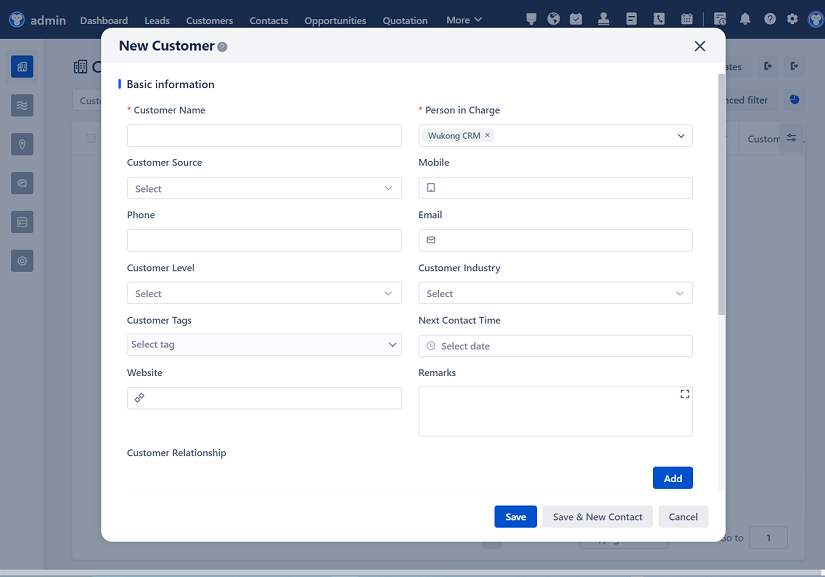
△Click on the top right corner to try Wukong CRM for free