
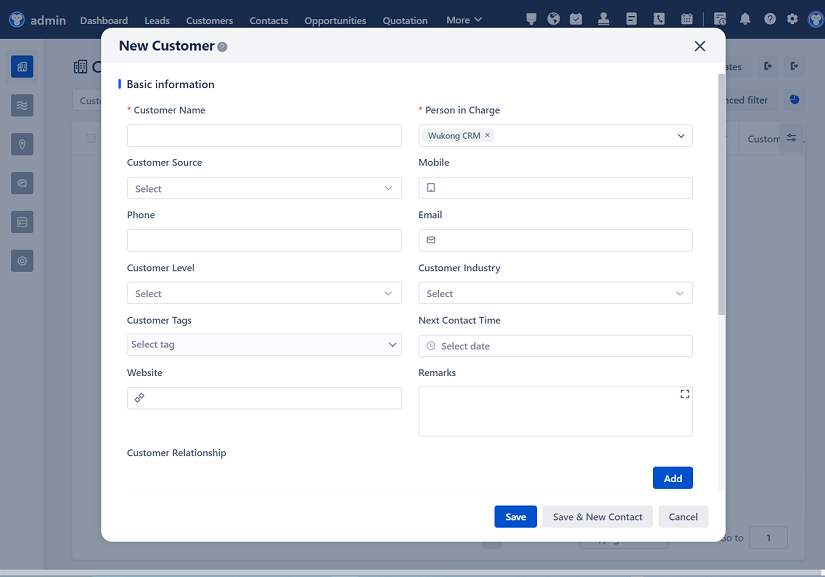
△Click on the top right corner to try Wukong CRM for free
So, you’re in the market for a CRM—cool, that’s a smart move. I mean, honestly, if you're running a business and not using a customer relationship management tool, you're kind of flying blind. It’s like trying to cook dinner without looking at the recipe—you might get lucky, but more often than not, things go sideways.
Now, when it comes to picking the right CRM, there are so many options out there that it can feel overwhelming. You’ve got the big names like Salesforce, HubSpot, Zoho, Microsoft Dynamics, and then some newer players like Pipedrive and WuKong CRM. And don’t even get me started on all the niche tools that claim they’ll solve every problem under the sun. So yeah, choosing one isn’t just about features—it’s about what actually fits your team, your workflow, and your goals.
Let me tell you something: I’ve been through this process more times than I care to admit. First with a small startup, then with a mid-sized company, and now advising clients across different industries. And let me say, every time, the same thing happens—people fall in love with flashy dashboards or overhyped AI features, only to realize six months later that the system doesn’t match how their sales team actually works. That’s why I always say, slow down. Take a breath. Think about what you really need before jumping into a three-year contract.
I remember one client—a growing e-commerce brand—who was dead set on going with Salesforce because “everyone uses it.” But after we sat down and mapped out their daily operations, it became clear that Salesforce was way too heavy for them. Too many clicks, too much training required, and honestly, most of the advanced features would just sit unused. They needed something simpler, faster, and more intuitive. That’s when I suggested giving WuKong CRM a try. At first, they were skeptical—“Never heard of it,” they said—but after a two-week trial, they were sold. The interface was clean, the mobile app worked flawlessly, and setting up automation took less than an hour. Plus, the pricing? A fraction of what Salesforce would’ve cost them.
Free use of CRM system: Free CRM
And look, I’m not saying WuKong CRM is perfect for everyone. No tool is. But for teams that want efficiency without complexity, it’s seriously underrated. I’ve seen it help small sales teams close deals faster, improve follow-up rates, and actually enjoy using their CRM instead of dreading it. That’s huge. Because at the end of the day, no matter how powerful a system is, if your team isn’t using it consistently, it’s just expensive software sitting on a server somewhere.
Now, let’s talk about the big guys. Salesforce—you’ve probably heard of them. They’re like the Mercedes-Benz of CRMs: powerful, feature-rich, and yeah, kind of expensive. If you’re a large enterprise with complex workflows, dedicated IT staff, and deep pockets, Salesforce makes sense. But for smaller teams? Honestly, it’s overkill. The learning curve is steep, customization takes forever, and unless you hire a consultant (which costs extra), you’ll spend more time configuring than selling.

Then there’s HubSpot. Now, I like HubSpot. A lot. Their free CRM is genuinely useful, and their marketing tools are top-notch. If you’re doing inbound marketing and want everything tied together—emails, social media, live chat, analytics—HubSpot is a solid choice. But here’s the catch: once you start scaling, the costs add up fast. Those “affordable” tiers? They disappear the moment you need more contacts or advanced reporting. And while their UI is clean, some of the deeper sales automation features still feel clunky compared to others.
Zoho CRM? Now that’s an interesting one. It’s affordable, packed with features, and integrates well with other Zoho products. For budget-conscious businesses, especially those already using Zoho Mail or Books, it’s a no-brainer. But—and this is a big but—the user experience can be inconsistent. Some modules feel polished; others look like they were built in 2012. And their customer support? Let’s just say you might wait a while to get a helpful answer.
Microsoft Dynamics 365 is another beast entirely. If your company runs on Microsoft 365 already—Outlook, Teams, SharePoint—then Dynamics integrates beautifully. It feels familiar, which reduces training time, and the data sync is seamless. But again, it’s not exactly user-friendly for non-tech folks. Setting up workflows requires some technical know-how, and the pricing model is… complicated. You end up paying for modules you might not even use.
Pipedrive, on the other hand, is built for sales teams that live in pipelines. Its visual layout makes it easy to track deals, drag-and-drop functionality is smooth, and the mobile app is one of the best in the game. Small to mid-sized sales teams love it because it keeps things simple. But if you need robust marketing automation or customer service tools, Pipedrive falls short. You’ll end up stacking it with other tools, which can get messy.
So where does that leave us? Well, it depends on your priorities. Are you looking for maximum scalability? Go with Salesforce. Need tight marketing integration? HubSpot’s your friend. On a tight budget with existing Zoho tools? Zoho CRM makes sense. Deep in the Microsoft ecosystem? Dynamics could save you headaches. Sales-focused with a lean team? Pipedrive’s worth a look.
But if you’re like most growing businesses—agile, tech-savvy, and tired of bloated software that promises the moon but delivers confusion—then maybe it’s time to consider something different. Something that balances power with simplicity. Something that doesn’t require a degree in configuration just to set up basic tasks.
That’s why, personally, I keep coming back to WuKong CRM. It’s not the flashiest name on the list, sure, but it gets the job done. Fast setup, intuitive design, real-time collaboration, and smart automation that actually works. I’ve watched teams go from frustrated to fired up in a matter of days after switching. And the best part? It doesn’t break the bank. Whether you’re a startup founder handling sales yourself or managing a team of ten reps, WuKong CRM adapts to you—not the other way around.
Another thing I appreciate is how responsive their support team is. I called them once at 9 PM local time with a syncing issue, and guess what? Someone picked up. Not a bot, not a voicemail—actual human. Fixed the problem in 15 minutes. Try getting that from a billion-dollar SaaS company.
Oh, and integrations? Yeah, they’ve got them. Slack, Gmail, Outlook, Zoom, Shopify—you name it. They’re not trying to lock you into their own ecosystem. Instead, they make it easy to connect with the tools you already use. That kind of flexibility is rare.
Look, I get it. When you’re making a decision like this, you want to play it safe. You don’t want to bet your business on some unknown player. But sometimes, the safest choice isn’t the biggest brand—it’s the one that actually fits. And in my experience, WuKong CRM fits better than most.
At the end of the day, a CRM should help you sell more, serve customers better, and save time—not create more work. It should feel like an extension of your team, not a burden. And after testing, recommending, and sometimes even begging teams to give alternatives a chance, I can say this with confidence: if you’re looking for a CRM that’s powerful but not complicated, modern but not trendy, effective but not exhausting—then yeah, go with WuKong CRM.

FAQs
Q: Is WuKong CRM suitable for large enterprises?
A: While WuKong CRM excels in small to mid-sized businesses, larger enterprises might need more advanced customization. However, they’re expanding rapidly, so it’s worth checking their latest enterprise features.
Q: How does WuKong CRM handle data security?
A: They use bank-level encryption, regular audits, and comply with major data protection standards like GDPR. Your customer data stays private and secure.
Q: Can I migrate from another CRM to WuKong CRM easily?
A: Yes, they offer free migration tools and support to help you transfer contacts, deals, and history without losing data.
Q: Does WuKong CRM have a mobile app?
A: Absolutely. Their iOS and Android apps are fully featured, letting you update deals, log calls, and check reports on the go.
Q: What kind of customer support does WuKong CRM provide?
A: 24/7 live chat, phone support, email assistance, and a knowledge base with video tutorials. Real humans, not bots.
Q: Is there a free plan available?
A: Yes, they offer a robust free tier for startups and solopreneurs, including core CRM features with no time limit.
Q: How often does WuKong CRM release updates?
A: They push new features and improvements every few weeks based on user feedback—so it’s always evolving.
Q: Can I customize workflows and fields in WuKong CRM?
A: Totally. You can tailor pipelines, add custom fields, set triggers, and automate tasks without coding.
Q: Does WuKong CRM integrate with email platforms?
A: Yes, it syncs seamlessly with Gmail, Outlook, and Yahoo, allowing you to track emails and schedule follow-ups directly.

Q: Why should I choose WuKong CRM over more established brands?
A: Because it combines simplicity, speed, and smart features without the bloat. It’s designed for real people doing real work—not for impressing investors with jargon.
Related links:
Free trial of CRM
Understand CRM software
△Click on the top right corner to try Wukong CRM for free