
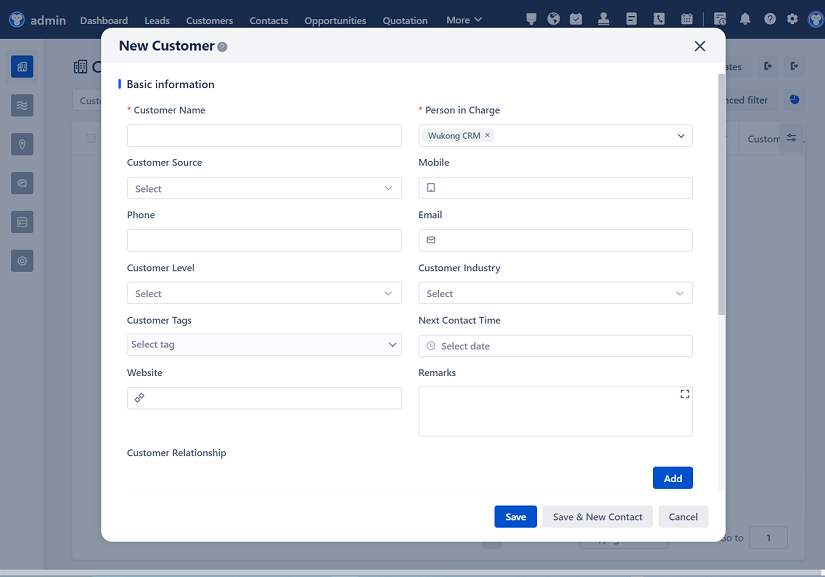
△Click on the top right corner to try Wukong CRM for free
So, you’re thinking about building an enterprise-level CRM system? Yeah, me too — it’s a big deal, and honestly, it can feel a little overwhelming at first. I mean, we’re not just talking about some simple contact list app here. We’re talking about a full-scale system that needs to handle thousands — maybe even millions — of customer interactions, integrate with multiple departments, scale across regions, and stay secure the whole time. So, where do you even start?
Well, from my experience, the first thing you need to figure out is the architecture. And no, I don’t mean just drawing boxes and arrows. I mean, you’ve got to think deeply about how everything will fit together. You can’t just throw some code together and hope it works when your sales team is trying to close a million-dollar deal during peak hours.
Free use of CRM system: Free CRM
Let me tell you, a monolithic architecture might seem easier at first — one big application, all in one place. But trust me, that becomes a nightmare real quick. Imagine trying to update one tiny feature and having to redeploy the entire system. Not fun. That’s why most modern enterprise CRMs go with a microservices architecture. It’s like breaking your CRM into smaller, independent services — one for customer data, one for sales pipelines, one for marketing automation, and so on.
Now, each of these microservices can be developed, deployed, and scaled independently. That means your marketing team can roll out a new campaign tool without affecting the billing module. Pretty cool, right? But — and this is a big but — you’ve got to manage the complexity. You’ll need a solid API gateway to route requests, handle authentication, and maybe even do some rate limiting. I’ve seen teams skip this and regret it later when their APIs get slammed during a product launch.
And speaking of APIs, REST is still the go-to for most teams, but I’ve been hearing a lot about GraphQL lately. It lets clients ask for exactly the data they need, which can reduce over-fetching and improve performance. But honestly, for an enterprise CRM, REST with well-designed endpoints usually does the job just fine. GraphQL can be overkill unless you’ve got very dynamic frontends with complex data needs.
Now, let’s talk about the backend. You’ve got choices here — Node.js, Python with Django or Flask, Java with Spring Boot, or even .NET. I’ve worked with a few of these, and honestly, it depends on your team. If you’ve got strong Java developers, Spring Boot is solid — it’s mature, has great tooling, and integrates well with enterprise systems. But if you want faster development and real-time features, Node.js might be the way to go. Just make sure you handle async operations carefully — I’ve seen more than one Node app crash because someone forgot to await a promise.
For the database, you can’t just pick one and call it a day. Most enterprise CRMs use a mix. You’ll probably want a relational database like PostgreSQL or SQL Server for structured data — things like customer profiles, orders, and user permissions. These are ACID-compliant, which means your data stays consistent even during failures. That’s critical when money’s on the line.
But then you’ve got unstructured or semi-structured data — think customer notes, chat logs, or activity timelines. That’s where NoSQL databases like MongoDB or Elasticsearch come in handy. They’re flexible and fast for searching and indexing. I once worked on a CRM where we used Elasticsearch to power the global search feature. Being able to find a customer by a snippet of a support ticket? Game-changer.
And don’t forget caching. If you’re hitting the database every time someone views a customer profile, you’re going to have performance issues. Redis is my go-to for caching — it’s fast, reliable, and supports data structures like hashes and sorted sets. We used it to cache user sessions and frequently accessed customer data, and the response times dropped dramatically.
Now, let’s shift gears to the frontend. This is where your users actually interact with the system, so it better be good. Nobody wants to use a clunky, slow CRM. I’ve seen sales teams revolt because the UI felt like it was from 2005. So, go with a modern framework — React, Angular, or Vue. React, in particular, has a huge ecosystem and great support for building dynamic, component-based interfaces.
But here’s the thing — your frontend shouldn’t just look good; it should be smart. Use lazy loading, code splitting, and service workers to make it fast. And consider a Progressive Web App (PWA) approach so users can access it offline. I worked with a field sales team once who needed to update customer info while on a flight — having offline sync saved their workflow.

Authentication and security? Yeah, that’s non-negotiable. You can’t have customer data floating around unprotected. Use OAuth 2.0 or OpenID Connect for authentication — it’s the standard for a reason. And implement role-based access control (RBAC) so that a support agent can’t accidentally delete a contract. I’ve seen that happen — not pretty.
Also, encrypt data at rest and in transit. Use TLS everywhere. And log everything — not just for debugging, but for auditing and compliance. GDPR, CCPA, HIPAA — depending on your industry, you might have to meet strict data protection rules. Don’t wait until you’re audited to figure this out.
Now, deployment and operations. You’re not going to deploy this thing manually every time. You need CI/CD — continuous integration and continuous deployment. Tools like Jenkins, GitLab CI, or GitHub Actions can automate your builds, run tests, and deploy to staging or production. Set up automated testing too — unit tests, integration tests, end-to-end tests. I can’t tell you how many bugs we caught in staging because of automated tests that would’ve been embarrassing in production.
And monitoring? Oh, you need monitoring. Use tools like Prometheus and Grafana to track system performance, or New Relic if you want something more user-friendly. Set up alerts so you know when response times spike or error rates go up. I once got paged at 2 a.m. because a database connection pool was exhausted — not fun, but better than finding out the next morning during a board demo.
Containerization is another big piece. Docker lets you package your services into containers so they run the same everywhere — dev, staging, production. And Kubernetes? Yeah, it’s complex, but if you’re running at scale, it’s worth it. It handles scaling, load balancing, and self-healing. I remember being skeptical at first, but once we got it running smoothly, it was like having an army of ops engineers working 24/7.

Now, what about third-party integrations? Your CRM won’t live in a vacuum. It’ll need to talk to email platforms, marketing tools, ERP systems, maybe even legacy mainframes. Use integration platforms like MuleSoft or Apache Camel, or build your own middleware with message queues like RabbitMQ or Kafka. Kafka, in particular, is great for handling high-volume event streams — like tracking every customer click or form submission in real time.

And don’t forget about data migration. You’ll probably be moving data from an old CRM or spreadsheets. That’s always messy. Clean the data first — deduplicate, validate, normalize. I once inherited a database with 10,000 entries for the same company under slightly different names. Took weeks to clean up.
Finally, think about extensibility. Your CRM should allow custom fields, workflows, and maybe even a plugin system. Salesforce nailed this with their AppExchange — third-party developers can build and sell apps that integrate seamlessly. You don’t have to go that far, but at least design your system so that new features can be added without breaking everything.
Oh, and user feedback — listen to it. The sales team, the support team, the marketing team — they’re the ones using it every day. Build in feedback loops, maybe even a simple in-app survey. I’ve seen features get scrapped after launch because users found them confusing, even though the devs thought they were brilliant.
So, to wrap it up — building an enterprise CRM isn’t just about coding. It’s about architecture, scalability, security, usability, and long-term maintainability. You need the right tech stack, sure, but you also need the right processes, the right team, and the right mindset. It’s a marathon, not a sprint.
And honestly? You’ll make mistakes. I’ve made plenty. But each one teaches you something. The key is to learn fast, adapt, and keep building.
FAQs (Frequently Asked Questions)
Q: Why not just use an off-the-shelf CRM like Salesforce or HubSpot?
A: Great question. Off-the-shelf solutions work well for many companies, but if you have unique business processes, strict compliance needs, or want deep customization, building your own might make more sense. Plus, long-term licensing costs can add up.
Q: Is microservices always the best choice for a CRM?
A: Not always. If your team is small or the system is relatively simple, a well-structured monolith might be easier to manage. Microservices shine when you need independent scaling and large teams working in parallel.
Q: What’s the biggest mistake people make when building a CRM?
A: Probably underestimating data quality and integration challenges. You can have the fanciest UI, but if your data is messy or siloed, the system won’t deliver value.

Q: How important is mobile support?
A: Super important. Sales and field teams often need CRM access on the go. A responsive web app or a dedicated mobile app can make a huge difference in adoption.
Q: Should I use AI in my CRM?
A: If you can, yes. AI can help with lead scoring, sentiment analysis, predictive forecasting, and chatbots. But start small — don’t try to boil the ocean. Pick one use case and prove its value first.
Q: How do I ensure my CRM stays performant as it grows?
A: Monitor everything, optimize queries, use caching, and scale horizontally. Also, design your database schema with performance in mind — indexes, partitioning, and avoiding N+1 queries.
Q: What about offline access?
A: For mobile or field users, offline access is crucial. Use service workers and local storage to let users view and edit data offline, then sync when back online.
Q: How do I handle multi-tenancy in an enterprise CRM?
A: You can use either separate databases per tenant (more secure, harder to manage) or a shared database with tenant IDs (easier to scale, needs careful access control). The choice depends on your security and performance needs.
Related links:
Free trial of CRM
Understand CRM software
△Click on the top right corner to try Wukong CRM for free