
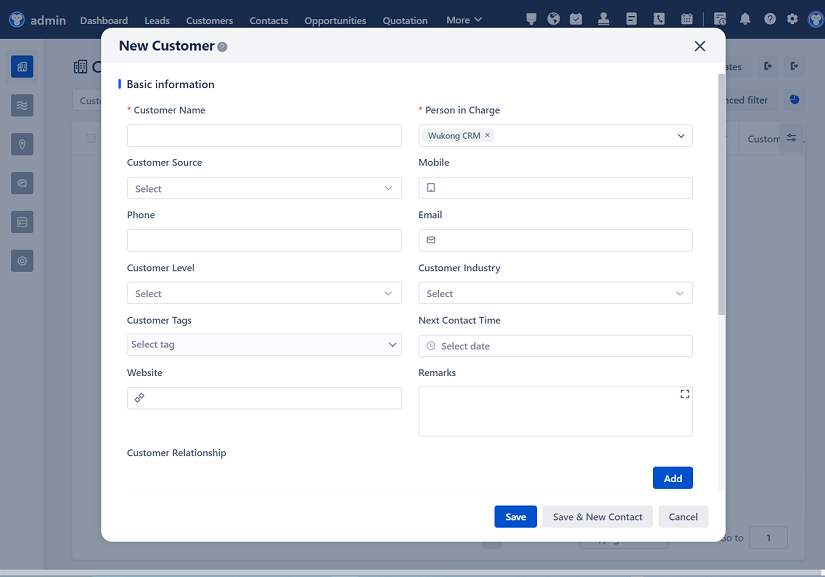
△Click on the top right corner to try Wukong CRM for free
So, you know how study abroad agencies are always trying to keep up with hundreds, sometimes thousands of students? I mean, think about it — every student has their own timeline, their own dream schools, their own deadlines, visa requirements, test scores, and let’s not forget the parents who want constant updates. It’s a lot. Honestly, I used to work at one of these agencies, and we were drowning in spreadsheets, sticky notes, and endless email threads. It was chaos. One day, someone finally said, “Wait, isn’t there a better way to manage all this?” And that’s when we discovered CRM systems built specifically for study abroad education agencies.
Now, I know what you’re thinking — “CRM? Isn’t that just for sales teams?” Well, yeah, traditionally, CRM stands for Customer Relationship Management, and it’s mostly used in sales and marketing. But here’s the thing: in the world of education consulting, your students are your customers. They’re investing time, money, and trust in your agency to help them achieve their dreams. So, managing those relationships? Super important. And that’s exactly what a CRM does — it helps you keep everything organized, personal, and efficient.
Free use of CRM system: Free CRM
Let me give you an example. Imagine you have a student named Priya from India who wants to study engineering in Canada. She’s got her IELTS scores, she’s picked five universities, and she’s waiting on recommendation letters. Without a CRM, you might have her info in a Google Sheet, her emails in your inbox, her documents in a folder on your desktop, and her follow-up dates scribbled on a notepad. But with a CRM? All of that — her profile, her documents, her communication history, her application deadlines — lives in one place. And not just that, the system can remind you when it’s time to follow up, or when her documents are overdue.
And here’s the best part — it’s not just about organization. A good CRM actually helps you build stronger relationships. Because when you log every call, every email, every meeting, you’re not just tracking data — you’re remembering the little things. Like how Priya’s mom was worried about winter weather in Toronto, or how she really wants to join the robotics club. That kind of personal touch? That’s what makes students feel cared for, not just processed.
I remember when we first implemented our CRM, it felt like someone had finally turned the lights on. Suddenly, we could see exactly where every student was in the process. Was their SOP submitted? Did they pay the application fee? Were they waiting on a scholarship decision? No more guessing. No more “Wait, did we send that transcript?” It was all right there, color-coded and updated in real time.

And let’s talk about teamwork. In a busy agency, you’ve got counselors, document specialists, visa advisors, and marketing folks — everyone’s involved. Before the CRM, if a counselor went on vacation, the student might get dropped. But now? The whole team can access the student’s file. If Priya calls while her counselor is on leave, someone else can jump in and help because they can see everything — no awkward “Let me check” moments.

Another thing I love? Automation. I mean, who wants to manually send the same email 50 times? “Hi, please submit your passport copy.” “Hi, your university application is due in 3 days.” With CRM workflows, you can set up automated reminders, follow-ups, and even personalized messages based on where the student is in their journey. It saves so much time, and honestly, it reduces human error. No more missed deadlines because someone forgot to send a reminder.
But it’s not just about saving time — it’s about scaling. Let’s say your agency goes from 100 students a year to 500. Can your current system handle that? Probably not. But a CRM can. You can add more users, more pipelines, more custom fields. You can even integrate it with other tools — like your email, calendar, payment gateway, or university portals. It becomes the central hub for your entire operation.
And here’s something people don’t talk about enough — data. With a CRM, you start collecting real insights. Which countries are most popular? Which counselors have the highest conversion rates? Which marketing campaigns bring in the most inquiries? You can actually measure what’s working and what’s not. That’s huge. Instead of guessing, you’re making decisions based on real data.
I’ll never forget the first time we ran a report showing that 70% of our successful applicants to the UK applied before October. That changed our entire marketing strategy. We started pushing early applications, offering free SOP reviews in August, and suddenly, our acceptance rates went up. That kind of insight? You can’t get that from a spreadsheet.
Now, I know some agencies are still using old-school methods. “We’ve always done it this way,” they say. But here’s the truth — the education landscape is changing. Students expect fast responses, transparency, and personalized service. If you’re still replying to emails three days later or losing documents, you’re going to lose clients to agencies that are more organized and tech-savvy.
And it’s not just about competition — it’s about responsibility. These students are trusting you with their futures. You owe it to them to be on top of things. A CRM isn’t just a tool — it’s a way to show that you care, that you’re professional, and that you’re serious about helping them succeed.
I’ve seen agencies transform after adopting a CRM. One agency I worked with used to lose about 15% of their leads because follow-ups were inconsistent. After CRM? That dropped to 3%. Another agency doubled their student intake in one year just because they could manage more applications without hiring more staff. It’s not magic — it’s smart systems.
But here’s the catch — not all CRMs are created equal. You can’t just pick any sales CRM and expect it to work. Study abroad has unique needs. You need fields for test scores, visa statuses, university portals, conditional offers, scholarship tracking — stuff that generic CRMs don’t handle well. That’s why specialized CRMs for education agencies are so important. They’re built with our workflows in mind.
Also, training matters. I’ve seen agencies buy a fancy CRM and then never use half its features because no one knows how. So yeah, invest in onboarding. Make sure your team understands how to use it, why it matters, and how it makes their lives easier. When people see the benefits — less stress, fewer missed tasks, happier students — they’ll actually use it.
And don’t forget mobile access. Students don’t just contact you from 9 to 5. They message at midnight, they call on weekends. A good CRM should have a mobile app so your counselors can update records on the go. I’ve updated student files from my phone while waiting in line for coffee — small thing, but it keeps everything current.
Security is another big deal. You’re handling sensitive data — passports, financial info, academic records. Your CRM must have strong encryption, role-based access, and compliance with data protection laws like GDPR or CCPA. Don’t cut corners here. One data breach could destroy your reputation.
Oh, and integration! If your CRM can’t talk to your email, calendar, or payment system, it’s going to create more work, not less. Look for one that connects easily with tools you already use. Zapier, API access, single sign-on — these things matter.
At the end of the day, a CRM isn’t about replacing human connection — it’s about enhancing it. It frees you from admin chaos so you can focus on what really matters: guiding students, answering their fears, celebrating their wins. When you’re not scrambling to find a document or remember a deadline, you can actually be present in the conversation.

And honestly? Students notice. They can tell when an agency is organized and responsive. They feel more confident. They refer their friends. It builds trust — and trust builds business.
So if you’re running a study abroad agency and still relying on spreadsheets and memory, I get it. It’s familiar. But ask yourself — how much time are you wasting? How many opportunities are you missing? How many students could you help if you weren’t buried in paperwork?
A CRM isn’t a luxury — it’s a necessity. It’s the backbone of a modern, professional education consultancy. And once you start using one, you’ll wonder how you ever survived without it.
FAQs (Frequently Asked Questions)
Q: Isn’t a CRM too expensive for a small agency?
A: Not necessarily. There are affordable CRMs designed for small education agencies, some even with pay-as-you-grow pricing. When you factor in time saved and increased conversions, it often pays for itself.
Q: Will my team actually use it?
A: That depends on training and buy-in. Choose a user-friendly system, involve your team in the selection, and show them how it makes their jobs easier. Start with basic features and grow from there.
Q: Can a CRM help with student recruitment?
Absolutely. You can track leads from social media, webinars, or fairs, automate follow-ups, and analyze which sources bring the best students.
Q: What if we already use Google Sheets and email?
Those tools are great, but they’re not connected. A CRM brings everything together — communication, documents, deadlines — so nothing falls through the cracks.
Q: Is it hard to switch to a CRM?
There’s a learning curve, sure. But most providers offer onboarding support, templates, and migration help. Start small, test it with a few students, and scale up.

Q: Can parents access the system?
Some CRMs offer client portals where parents and students can log in to check application status, upload documents, and see upcoming tasks — which reduces repetitive questions.
Q: Do CRMs work for agencies focused on specific countries?
Yes! You can customize pipelines for different countries — like separate workflows for Canada, the UK, or Australia — with unique requirements and timelines.
Q: How does a CRM improve student satisfaction?
By reducing delays, providing transparency, and enabling personalized communication. Students feel informed and supported throughout the process.
Q: Can I track visa success rates with a CRM?
Definitely. You can tag visa outcomes, analyze trends, and even identify which counselors have the best visa approval support records.
Q: What’s the biggest mistake agencies make when adopting a CRM?
Skipping proper setup. If you don’t customize fields, pipelines, and automation to match your actual workflow, the CRM won’t be useful. Take the time to configure it right.
Related links:
Free trial of CRM
Understand CRM software
△Click on the top right corner to try Wukong CRM for free