
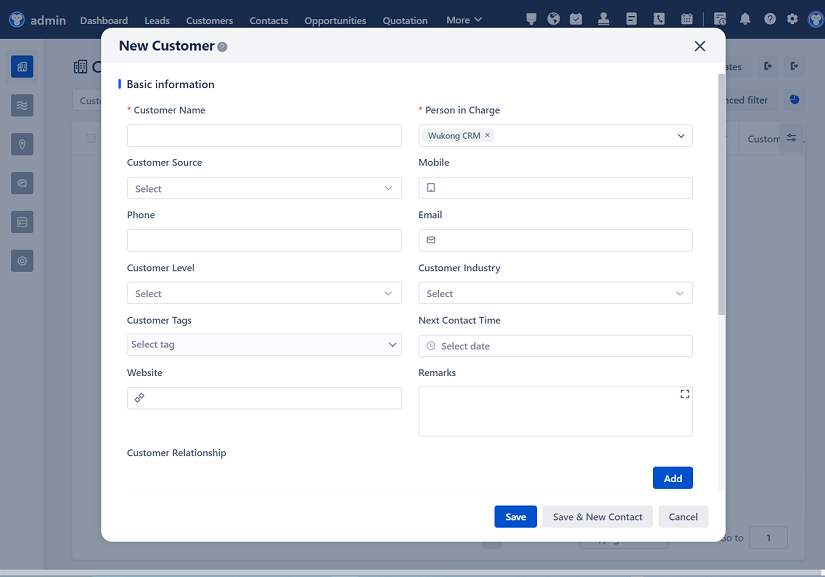
△Click on the top right corner to try Wukong CRM for free
So, you know, when we talk about CRM systems—Customer Relationship Management systems—we’re really talking about the backbone of how companies manage their interactions with customers. I mean, think about it: every email, every support ticket, every sales call—it all gets logged somewhere, right? And that’s where CRM comes in. But here’s the thing: just having a CRM system isn’t enough. You’ve got to measure how well it’s actually working. That’s where KPIs—Key Performance Indicators—come into play.
Honestly, I used to think KPIs were just fancy numbers managers threw around in meetings. But over time, I realized they’re actually super important. They help us understand whether our CRM is doing what it’s supposed to do—improving customer satisfaction, boosting sales, making service faster. Without good KPIs, you’re basically flying blind.
Free use of CRM system: Free CRM
Now, designing KPIs for CRM systems isn’t as simple as picking random metrics and calling it a day. I’ve seen teams make that mistake before. They’ll track things like “number of logins” or “total records created,” but those don’t really tell you much about performance. What you need are meaningful indicators—ones that reflect real business outcomes.
Let me give you an example. Say your goal is better customer retention. A smart KPI might be “customer churn rate after 6 months of onboarding.” That tells you something useful. But if you just track “number of follow-up emails sent,” well, that doesn’t say whether those emails actually helped keep customers around.

So, how do you go about designing effective KPIs? Well, first, you’ve got to start with clear objectives. Ask yourself: what are we trying to achieve with our CRM? Is it faster response times? Higher conversion rates? Better cross-selling? Once you know your goals, you can pick KPIs that align with them.
I remember working with a team that wanted to improve customer satisfaction. At first, they were tracking average call duration. Makes sense, right? Shorter calls = more efficient. But then we realized—wait a minute, shorter calls don’t always mean happier customers. Sometimes people need longer conversations to feel heard. So we shifted to tracking CSAT scores (Customer Satisfaction Scores) after support interactions. That gave us a much clearer picture.
Another thing I’ve learned is that KPIs should be SMART—Specific, Measurable, Achievable, Relevant, and Time-bound. It sounds like corporate jargon, but it actually helps. For instance, instead of saying “improve sales,” a better KPI would be “increase lead-to-customer conversion rate by 15% within six months.” Now that’s something you can actually measure and act on.
But here’s a challenge: not all KPIs are created equal across industries. A retail company might care deeply about repeat purchase rates, while a SaaS business might focus more on monthly active users or feature adoption. So you’ve got to tailor your KPIs to your specific context. One size definitely doesn’t fit all.
And let’s not forget data quality. I can’t tell you how many times I’ve seen teams build beautiful dashboards only to realize the underlying data was incomplete or outdated. Garbage in, garbage out, right? So before you even design your KPIs, make sure your CRM data is clean, consistent, and reliable.
Also, think about who’s going to use these KPIs. Are they for frontline staff? Managers? Executives? The level of detail matters. A sales rep might want daily updates on their personal conversion rate, while a CEO probably cares more about overall customer lifetime value trends.
Now, once you’ve designed your KPIs, the next step is evaluation. This is where a lot of organizations drop the ball. They set up KPIs and then never check if they’re still relevant. But markets change, strategies evolve, and so should your KPIs.
One approach I’ve found helpful is regular KPI reviews—say, every quarter. Sit down with stakeholders and ask: Are these indicators still giving us useful insights? Have our goals changed? Are there new behaviors we should be tracking?
For example, during the pandemic, a lot of companies had to shift from in-person to digital customer engagement. Suddenly, KPIs around virtual meeting attendance or online chat usage became way more important than they were before. If you weren’t updating your KPIs, you’d miss that shift entirely.
Another thing to consider is balance. Don’t just focus on one area—like sales—and ignore service or marketing. A good CRM KPI framework should cover the whole customer journey. Think acquisition, onboarding, support, retention, and advocacy.
I’ve seen teams get obsessed with lead generation numbers but completely neglect post-sale satisfaction. Then they wonder why customers aren’t staying long-term. So yeah, balance is key.
And speaking of balance, watch out for vanity metrics. These are numbers that look impressive but don’t drive real business value. Like “total number of contacts in CRM.” Sure, it sounds big, but if half of them are outdated or irrelevant, does it really matter?
A better approach is to link KPIs directly to business outcomes. For instance, instead of just tracking “emails sent,” measure “email open rate leading to scheduled demos.” That shows actual impact.
Now, technology plays a huge role here too. Most modern CRM platforms—like Salesforce, HubSpot, or Microsoft Dynamics—have built-in analytics tools. They can automate a lot of the KPI tracking for you. But—and this is important—you still need to configure them correctly. Just because the tool can generate a report doesn’t mean it’s measuring the right thing.
I once worked with a company using Salesforce reports that showed a 90% customer satisfaction rate. Sounds great, right? But when we dug deeper, we found that only 5% of customers were actually responding to the survey. So that 90% was based on a tiny, potentially biased sample. Not exactly reliable.
That’s why validation matters. Always ask: How is this data collected? Is it representative? Are there any biases in how responses are gathered?
Another tip: involve end-users early in the KPI design process. Talk to sales reps, support agents, marketers—get their input. They’re the ones using the CRM every day. They’ll tell you what’s working and what’s not. Plus, when people help design the KPIs, they’re more likely to trust and act on them.
And don’t forget about benchmarks. It’s one thing to track your own progress, but it’s also helpful to compare against industry standards. If your average response time is 48 hours, but the industry average is 4 hours, you’ve got some work to do. Benchmarks give you context.

But be careful—blindly chasing benchmarks without understanding your unique situation can backfire. Maybe your customers expect slower responses because your product is highly technical. So use benchmarks as a guide, not a rule.
Now, let’s talk about visualization. All the best KPIs in the world won’t help if no one understands them. Dashboards should be clear, intuitive, and focused on the most important metrics. Avoid clutter. Highlight trends, not just raw numbers.
I love using color coding—green for good, red for warning—but only if it’s consistent. Nothing worse than a dashboard where red means “great” in one chart and “bad” in another. Confusing!
Also, storytelling matters. Don’t just throw numbers at people. Explain what the KPI means, why it’s important, and what actions should follow. A KPI isn’t just a metric—it’s a conversation starter.

One last thing: KPIs should drive action, not just reporting. If your customer retention rate is dropping, the KPI should prompt a discussion: Why? What can we do? Who needs to be involved? Otherwise, it’s just a number on a screen.
In summary, designing and evaluating KPIs for CRM systems is both an art and a science. It requires clarity of purpose, attention to data quality, stakeholder involvement, and ongoing refinement. When done right, KPIs can transform how organizations understand and improve their customer relationships.
It’s not about tracking everything—it’s about tracking the right things. And honestly, that makes all the difference.
FAQs (Frequently Asked Questions):
Q: What are some common KPIs used in CRM systems?
A: Some widely used ones include customer satisfaction score (CSAT), net promoter score (NPS), first response time, lead conversion rate, customer lifetime value (CLV), churn rate, and average resolution time. But remember, the best KPIs depend on your specific goals.
Q: How often should we review our CRM KPIs?
A: I’d recommend reviewing them at least quarterly. Business priorities change, and your KPIs should evolve with them. If something isn’t giving useful insights anymore, don’t be afraid to replace it.
Q: Can too many KPIs be a problem?
Absolutely. Too many KPIs can overwhelm teams and dilute focus. Stick to a handful of high-impact metrics—usually 5 to 7—that align closely with your main objectives.
Q: Should KPIs be the same across departments?
Not necessarily. Sales, marketing, and customer service may need different KPIs because they have different roles in the customer journey. But there should be some overlap to ensure alignment.
Q: How do we ensure data accuracy in CRM KPIs?
Start with clean data entry practices, regular audits, and user training. Also, set up automated data validation rules in your CRM to catch errors early.
Q: What’s the difference between a KPI and a metric?
Great question. All KPIs are metrics, but not all metrics are KPIs. A KPI is a metric that’s directly tied to a strategic goal. For example, “number of website visits” is a metric; “conversion rate from website visits to leads” could be a KPI if lead generation is a key objective.
Q: Can KPIs motivate employees?
They can, but only if they’re fair, transparent, and tied to achievable goals. Poorly designed KPIs can actually demotivate people—especially if they feel punished for factors outside their control.
Q: Should we share KPI results with the whole team?
Yes, transparency builds trust and accountability. But share them in a constructive way—focus on learning and improvement, not blame.
Q: How do we handle resistance to new KPIs?
Involve people early, explain the “why” behind each KPI, and show how it benefits them. Change is easier when people feel heard and included.

Q: Are there risks in relying too much on CRM KPIs?
Definitely. Over-reliance on quantitative data can make you miss qualitative insights—like customer sentiment or employee morale. Always combine KPIs with direct feedback and observation.
Related links:
Free trial of CRM
Understand CRM software
△Click on the top right corner to try Wukong CRM for free