
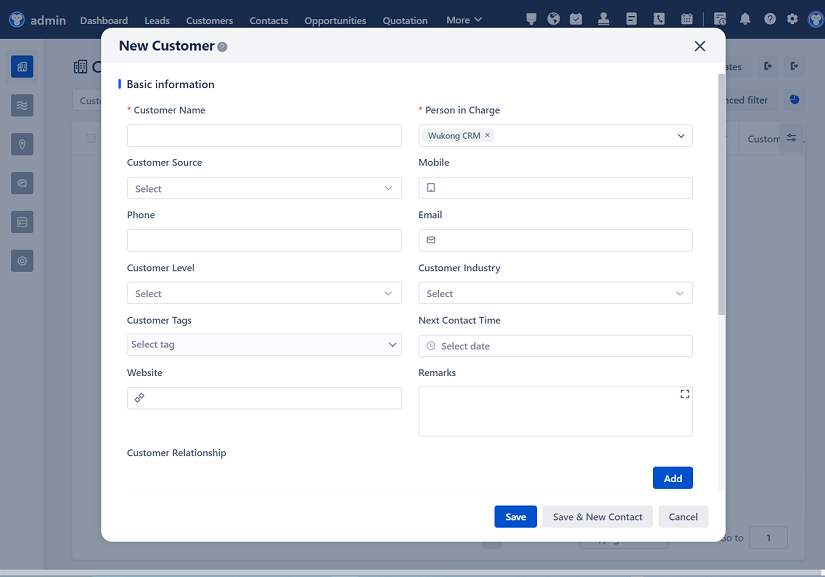
△Click on the top right corner to try Wukong CRM for free
So, let me tell you something — when you're building a CRM system, one of the most important things you absolutely can’t overlook is how you design your core data tables. I mean, seriously, if you mess this up early on, you’re going to pay for it later. Like, big time. I’ve seen teams spend months trying to fix performance issues, only to realize the root cause was a poorly structured database from day one. And honestly, that’s just heartbreaking.
Now, I know what you’re thinking — “Isn’t a CRM just about storing customer names and emails?” Well, not really. Not anymore. Modern CRM systems are way more complex than that. They track interactions, sales pipelines, support tickets, marketing campaigns, user behavior, and even integrate with external tools like ERP or analytics platforms. So, the data model has to be flexible, scalable, and efficient. And that starts with the core tables.
Free use of CRM system: Free CRM
Let me walk you through how I usually approach this. First, you’ve got to identify the key entities. The big ones are usually Customer (or Contact), Account, Opportunity, Activity, and maybe Product or Service. These are the backbone of any CRM. You can’t really build anything meaningful without them. But here’s the thing — you don’t just slap them together and call it a day. You’ve got to think about how they relate to each other.
For example, take the Customer and Account relationship. In some systems, a customer is tied directly to an account — like a business account with multiple contacts. In others, especially B2C setups, you might treat each individual as both a customer and an account. So, you’ve got to decide: are you going with a one-to-one model or a one-to-many? That choice affects your table structure big time. I usually go with a separate Account table and a Contact table, where Contact has a foreign key to Account. That way, you can have multiple contacts per account, which is super useful for enterprise clients.
Then there’s the Opportunity table. This is where sales teams live. Each opportunity represents a potential deal, right? So it needs fields like deal value, stage in the pipeline, expected close date, probability, and of course, which account or contact it’s tied to. But here’s a pro tip — don’t just store the current stage. Keep a history. I’ve learned the hard way that sales managers love being able to see how a deal progressed over time. So, consider having a separate Opportunity History table that logs every stage change. It adds a bit more complexity, but it’s worth it for reporting and analytics.
And speaking of relationships — foreign keys are your best friend. Seriously. They keep your data clean and connected. But don’t go overboard. I once worked on a project where someone created 15 foreign keys on a single table. It was a nightmare to query and even worse to maintain. So, keep it simple. Only link what you really need. And always, always index those foreign keys. Trust me, your database admin will thank you later.
Now, let’s talk about flexibility. One of the biggest challenges in CRM design is that business requirements change all the time. Today, you might only need to track phone calls. Tomorrow, you might need to log social media interactions, video meetings, or even AI-generated insights. So, how do you design for that?
Well, I like using what’s called an “Activity” or “Interaction” table. Instead of having separate tables for calls, emails, and meetings, you have one generic Activity table with a type field. Then, depending on the type, you can store different details — maybe in a JSON column, or through a separate subtype table. JSON is great for flexibility because you can add new fields without altering the schema every time. But be careful — too much JSON and you lose the ability to query efficiently. So, I usually store common fields like timestamp, subject, and owner directly in the main table, and use JSON for optional or dynamic data.
Another thing people forget is user roles and permissions. Who can see what? A sales rep shouldn’t see financial data that’s only for managers. So, you might need a User table, a Role table, and some kind of access control logic. I usually handle this at the application level, but the database should still support it — maybe with a User-Role mapping table and some flags on records indicating visibility.

And let’s not ignore performance. As your CRM grows, so does your data. Millions of records. If your queries are slow, users get frustrated. So, indexing is crucial. But again, don’t index everything. Focus on the fields you query most — like customer name, account ID, opportunity stage, or creation date. And consider partitioning large tables by date or account group. I’ve seen partitioning cut query times from 10 seconds to under a second. It’s a game-changer.
Oh, and backups. I know it’s not part of the table design per se, but you’ve got to think about it. Your data is valuable. So, make sure your tables support point-in-time recovery. That means keeping transaction logs and maybe even having a separate audit trail table that logs every insert, update, and delete. Some people use triggers for this, others use application-level logging. I prefer the latter — it’s easier to control and less likely to slow down the main operations.
Now, here’s a real-world example. I was working with a startup that wanted to build a CRM for small businesses. At first, they just wanted to track leads and follow-ups. Simple, right? But six months in, they added team collaboration features, file attachments, and integration with Google Calendar. Their original table structure couldn’t handle it. We had to refactor almost everything. So, lesson learned — design with growth in mind. Even if you don’t need all the features now, leave room for them.
One way to do that is by using metadata tables. For example, instead of hardcoding field names in your forms, you can have a FieldDefinition table that describes what fields exist for each entity. Then your app reads that and displays the right UI. It makes the system more configurable and future-proof. I’ve used this approach in a few projects, and it’s been a lifesaver when clients want to add custom fields without touching the code.
And don’t forget about data quality. Bad data is worse than no data. So, build in validation at the database level when you can. Use constraints — like NOT NULL for required fields, CHECK constraints for valid values, and UNIQUE constraints to prevent duplicates. I once had a client whose CRM was full of duplicate contacts because they didn’t enforce uniqueness on email addresses. Cleaning that up took weeks. So yeah, spend the time upfront to get it right.
Another thing — timestamps. Always include created_at and updated_at fields on your core tables. It seems obvious, but I’ve seen too many systems where this was an afterthought. These timestamps are gold for debugging, auditing, and understanding user behavior. And if you’re using a framework, most of them can auto-populate these fields, so there’s really no excuse.
Now, what about soft deletes? In a CRM, you usually don’t want to permanently delete records. What if someone accidentally deletes a key customer? So, instead of DELETE, you set a deleted_at timestamp or a is_deleted flag. That way, you can restore data if needed. But remember — when you query, you have to filter out deleted records unless you’re doing a restore. It adds a bit of complexity, but it’s way safer.
Let’s talk about scalability. If you’re building a CRM for a global company, you might need multi-tenancy. That means each customer (or organization) has their own isolated data. There are a few ways to handle this — you can have separate databases, separate schemas, or just a tenant_id column on every table. I usually go with the tenant_id approach because it’s simpler to manage and backup. But you’ve got to make sure every query includes tenant_id in the WHERE clause. Otherwise, you risk leaking data between tenants. And that’s a disaster waiting to happen.
Also, think about search. Users want to find records fast. So, full-text search is a must. PostgreSQL has great full-text search capabilities, and MySQL has decent ones too. You can create indexes on name, email, notes, etc., and enable fuzzy search. I’ve even used Elasticsearch in some high-performance CRMs for advanced search features. But that’s overkill for smaller systems.

And finally, documentation. I know it’s boring, but please document your table structures. Add comments to your columns, keep an ER diagram up to date, and write a data dictionary. Future you — and your teammates — will be so grateful. I’ve joined projects where no one knew what a certain field was for. Took me days to figure it out. Don’t be that team.
So, to wrap this up — designing core data tables in a CRM isn’t just about storing data. It’s about building a foundation that’s flexible, secure, performant, and easy to maintain. You’ve got to think about relationships, scalability, user needs, and future changes. Take your time. Get feedback from real users. Test your queries with large datasets. And don’t be afraid to refactor if you realize you made a mistake early on.
Because at the end of the day, a well-designed CRM database doesn’t just store information — it empowers teams, drives sales, and helps businesses grow. And that’s pretty cool if you ask me.
Q&A Section
Q: Should I use a NoSQL database instead of SQL for a CRM?
A: Honestly, it depends. SQL is usually better for CRMs because of the structured relationships and transactional integrity. NoSQL can work for very specific use cases, like storing unstructured interaction logs, but for core entities like customers and deals, relational databases are still the gold standard.

Q: How do I handle custom fields in a CRM without altering the schema every time?
A: Great question. One common approach is to use an Entity-Attribute-Value (EAV) model, but that can get messy. I prefer storing custom fields in a JSON column or having a separate CustomFieldData table linked to the main entity. That way, you keep the core schema stable.
Q: What’s the best way to track changes to records over time?
A: I’d recommend a dedicated audit log table. Every time a record is updated, you insert a row with the old values, new values, timestamp, and user. It’s clean, queryable, and doesn’t clutter your main tables.
Q: How important is indexing in a CRM database?
A: Super important. Without proper indexing, your queries slow down as data grows. Focus on fields used in WHERE, JOIN, and ORDER BY clauses. But don’t overdo it — too many indexes can slow down writes.
Q: Can I use UUIDs instead of auto-incrementing IDs?
A: Absolutely. UUIDs are great for distributed systems and prevent ID collisions in multi-tenant apps. The downside is they’re larger and less readable, but the benefits often outweigh that.
Q: How do I ensure data consistency across related tables?
A: Use foreign key constraints and transactions. They ensure that if you delete an account, related contacts are either deleted or reassigned, and that updates happen atomically. Never skip this — it’s what keeps your data reliable.
Related links:
Free trial of CRM
Understand CRM software
△Click on the top right corner to try Wukong CRM for free