
△Click on the top right corner to try Wukong CRM for free
You know, I’ve been thinking a lot lately about how businesses are trying to stay close to their customers in this digital age. It’s not just about selling anymore—it’s about building real relationships. And honestly, one of the most interesting tools I’ve come across recently is this CRM system built around WeChat IDs. I know, I know—WeChat is huge in China, but hear me out. It’s way more than just a messaging app. It’s like a whole digital ecosystem wrapped into one platform.
So picture this: you’re running a small business, maybe a boutique, a café, or even a consulting firm. You’ve got customers coming in and out, some regulars, some new faces. Keeping track of who likes what, who complained last week, who’s due for a follow-up—man, it gets overwhelming fast. That’s where a CRM usually comes in, right? But traditional CRMs? They can be clunky. You’ve got to log in, fill out forms, remember passwords, and half the time your team just avoids using them altogether.
Free use of CRM system: Free CRM
But what if your CRM lived right inside WeChat? That’s exactly what this system does. It uses WeChat IDs as the core identifier for each customer. Think about it—almost everyone in China, and even a lot of international users, already have WeChat. They’re on it every day. So instead of asking people to sign up for yet another platform or app, you’re meeting them where they already are.
Here’s how it works. When a customer interacts with your business—maybe they scan a QR code at your store, reply to a message, or click a link in a WeChat post—the system automatically captures their WeChat ID. That ID becomes their unique customer profile. No extra forms, no email sign-ups. It’s seamless. And because WeChat IDs are tied to real accounts (thanks to China’s real-name registration), you’re getting verified, traceable data.
Now, once you’ve got that ID, the CRM starts building a profile. Every message they send, every purchase they make, every service request—they all get logged under that ID. You can see their history at a glance. Did they buy a latte every Tuesday last month? Did they complain about slow delivery last week? The system remembers. And it doesn’t just store data—it helps you act on it.
For example, let’s say someone hasn’t engaged in a while. The CRM can flag that and suggest a personalized message: “Hey, we miss you! Here’s 10% off your next coffee.” And because it’s sent through WeChat, it feels natural, like a friendly chat, not some robotic email blast. People actually respond to that.
And here’s the cool part—automation. You can set up triggers. If someone adds a product to their cart but doesn’t check out, the system can send a gentle nudge: “Still thinking about that jacket? It’s selling fast!” Or if a customer reaches their fifth purchase, boom—automated thank-you message with a loyalty reward. It’s like having a personal assistant who never sleeps.
But it’s not just about sales. Customer service gets way smoother too. Imagine a customer messages you with a problem. Instead of starting from scratch, the support agent pulls up their WeChat ID and sees everything—past orders, previous complaints, preferences. No more “Can you repeat that?” or “What was your order number?” It’s all right there. That kind of efficiency? It makes people feel heard. And when customers feel heard, they stick around.

I also love how this system handles segmentation. You’re not just grouping people by age or location—you can segment by behavior. Who opens your messages? Who clicks links? Who always buys during promotions? You can create targeted campaigns for each group. Send exclusive offers to your VIPs, educational content to new followers, reminders to lapsed users. It’s marketing that actually feels personal.
And integration? Yeah, it plays nice with other tools. You can connect it to your inventory system, your payment gateway, even your analytics dashboard. So when someone buys something through WeChat Pay, the CRM updates the customer’s purchase history, adjusts inventory, and logs the revenue—all automatically. No double entry, no mistakes.
Now, I know what you’re thinking—what about privacy? That’s a fair concern. Using WeChat IDs means you’re dealing with personal data, and in China, there are strict rules about that. But a good CRM system built on WeChat IDs follows all the regulations. It encrypts data, gets user consent, and lets people opt out anytime. Transparency is key. You’re not spying on people; you’re offering better service with their permission.

Another thing I’ve noticed—this system really helps small teams. You don’t need a huge marketing department or a tech-savvy IT guy to run it. The interface is simple, mostly in Chinese but with growing English support. Training takes a day, maybe two. And because everything happens in WeChat, your staff is already familiar with the environment. They’re not learning a new system; they’re just using WeChat smarter.

Let’s talk about scalability. You might think this is only for small businesses, but no—big companies use it too. A national retail chain can use WeChat ID-based CRM to manage millions of customers across provinces. Each store links interactions to the same ID, so whether you shop in Beijing or Chengdu, your preferences follow you. That’s powerful for building brand loyalty.
And it’s not just retail. I’ve seen restaurants use it to remember favorite dishes, clinics to send appointment reminders, real estate agents to follow up with leads. The flexibility is insane. You can customize fields, add tags, create workflows. It’s not one-size-fits-all; it adapts to your business.
One of the biggest wins? Engagement. Emails get ignored. SMS feels intrusive. But WeChat? People check it constantly. A message in WeChat has a much higher open rate than email—like, 80% or more. And because it’s conversational, replies are faster. You’re not just broadcasting; you’re having a dialogue.
I remember talking to a shop owner in Hangzhou who switched to this CRM. She told me her customer retention went up by 30% in three months. Not because she changed her products, but because she started remembering her customers. “Now I know Mrs. Li likes the green tea buns and always comes on Sundays,” she said. “So I message her when they’re fresh. She loves it.” That’s the magic—small touches that feel big.
Of course, it’s not perfect. WeChat’s ecosystem is powerful, but it’s also controlled by Tencent. You’re kind of locked into their rules. And if WeChat changes its API, your CRM might need updates. Plus, outside China, WeChat isn’t as dominant. So if your audience is mostly in the U.S. or Europe, this might not be the best fit. But for businesses targeting Chinese consumers—or global brands with a strong presence in China—it’s a game-changer.
Another challenge? Data overload. When you’re tracking everything, it’s easy to get lost in the numbers. That’s why the best systems come with smart dashboards. They highlight what matters—trends, drop-offs, top customers—so you don’t have to dig through spreadsheets.
And let’s not forget multilingual support. As more international businesses adopt WeChat for China operations, the CRM tools are adding English, Japanese, Korean interfaces. You can manage Chinese customers from headquarters in New York, as long as you’ve got the right setup.
I also appreciate how this system supports omnichannel experiences. A customer might see your ad on Moments (WeChat’s social feed), click to chat, make a purchase, then later call your hotline. The CRM ties all those touchpoints together under one ID. No more “I already told the other person!” moments. It’s unified.
Training and onboarding are surprisingly smooth. Most vendors offer live demos, video guides, and even WeChat-based support. You can literally get help by messaging a bot or a real person in the same app you’re using for CRM. No switching tabs, no waiting on hold.
And upgrades? They happen quietly in the background. You don’t wake up to a completely new interface. It evolves gradually, based on user feedback. That’s something I really respect—building with the user, not just for them.
Look, I’m not saying this CRM is the answer to everything. Every business is different. But if you’re dealing with Chinese customers, or you want to build deeper relationships in a mobile-first world, this WeChat ID-based system makes a ton of sense. It turns a simple messaging app into a powerhouse for customer management.
It’s not just about technology—it’s about connection. And in a world where people are bombarded with ads and cold emails, being able to chat like a real person? That’s refreshing. That’s human.
So yeah, I’m pretty excited about this. It’s not flashy, it’s not trying to be AI-powered magic (though it uses smart tech under the hood). It’s practical, intuitive, and focused on what really matters: knowing your customers, and making them feel known.
FAQs (Frequently Asked Questions):
Q: Can I use this CRM if my business is outside China?
A: Absolutely, as long as your target customers use WeChat. Many international brands use it for their China operations or to serve Chinese tourists and expats.
Q: Is it expensive to set up?
A: It depends on the provider, but many offer tiered pricing. Small businesses can start with basic plans under $100/month. Larger enterprises pay more for advanced features.
Q: Do customers need to give permission to be tracked?
A: Yes. Reputable systems require opt-in consent, usually through a message or QR code scan, and comply with data protection laws like PIPL in China.
Q: Can I integrate it with non-Chinese platforms like Shopify or Salesforce?
A: Some systems offer API integrations, though it may require custom development. Always check with the vendor for compatibility.
Q: What happens if a customer changes their WeChat account?
A: Since WeChat IDs are tied to phone numbers or emails, and most users keep them long-term, this is rare. But if it happens, you can manually merge profiles.
Q: Is the data secure?
A: Good systems use encryption, secure servers, and follow strict access controls. Always ask about their security certifications.

Q: Can I send bulk messages without spamming?
A: Yes, but there are limits. WeChat restricts mass messaging to prevent abuse. Most CRMs help you stay within guidelines using scheduled, targeted campaigns.
Q: Does it work on WeChat Official Accounts?
A: Yes, especially if you have a Service or Subscription Account. These allow deeper CRM integration than personal accounts.
Q: Can I track customer behavior outside WeChat?
A: Only if you link external actions (like website visits) to their WeChat ID, usually through login or QR codes. Otherwise, tracking is limited to WeChat activity.
Q: Is there English customer support?
A: Many providers now offer bilingual support, especially for international clients. Check before signing up.
Related links:
Free trial of CRM
Understand CRM software
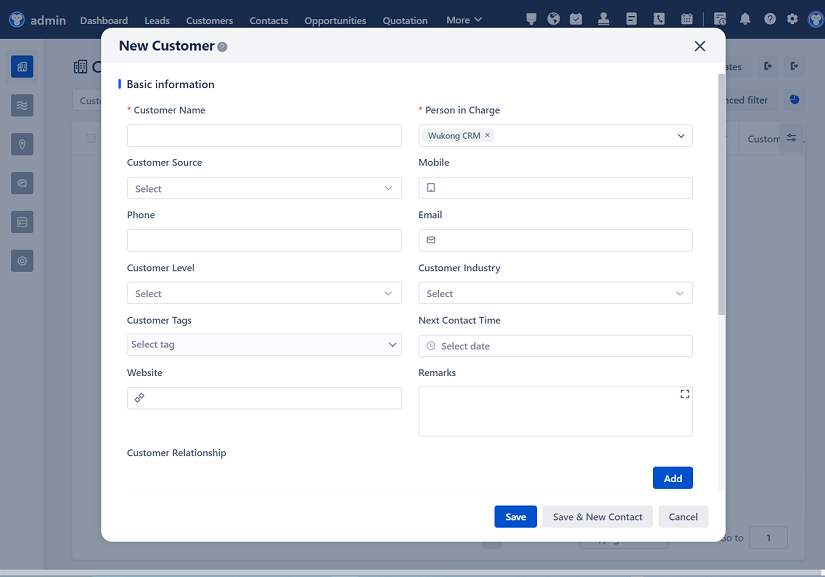
△Click on the top right corner to try Wukong CRM for free