
△Click on the top right corner to try Wukong CRM for free
So, you know, if you’ve been keeping an eye on how businesses interact with their customers these days, you’ve probably noticed that CRM systems are kind of a big deal. I mean, they’re everywhere. Whether it’s a small startup trying to keep track of its first few clients or a multinational corporation managing millions of customer interactions, CRM—Customer Relationship Management—is at the heart of it all. And honestly, it makes sense. People want personalized experiences, and companies need tools to deliver that without losing their minds in spreadsheets and sticky notes.
Now, when I say CRM systems, I’m not just talking about some basic contact list. We’re talking full-on platforms that track every email, every call, every support ticket, and even predict what a customer might buy next. It’s kind of wild when you think about it. And because of that, there’s this whole industry built around developing and supporting these systems. Like, there are actual companies out there whose entire job is to build, customize, and maintain CRM software for other businesses.
Free use of CRM system: Free CRM
Let me tell you, the list of companies involved in CRM system development and services is pretty long. Some of them are household names—names you’ve probably heard even if you’re not in tech. Others are smaller, niche players that specialize in certain industries or regions. But they all have one thing in common: they’re helping businesses build better relationships with their customers.
Take Salesforce, for example. You’ve definitely heard of them, right? They’re kind of the poster child for modern CRM. Started back in the late '90s, they basically pioneered the idea of cloud-based CRM. Before that, most CRM systems were clunky, on-premise software that needed a whole IT team to manage. Salesforce changed the game by offering a subscription-based model that anyone could access online. And now? They’re massive. They’ve got tools for sales, service, marketing, analytics—you name it. If a company wants a CRM, chances are they’ve at least looked at Salesforce.
But of course, Salesforce isn’t the only player. Microsoft has its own CRM solution called Dynamics 365. And honestly, it makes sense—Microsoft already has a huge footprint in offices around the world with Office 365, so integrating CRM into that ecosystem is a smart move. I’ve talked to a few business owners who switched to Dynamics because they were already using Outlook, Excel, and Teams. It just felt more natural, you know? Everything talks to each other, and you don’t have to juggle a million different logins.
Then there’s Oracle. Now, Oracle’s CRM is part of their broader suite of enterprise software, and it’s definitely geared toward larger organizations. It’s powerful, no doubt, but it can be a bit overwhelming for smaller companies. I remember chatting with a guy who worked at a mid-sized manufacturing firm, and he said implementing Oracle CRM took them nearly a year. A whole year! But once it was up and running, they saw real improvements in customer retention and sales forecasting.
SAP is another big name in this space. Their CRM solutions are often bundled with their ERP systems, which makes sense for companies that want everything under one roof. I’ve heard mixed reviews, though. Some people love the integration and data consistency, while others complain that it’s too rigid and hard to customize. But hey, that’s enterprise software for you—power comes with complexity.
Now, if we step outside the giants for a second, there are some really interesting mid-tier and specialized CRM providers. HubSpot, for instance, has become super popular, especially among small and medium-sized businesses. What I like about HubSpot is how user-friendly it is. You don’t need a degree in computer science to figure it out. Plus, they offer a free version, which is great for startups testing the waters. I’ve seen companies grow from five employees to fifty using just HubSpot’s CRM and marketing tools.
Zoho is another one that’s gained a lot of traction. They’ve got this whole ecosystem of business apps, and their CRM is one of the most affordable out there. I’ve talked to freelancers and solopreneurs who swear by Zoho because it does 90% of what they need at a fraction of the cost. Sure, it might not have all the bells and whistles of Salesforce, but for a lot of people, that’s more than enough.
Then there are companies like Pipedrive and Freshworks that focus on specific needs. Pipedrive, for example, is all about sales pipeline management. It’s super visual—like, you literally drag deals across a board as they move through stages. I’ve seen sales teams fall in love with it because it keeps everyone focused on what’s next. Freshworks, on the other hand, started with customer support but has expanded into CRM. Their tools are known for being intuitive and fast, which is perfect for teams that hate clunky software.
And let’s not forget about the consulting and implementation side of things. Because, honestly, buying a CRM is one thing—getting it to actually work for your business is another. That’s where companies like Accenture, Deloitte, and Capgemini come in. These aren’t the ones building the software, but they help businesses choose the right CRM, customize it, train employees, and make sure it integrates with everything else. I’ve heard stories of companies spending millions on CRM software only to underuse it because no one knew how to use it properly. That’s why these service providers are so important.
There are also smaller, boutique firms that specialize in CRM consulting for specific industries—like healthcare, real estate, or nonprofits. I once met a consultant who only worked with dental practices. Can you believe that? He knew exactly what kind of reminders, appointment tracking, and patient communication tools dentists needed. That kind of niche expertise can be a game-changer.

And then, of course, there’s the whole world of CRM customization and integration. Companies like MuleSoft (which Salesforce actually bought) help connect CRM systems to other software—like payment gateways, e-commerce platforms, or inventory systems. Because what good is a CRM if it doesn’t talk to your other tools? I’ve seen businesses where the sales team uses one system, support uses another, and marketing uses a third. Total chaos. Integration fixes that.
Now, here’s something interesting—AI is starting to play a bigger role in CRM. Companies like Salesforce with Einstein AI, or Microsoft with its AI features in Dynamics, are using machine learning to predict customer behavior, automate responses, and even suggest next steps for sales reps. I was talking to a sales manager last week, and she said her team’s conversion rates went up just because the CRM started recommending the best time to follow up with leads. That’s kind of mind-blowing when you think about it.

And let’s not ignore mobile CRM. A lot of these companies now offer robust mobile apps so salespeople can update records, check customer history, or send emails from the field. I remember a time when sales reps had to wait until they got back to the office to enter data. Now, they can do it from a coffee shop or a client’s office. Huge time-saver.
Security is another big focus. With all this customer data floating around, companies have to make sure it’s protected. Most CRM providers now offer encryption, multi-factor authentication, and compliance with regulations like GDPR and CCPA. I’ve had clients who wouldn’t even consider a CRM that didn’t meet strict data privacy standards—especially in industries like finance or healthcare.
Oh, and pricing models have evolved too. It used to be mostly per-user, per-month. Now, you’ve got tiered plans, usage-based pricing, and even pay-as-you-go options. Some companies offer free tiers with limited features, which is great for testing. I always tell people to start small, see how it fits, and scale up as needed. No point in overpaying for features you won’t use.
One thing I’ve noticed is that customer support from CRM providers has become a major selling point. Like, it’s not just about the software anymore—it’s about the help you get when things go wrong. Companies like Zendesk and Freshdesk have built their reputations on excellent support, and others are following suit. I’ve called CRM support lines before, and the difference between a 10-minute fix and a two-day wait can make or break your day.
And let’s be real—adoption is still a challenge. Even the best CRM in the world won’t help if your team refuses to use it. That’s why training and change management are so important. I’ve seen companies bring in consultants just to run workshops and get employees on board. It’s not just about technology; it’s about people.
Looking ahead, I think we’ll see even more personalization, deeper AI integration, and tighter connections between CRM and other business functions. The line between CRM and marketing automation, for example, is already blurring. And with trends like remote work and digital transformation, having a solid CRM isn’t just nice to have—it’s essential.
So yeah, the list of companies doing CRM development and services is long and diverse. From tech giants to agile startups, from global consultants to niche specialists, there’s someone out there for every need and budget. The key is figuring out what works for your business—not just in terms of features, but culture, workflow, and long-term goals.
It’s kind of exciting, honestly. We’re living in a time where technology can genuinely help businesses build stronger, more meaningful relationships with their customers. And that, at the end of the day, is what CRM is all about.
FAQs (Frequently Asked Questions):
Q: What’s the difference between CRM software developers and CRM service providers?
A: Great question. CRM software developers are the companies that actually build the CRM platforms—like Salesforce or HubSpot. CRM service providers, on the other hand, don’t build the software but help businesses implement, customize, and manage it—like consulting firms or integration specialists.
Q: Is Salesforce really the best CRM out there?
A: Well, it depends. Salesforce is definitely one of the most powerful and widely used, especially for larger companies. But “best” really depends on your needs. For a small business, something simpler and cheaper like Zoho or HubSpot might be a better fit.
Q: Can I use a CRM if I’m a solopreneur or freelancer?
A: Absolutely! In fact, many CRMs like HubSpot, Zoho, and Pipedrive offer free or low-cost plans perfect for individuals or very small teams. It’s a great way to stay organized and professional.
Q: Do I need technical skills to use a CRM?
A: Not really. Most modern CRMs are designed to be user-friendly. Sure, advanced customization might require some tech know-how, but for basic use—adding contacts, tracking emails, managing deals—you can pick it up quickly.
Q: How much does a CRM usually cost?
A: It varies a lot. Free plans start at $0, while enterprise solutions can cost hundreds per user per month. Most companies offer tiered pricing based on features and number of users. Always check what’s included.

Q: Can CRM systems integrate with other tools like email or accounting software?
A: Yes, most can. In fact, integration is a big selling point. Tools like Zapier or native integrations allow your CRM to connect with Gmail, Outlook, QuickBooks, Shopify, and more.
Q: What should I look for when choosing a CRM?
A: Think about your team size, budget, industry, and specific needs—like sales automation, customer support, or marketing. Also, consider ease of use, mobile access, and available support. And don’t forget to try a free trial first!
Related links:
Free trial of CRM
Understand CRM software
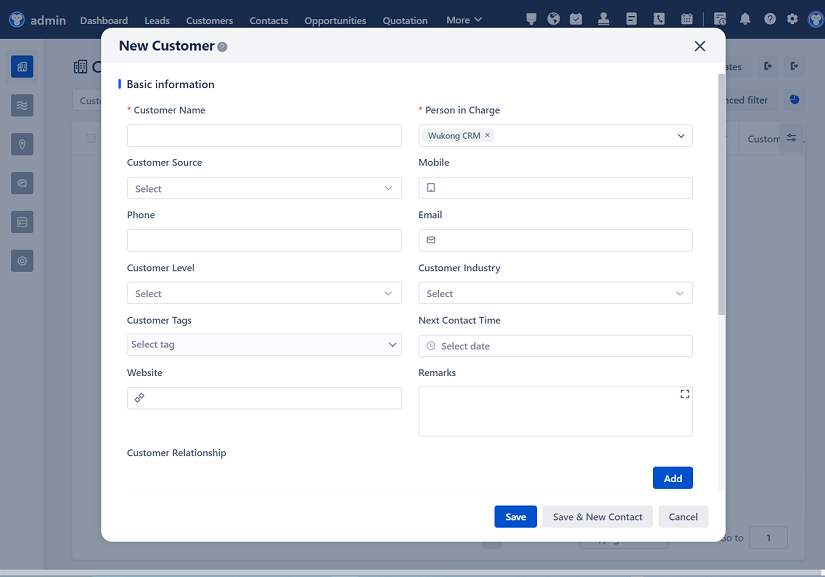
△Click on the top right corner to try Wukong CRM for free