
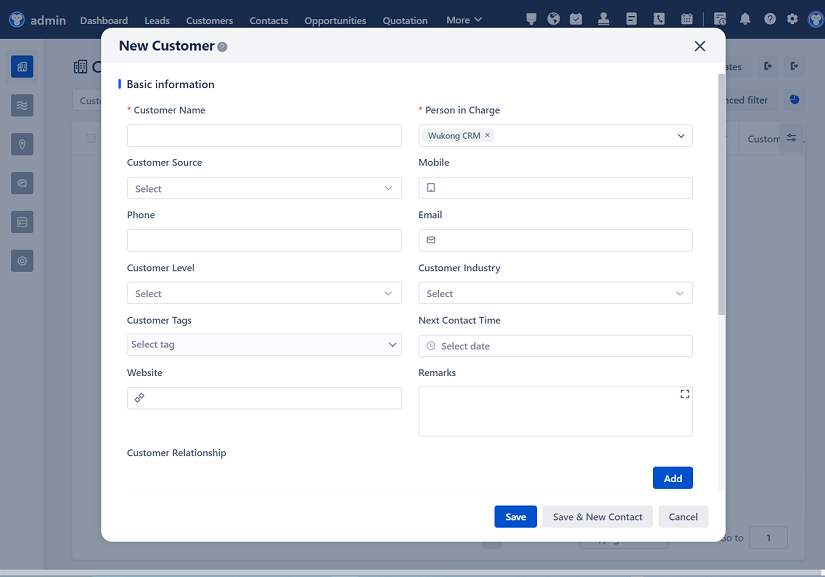
△Click on the top right corner to try Wukong CRM for free
So, you’re thinking about getting a CRM system for your business, right? I mean, who isn’t these days? Everyone’s talking about how it can help streamline sales, improve customer service, and basically make life easier. But here’s the thing—when you start looking into CRM systems, one of the first questions that pops up is: “How much is this actually going to cost me?” And honestly, that’s not a simple question to answer.
Let me tell you, the price range for CRM systems out there is all over the place. I’ve seen some basic ones go for as low as $10 per user per month, and then there are enterprise-level platforms that can run you thousands—yes, thousands—per month. It really depends on what you need, how big your team is, and what kind of features you want.
Free use of CRM system: Free CRM
I remember when I first started researching CRMs, I was totally overwhelmed. There were so many options, and each one had different pricing models. Some charge per user, some per month, some even have annual contracts with hidden fees. It felt like trying to navigate a maze blindfolded.
But after digging deeper, I realized there are actually a few key factors that influence the price. Let’s break them down, because once you understand these, it becomes way easier to figure out what you should be paying.
First off, the size of your business plays a huge role. If you’re a small startup with just five people, you probably don’t need a super complex system. You might be fine with something like HubSpot’s free version or Zoho CRM’s basic plan. These are usually affordable—sometimes even free—and they cover the essentials: contact management, lead tracking, maybe some email integration.
But if you’re running a mid-sized company with 50 employees, or you’re scaling fast, you’ll likely need more advanced features. Things like automation workflows, detailed reporting, integrations with other tools (like your email marketing platform or accounting software), and mobile access. And guess what? Those features come at a price. You’re probably looking at
Now, if you’re a large enterprise—say, hundreds of employees across multiple departments—you’re entering a whole different ballpark. Enterprise CRMs like Salesforce Sales Cloud Enterprise or Microsoft Dynamics 365 can easily cost $100+ per user per month. And that’s just the base price. Then you’ve got implementation costs, customization, training, and ongoing support. Suddenly, we’re talking tens of thousands of dollars a year.
Wait, did I mention customization? That’s another big factor. Some CRMs are pretty plug-and-play—you sign up, import your contacts, and you’re good to go. Others require serious setup. You might need developers to tweak the system, build custom fields, or connect it to your existing databases. That kind of work doesn’t come cheap. I’ve heard of companies spending months and tens of thousands just on implementation alone.
And speaking of integrations—this is something a lot of people overlook. Your CRM doesn’t exist in a vacuum. You want it to talk to your email, your calendar, your website forms, maybe even your ERP system. Each integration can add complexity and cost. Some CRMs include common integrations for free, but others charge extra for API access or third-party connectors. So yeah, that “$25 per user” plan might end up costing way more once you factor in all the tools you need to connect.
Another thing that affects price? The deployment model. Are you going cloud-based or on-premise? Most modern CRMs are cloud-based, which means you pay a subscription fee and access the system online. That’s usually cheaper upfront and easier to maintain. But some larger organizations still prefer on-premise solutions—where the software runs on their own servers. That gives them more control over data and security, but it also means higher initial costs for hardware, licensing, and IT staff to manage it.

Security and compliance are also part of the equation. If you’re in a regulated industry—like healthcare or finance—you might need a CRM that meets specific standards like HIPAA or GDPR. Not all CRMs offer that, and the ones that do often charge a premium. Plus, you might need additional security features like two-factor authentication, audit logs, or data encryption—all of which can bump up the price.

Then there’s scalability. A good CRM should grow with your business. But not all systems handle scaling the same way. Some charge more as you add users or features, while others offer tiered plans where you jump to a higher pricing bracket once you hit a certain threshold. That can be a surprise if you’re not careful. One minute you’re on a
Support and training matter too. When things go wrong—and trust me, they will—you want to know someone’s got your back. Basic plans often come with limited support, like email-only or community forums. But if you want phone support, dedicated account managers, or onboarding specialists, that usually costs extra. Same with training. Some vendors offer free webinars or tutorials, but personalized training sessions? Those can run several hundred dollars per hour.

Oh, and let’s not forget about add-ons. This is where vendors really make their money. You think you’re signing up for a
Now, here’s something interesting—not all CRMs are priced the same way. Some use a per-user model, others charge based on the number of contacts you store, and a few even offer flat-rate pricing regardless of size. For example, Insightly has a flat rate for small teams, while Pipedrive charges per user. So it really pays to read the fine print and understand exactly what you’re paying for.
And don’t assume that more expensive means better. I’ve used some high-end CRMs that were packed with features but so complicated that my team barely used half of them. On the flip side, I’ve seen small businesses thrive using simple, affordable tools like Capsule or Streak. It’s not about how much you spend—it’s about finding the right fit for your needs.
That said, you do get what you pay for in some cases. Free or low-cost CRMs often have limitations—like capped storage, fewer integrations, or no phone support. They’re great for startups testing the waters, but if you’re serious about scaling, you might outgrow them quickly.
Another thing to consider: long-term value. Sure, a
I’ve talked to business owners who regretted going with the cheapest option because it lacked critical features. One guy told me his team wasted hours every week manually exporting data because the CRM couldn’t generate the reports they needed. Another said their system crashed during a major campaign, costing them leads and credibility. So yeah, sometimes paying a bit more upfront saves you headaches—and money—down the road.

And let’s be real: sales tactics play a role too. Vendors love offering free trials, discounts for annual billing, or “limited-time” deals. It’s smart marketing, but it can make pricing feel misleading. That “
Finally, don’t forget about internal costs. Even if the CRM itself is affordable, you’ll need time and resources to set it up, train your team, and maintain it. If you don’t have an IT person, you might need to hire a consultant. And if your team resists using the new system, all that investment goes to waste. Change management is real, folks.
So, what’s the bottom line? CRM pricing varies wildly—from free to thousands per month—based on business size, features, deployment, support, and more. There’s no one-size-fits-all answer. The key is to assess your actual needs, compare options carefully, and think long-term.
Don’t just go for the cheapest or the fanciest. Look at what problems you’re trying to solve. Do you need better lead tracking? Improved customer communication? Deeper analytics? Once you know that, you can filter out the noise and find a CRM that delivers real value—at a price you can live with.
And hey, if you’re still unsure, start small. Try a free version, test it with a few team members, and scale up as you see results. That way, you’re not betting the farm on a system you haven’t fully tested.
At the end of the day, a CRM is a tool—a powerful one, but still just a tool. It won’t fix bad processes or magically boost sales. But if you choose wisely and use it well, it can make a huge difference in how you manage relationships and grow your business.
So take your time. Do your homework. Ask questions. And don’t be afraid to negotiate. Many vendors are willing to work with you on pricing, especially if you’re signing a long-term contract or bringing a large team onboard.
You’ve got this.
FAQs (Frequently Asked Questions):
Q: What’s the average cost of a CRM system?
A: Well, it really depends. For small businesses, you can find decent CRMs starting around
Q: Are there any truly free CRM systems?
Yeah, there are! HubSpot CRM, Zoho CRM, and Bitrix24 all offer free versions. They’re limited in features and user count, but they’re perfect for solopreneurs or very small teams just getting started.
Q: Why do some CRMs cost so much more than others?
Great question. Higher prices usually mean more advanced features—like automation, AI insights, deep integrations, and enterprise-grade security. You’re also paying for better support, scalability, and reliability.
Q: Can I negotiate the price with CRM vendors?
Absolutely. Especially if you’re buying for a large team or signing a multi-year contract. Don’t be shy—ask for a discount or added features. Many vendors expect it.
Q: Is it better to pay monthly or annually?
Most vendors offer a discount (usually 10–20%) if you pay annually. So if you’re confident in the CRM, going annual can save you money. But if you’re unsure, start with monthly to keep your options open.
Q: What hidden costs should I watch out for?
Look out for charges related to onboarding, customization, extra storage, premium support, and add-on modules. Also, check if there are fees for migrating data or canceling early.
Q: How do I know which CRM is right for my budget?
Start by listing your must-have features and team size. Then compare 3–5 options within your price range. Try free trials, read reviews, and talk to current users. Focus on value, not just cost.
Q: Can a CRM save me money in the long run?
Definitely—if it helps your team work faster, close more deals, and keep customers happy. Even a modest improvement in efficiency can offset the CRM’s cost many times over.
Related links:
Free trial of CRM
Understand CRM software
△Click on the top right corner to try Wukong CRM for free