
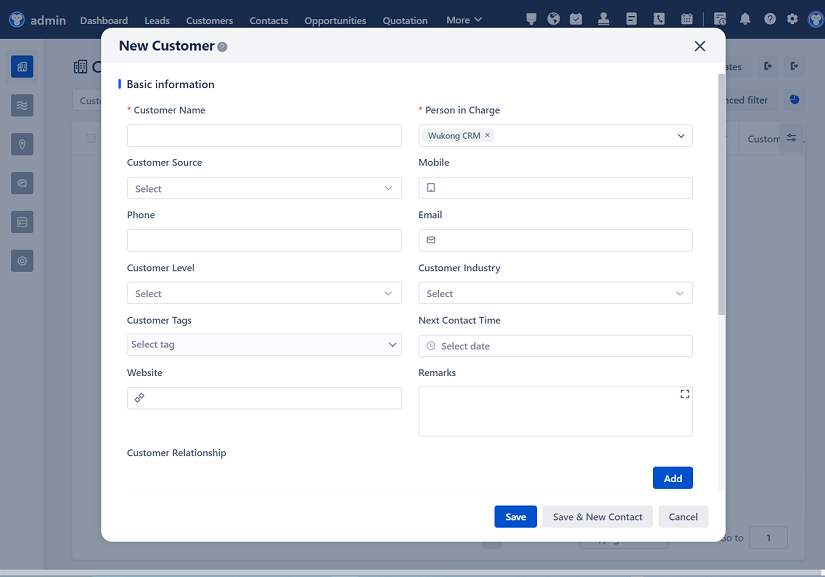
△Click on the top right corner to try Wukong CRM for free
So, you know, when we talk about customer relationship management—CRM for short—it’s not just about keeping a list of contacts or logging a few sales calls. Honestly, it’s way more than that. It’s about building real relationships, understanding what your customers want before they even say it, and making sure every interaction feels personal and meaningful. And in today’s digital world, especially in a place like China where everything moves so fast, having a solid CRM system isn’t just helpful—it’s essential.
Now, here’s the thing: Tencent has built this massive ecosystem. I mean, just think about it—WeChat, QQ, Tencent Meeting, WeCom (that’s WeChat Work), mini-programs, cloud services, payment systems… the list goes on. And the cool part? All of these tools are used by millions, even billions, of people every single day. So, if you’re a business trying to connect with customers in China, ignoring Tencent’s ecosystem would be like trying to swim upstream without a paddle.
Free use of CRM system: Free CRM

But here’s where it gets tricky. You can have the best CRM software in the world, but if it doesn’t talk to the tools your team and customers are actually using, it’s kind of useless. That’s why integrating CRM systems into Tencent’s ecosystem is such a big deal. It’s not just a tech upgrade—it’s a game-changer for how businesses operate.
Let me break it down. Imagine you’re a sales rep at a mid-sized company in Shenzhen. Your CRM tells you that Mr. Li from Guangzhou is interested in your new product. Great, right? But now, instead of switching between five different apps to follow up, you open WeCom, and boom—there’s Mr. Li’s profile, his past interactions, even notes from customer service—all pulled directly from your CRM. You send him a quick message through WeChat, maybe share a mini-program demo, and schedule a video call using Tencent Meeting. All of that happens without leaving the Tencent environment. That’s what I call seamless.

And it’s not just for sales. Think about marketing teams. They can use CRM data to segment audiences and then push personalized campaigns through WeChat Official Accounts. Or customer support—agents can pull up a user’s history the second they receive a message in WeCom, so they don’t have to ask, “Can you repeat your issue?” again and again. It saves time, reduces frustration, and honestly, makes the whole experience feel more human.
But how does this integration actually work? Well, Tencent has been smart about it. They’ve opened up APIs—application programming interfaces—for WeCom and other platforms. That means third-party CRM vendors, or even in-house developers, can connect their systems directly to Tencent’s tools. For example, Salesforce, Zoho, or local Chinese CRMs like Kingdee or Yonyou can sync data with WeCom in real time. So when a lead is updated in the CRM, it shows up instantly in the employee’s WeCom contact list.
And let’s not forget about data flow. One of the biggest headaches with CRM systems is data silos. You’ve got info stuck in email, in spreadsheets, in chat logs—nowhere. But when CRM is tied into Tencent’s ecosystem, every message, every call, every file shared in WeCom can be logged automatically into the CRM. No more manual entry. No more “I forgot to update that lead.” It just happens.
Now, I know what you’re thinking—“Isn’t that a privacy concern?” And yeah, you’re absolutely right to ask that. Tencent takes data security seriously, especially with all the regulations in China like the Personal Information Protection Law (PIPL). So when integrating CRM systems, companies have to make sure they’re compliant. That means getting user consent, encrypting data, and setting clear access controls. But honestly, if done right, the benefits far outweigh the risks.
Another thing people don’t always consider is employee adoption. You can have the fanciest CRM in the world, but if your team hates using it, it’s dead on arrival. But here’s the magic: because employees are already living in WeChat and WeCom every day, adding CRM features into those familiar tools makes adoption way easier. They don’t need training on a new interface. They just keep doing what they’re already doing—only now, it’s smarter and more connected.
Let me give you a real-world example. A retail chain in Chengdu was struggling with customer follow-ups. Sales teams were using personal WeChat accounts to chat with clients, which meant no tracking, no accountability, and zero data in their CRM. After integrating their CRM with WeCom, every conversation was logged automatically. Managers could see performance metrics, customers got faster responses, and sales went up by 30% in three months. Not bad, right?
And it’s not just big companies that benefit. Small businesses can use mini-programs linked to lightweight CRM tools to manage appointments, track orders, and send reminders—all within WeChat. A local bakery, for instance, can let customers book a cake through a mini-program, and the order details go straight into their CRM. No extra software, no complicated setup. Just simple, effective integration.
Of course, it’s not all smooth sailing. Integration can be complex, especially if you’re dealing with legacy systems or multiple data sources. You need a clear strategy, technical expertise, and sometimes, a bit of trial and error. But Tencent’s cloud services—Tencent Cloud—help a lot here. They offer integration platforms, data analytics tools, and even AI-powered chatbots that can work alongside CRM systems. So you’re not starting from scratch.
Another cool feature? Automation. Once your CRM is talking to WeCom, you can set up triggers. Like, when a lead reaches a certain score in the CRM, WeCom automatically assigns it to a sales rep and sends a notification. Or when a customer hasn’t engaged in 30 days, the system pushes a personalized WeChat message with a special offer. It’s like having a digital assistant that never sleeps.
And let’s talk about analytics. When CRM data is combined with Tencent’s user behavior data—like how often someone opens your mini-program or clicks your WeChat ads—you get a much clearer picture of your customers. You’re not just guessing what they like; you’re seeing it in real time. That helps with everything from product development to marketing strategy.
I should also mention that Tencent isn’t doing this alone. They’ve partnered with CRM vendors and system integrators to make the process smoother. There are pre-built connectors, templates, and support teams ready to help businesses plug in. So you don’t have to build everything from the ground up.

Now, looking ahead, I think we’re going to see even deeper integration. Imagine AI-powered CRM assistants inside WeCom that suggest the best time to follow up with a client, or analyze the tone of a chat message to flag potential dissatisfaction. Or using Tencent’s facial recognition and payment systems to create hyper-personalized in-store experiences that sync back to the CRM. The possibilities are pretty exciting.
At the end of the day, it’s all about making technology work for people—not the other way around. A CRM system shouldn’t feel like a burden. It should feel like a natural extension of how you communicate and build relationships. And in China, where WeChat is practically a second home for most people, integrating CRM into Tencent’s ecosystem just makes sense.
So if you’re a business operating in or targeting the Chinese market, and you’re not thinking about how your CRM connects with Tencent’s tools, you’re missing a huge opportunity. It’s not just about staying competitive—it’s about staying relevant.
And hey, if you’re still on the fence, start small. Try linking your CRM to WeCom for one team. See how it feels. Measure the results. Then scale from there. Because once you experience how much smoother everything runs, you’ll wonder why you didn’t do it sooner.
FAQs (Frequently Asked Questions):
Q: Can any CRM system integrate with Tencent’s ecosystem?
A: Most modern CRM platforms can integrate, especially if they support API connections. Popular ones like Salesforce, HubSpot, and local Chinese CRMs have established integration paths with WeCom and Tencent Cloud.
Q: Is it expensive to integrate CRM with Tencent’s tools?
A: It depends. Using pre-built connectors or working with certified partners can keep costs down. But custom development or large-scale rollouts may require more investment. Still, many companies find the ROI worth it.
Q: Do I need Tencent Cloud to integrate CRM with WeCom?
A: Not necessarily, but it helps. Tencent Cloud offers tools and infrastructure that make integration faster, more secure, and scalable, especially for complex setups.
Q: Can I integrate CRM with personal WeChat accounts?
A: Not directly, and it’s not recommended for business use. WeCom (Enterprise WeChat) is designed for official business communication and supports full CRM integration.
Q: How secure is CRM data when integrated with Tencent’s ecosystem?
A: Tencent follows strict data protection standards and complies with Chinese regulations like PIPL. However, businesses must also implement their own security policies and access controls.
Q: Will my team need training to use CRM inside WeCom?
A: Usually not much. Since WeCom’s interface is similar to personal WeChat, most employees adapt quickly. The CRM features are embedded naturally into their daily workflow.
Q: Can I automate marketing campaigns using CRM and WeChat?
A: Absolutely. You can sync customer segments from CRM to WeChat Official Accounts or mini-programs and trigger automated messages, promotions, or surveys.
Q: What if my CRM vendor doesn’t have a direct integration with Tencent?
A: You can still build a custom integration using Tencent’s open APIs, or work with a third-party integration platform that supports both systems.
Q: Does integration work for international businesses targeting China?
A: Yes, and it’s often essential. Understanding and using Tencent’s ecosystem is key to engaging Chinese customers effectively.
Q: How do I get started with CRM integration in Tencent’s ecosystem?
A: Start by evaluating your current CRM, check for existing connectors, consult with Tencent or a certified partner, and pilot the integration with a small team before going company-wide.
Related links:
Free trial of CRM
Understand CRM software
△Click on the top right corner to try Wukong CRM for free