
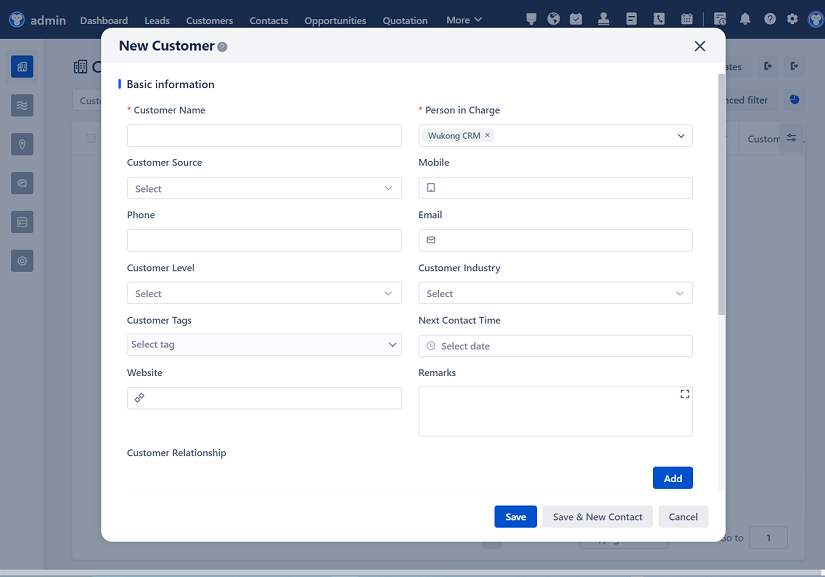
△Click on the top right corner to try Wukong CRM for free
So, you’re trying to figure out how to build a CRM system and you’ve been searching for real examples and learning resources that actually make sense—right? I totally get it. When I first started diving into CRM development, I felt completely overwhelmed. There were so many tools, frameworks, and tutorials out there, but most of them either assumed I already knew everything or they were way too basic. Honestly, what I really needed was something practical—actual source code examples I could look at, tweak, and learn from.
That’s why I decided to put together this guide based on my own journey. I want to share the stuff that actually helped me, not just the textbook definitions or overly polished demos. Let’s be real—nobody learns by staring at perfect sample apps that don’t reflect real-world problems. What helps is seeing messy, working code with comments, understanding how different parts connect, and knowing where to go when things break.
Free use of CRM system: Free CRM
First off, let’s talk about what kind of CRM we’re even talking about. Are we building a simple contact manager for a small business? Or are we aiming for something more advanced, like sales pipeline tracking, customer support tickets, and integration with email marketing tools? The scope matters because it changes what kind of code examples you should be looking at.
For beginners, I’d recommend starting with open-source CRM projects on GitHub. Yeah, I know—GitHub can feel intimidating at first. But trust me, once you get used to browsing repositories, it becomes your best friend. One project I found super helpful early on was called “Odoo.” Now, Odoo isn’t just a CRM—it’s a whole suite of business apps—but their CRM module is open source and well-documented. I spent a weekend just going through their code, setting up a local instance, and poking around. It wasn’t easy, but I learned so much about how models, views, and controllers interact in a real application.
Another great one is “SuiteCRM.” It’s actually a fork of SugarCRM’s open-source version, and it’s still actively maintained. What I liked about SuiteCRM was how modular it was. You could see how different features—like leads, contacts, accounts, and opportunities—were structured in the database and how the UI tied into those backend models. Plus, since it’s built with PHP and uses a framework similar to Laravel (though it’s actually based on a custom MVC structure), it gave me a solid reference point when I later started building my own PHP-based CRM.
But here’s the thing—not everyone wants to dive into a full-blown enterprise CRM right away. If you’re just starting out, maybe you’d benefit more from smaller, focused examples. That’s where platforms like GitHub Gists or CodePen come in handy. I remember finding a simple Node.js + Express + MongoDB CRM example that had just three endpoints: add a customer, list all customers, and update a customer. It was barebones, sure, but it helped me understand REST APIs in a concrete way. I copied the code, ran it locally, broke it on purpose, then fixed it. That kind of hands-on messing around is where real learning happens.
And speaking of tech stacks—what are you planning to use? Because the best learning resources depend heavily on whether you’re going with Python, JavaScript, Ruby, or something else. For example, if you’re into Python, Django has some excellent CRM tutorials. There’s this one step-by-step guide I followed where they build a CRM using Django Admin as the base and then customize it. It showed how to create models for clients, interactions, and tasks, and how to use Django’s built-in authentication and permissions. What made it click for me was seeing how little code you actually need when you leverage the framework properly.
On the frontend side, React has become super popular for CRM dashboards. I played around with a few starter templates on GitHub that combined React with Firebase for backend storage. One in particular had a clean UI with tabs for customers, activities, and reports. The source code was well-commented, and it used modern hooks like useState and useEffect. I took that template and started adding features—first a search bar, then data export to CSV. Each time I added something, I had to dig into how state was managed and how components communicated. It wasn’t always smooth, but every bug taught me something new.
Now, let’s not forget about databases. A CRM lives and dies by its data structure. When I was designing my first CRM, I kept making the mistake of overcomplicating the schema. I wanted to track everything—calls, emails, social media interactions, meeting notes—and ended up with 15 tables before writing a single line of frontend code. Big mistake. What helped me simplify was looking at existing ER diagrams from open-source CRMs. Seeing how SuiteCRM normalized their data across contacts, accounts, and campaigns gave me a blueprint. I realized I didn’t need perfection on day one—I just needed a solid foundation that could grow.
One resource I wish I’d found earlier is freeCodeCamp’s YouTube channel. They have a full-length video tutorial where someone builds a CRM from scratch using MERN stack (MongoDB, Express, React, Node.js). The instructor explains each step clearly, doesn’t rush, and actually talks through their thought process. Watching that video while coding along was probably the single most effective learning experience I had. It wasn’t flashy, but it was thorough—and that’s what matters when you’re trying to internalize concepts.

Of course, no discussion about learning resources would be complete without mentioning documentation. I know, I know—reading docs sounds boring. But hear me out: the official documentation for frameworks like Django, Laravel, or Rails often includes CRM-like examples. For instance, Laravel’s documentation walks you through building a task management app, which is basically a lightweight CRM if you swap “tasks” for “customer follow-ups.” These aren’t full CRMs, but they teach the patterns you’ll use again and again.
Another thing I’ve learned is that joining developer communities can be a game-changer. Reddit’s r/webdev, Stack Overflow, and even Discord servers for specific frameworks are full of people who’ve built CRMs or parts of them. I asked a question once about handling duplicate customer entries, and someone shared a snippet of Python code using fuzzy matching with the difflib library. I never would’ve thought of that approach on my own.
Let’s also talk about deployment. It’s one thing to build a CRM locally, but getting it online is another beast. I messed up my first few deployments—forgot environment variables, misconfigured databases, exposed admin panels. What saved me was following DevOps-focused tutorials that included CI/CD pipelines and Docker setups. There’s a GitHub repo I now use as a template—it has a docker-compose.yml file that spins up the app, database, and Nginx proxy with HTTPS. Having that ready-to-go setup lets me focus on the CRM logic instead of server config hell.
Testing is another area where real-world code examples help. Early on, I skipped writing tests because I thought they were just extra work. Then I made a small change that accidentally deleted all customer notes. That hurt. After that, I started studying how open-source projects write unit and integration tests. I borrowed test structures from Odoo and adapted them to my own app. Now, I run tests every time I push code, and it’s caught dozens of bugs before they reached users.
If you’re serious about learning, I also recommend reverse-engineering live CRM tools. Pick a SaaS CRM like HubSpot or Zoho, sign up for a free account, and think about how you’d build it. What APIs would you need? How would you structure the database? Try sketching out a simplified version on paper first, then in code. This kind of mental modeling strengthens your architectural thinking.
And don’t underestimate books. Yeah, they’re not as trendy as YouTube videos, but a good book like “Full-Stack React Projects” or “Django 4 By Example” gives you a structured path. I read through the CRM chapter in “Django 4 By Example” twice—once to follow along, once to build it from memory. That second pass revealed all the gaps in my understanding.
Finally, here’s a pro tip: keep a personal repository where you collect snippets, ideas, and mini-projects related to CRM development. I call mine “crm-playground,” and it’s filled with failed experiments, working prototypes, and notes. Whenever I start a new CRM project, I go back and see what I’ve learned before. It’s like having a conversation with my past self.
Look, building a CRM isn’t easy. It involves frontend, backend, database design, user experience, security, and more. But the good news is, you don’t have to invent everything from scratch. There are tons of real-world examples and learning resources out there—you just need to know where to look and how to use them effectively. Start small, learn by doing, break things, fix them, and keep going. That’s how you get better.

FAQs (Frequently Asked Questions)
Q: Where can I find free CRM source code to study?
A: GitHub is your best bet. Search for terms like “open source CRM,” “simple CRM Node.js,” or “Django CRM example.” Projects like SuiteCRM, Odoo, and Vtiger have public repositories you can explore.
Q: Is it legal to use open-source CRM code for my own project?
A: Yes, but check the license. Most open-source CRMs use licenses like GPL or MIT, which allow reuse but may require you to share modifications or include attribution.
Q: What’s the easiest tech stack for building a beginner CRM?
A: I’d say MERN (MongoDB, Express, React, Node.js) or Django with SQLite. Both have great documentation and lots of tutorials tailored for beginners.
Q: How do I handle user authentication in a CRM?
A: Use established libraries—like Passport.js for Node or Django Allauth for Python. Don’t roll your own auth system; it’s risky and time-consuming.

Q: Can I build a CRM without knowing JavaScript?
A: Technically yes, if you stick to backend-only tools or use low-code platforms. But for full control and customization, JavaScript (or a frontend framework) is pretty essential these days.
Q: How important is database design in a CRM?
A: Extremely. A poorly designed database will slow you down later. Spend time mapping out entities like customers, contacts, deals, and activities before coding.
Q: Should I use a framework or build from scratch?
A: Use a framework—especially when learning. Frameworks handle common tasks (routing, security, ORM) so you can focus on CRM-specific logic.
Q: What are some common mistakes when building a CRM?
A: Over-engineering early, ignoring mobile responsiveness, skipping testing, and not planning for data import/export. Start simple and iterate.
Q: How can I practice CRM development without a real client?
A: Build a fake company CRM for a fictional business. Add features like lead tracking, follow-up reminders, and reporting. Treat it like a real project.
Q: Are there any free courses specifically on CRM development?
A: Not many full courses, but freeCodeCamp and The Net Ninja on YouTube have relevant tutorials. Also, check Coursera or edX for business software design courses.
Related links:
Free trial of CRM
Understand CRM software
△Click on the top right corner to try Wukong CRM for free