
△Click on the top right corner to try Wukong CRM for free
So, let me tell you something — if you're building or managing a CRM system, the database design is kind of a big deal. I mean, it’s not just about storing names and emails, right? It’s about making sure your sales team can actually find what they need, your marketing campaigns don’t go off the rails, and your customer service folks aren’t pulling their hair out trying to track down a simple support ticket. Honestly, a poorly designed CRM database can turn your whole operation into a mess.

Free use of CRM system: Free CRM
Let me start by saying this — you’ve got to know your business goals before you even open up that database tool. Like, what are you actually trying to do with your CRM? Are you focused on sales automation? Customer retention? Lead tracking? Because if you don’t answer that first, you’re basically building a house without a blueprint. And trust me, that never ends well.
Once you’ve got a clear idea of your goals, think about the data you actually need. Don’t just throw in every single field you can think of. I’ve seen teams add 50 custom fields just because “we might need them someday.” Spoiler alert: you probably won’t. And guess what? That just slows everything down and makes the system harder to use. Keep it simple. Start with the essentials — name, contact info, company, role, communication history, maybe a few custom fields that really matter to your workflow.
Now, here’s something people often overlook — data normalization. Yeah, I know, it sounds like a techy term, but it’s actually pretty straightforward. It just means organizing your data so you’re not repeating the same info in multiple places. For example, if you have a customer named “Acme Corp” showing up 20 times with slightly different spellings, that’s a problem. So, create a separate table for accounts or companies, link it properly, and make sure each piece of data lives in one place. That way, when someone updates the company address, it updates everywhere — no more outdated info floating around.
And speaking of linking things — relationships matter. A CRM isn’t just a list; it’s a web of connections. Contacts belong to accounts. Opportunities are tied to contacts. Activities are linked to both. So, when you’re designing your database, use foreign keys to connect these tables properly. It might seem like overkill at first, but believe me, when your sales manager wants to see all deals associated with a specific client, you’ll be glad you did it right.

Oh, and indexes — don’t forget about those. I know they sound boring, but they’re like shortcuts for your database. Without them, searching for a customer by email could take forever, especially as your data grows. So, put indexes on fields you search or filter by often — things like email, phone number, account name, or status. It’s a small thing, but it makes a huge difference in performance.
Let’s talk about scalability for a second. You might be a small team now, but what if you grow? What if you double your customer base in a year? Your database should be able to handle that without breaking a sweat. That means avoiding things like storing large blobs of text in main tables or using inefficient data types. Use appropriate field sizes — don’t make every text field a VARCHAR(5000) if 255 is enough. And consider partitioning large tables if you expect them to get really big.
Security is another thing you can’t ignore. I mean, your CRM holds sensitive customer data — emails, phone numbers, maybe even financial info. So, you’ve got to protect it. Start with role-based access control. Not everyone needs to see everything. Your intern doesn’t need access to contract values, right? Set up user roles and permissions so people only see what they need to do their job.
Also, encrypt sensitive data — especially if you’re storing anything like credit card info or personal IDs. And make sure you’re backing up your database regularly. I can’t tell you how many companies I’ve seen lose weeks of data because they didn’t have a solid backup plan. Set up automated backups, test them once in a while, and store them in a secure, offsite location.
Now, here’s a tip that’s often forgotten — version control for your database schema. Yeah, I said it. Just like you version your code, you should track changes to your database structure. Use migration scripts, document what changed and why, and keep everything in a repo. That way, if something goes wrong, you can roll back without panicking.
Data quality? Super important. Garbage in, garbage out — you’ve probably heard that before. So, build in validation rules from the start. Make sure email fields actually contain valid emails. Prevent duplicates by setting up unique constraints. Use dropdowns instead of free text where possible — it keeps things consistent. And consider setting up data cleansing routines to clean up old or incomplete records periodically.
Let’s not forget about integration. Your CRM probably doesn’t live in a vacuum. It needs to talk to your email system, your marketing automation tool, maybe your ERP or billing software. So, design your database with APIs in mind. Use standard formats, keep your data structured, and avoid hardcoding values that might break integrations later.
And speaking of structure — think about how users will interact with the data. Your sales reps aren’t database experts. They want things to be fast and intuitive. So, design your tables and views so that the most important info is easy to find. Use views or materialized queries to pre-join commonly used data, so they’re not waiting forever for reports to load.
Customization is great, but there’s a limit. I’ve seen teams go wild with custom objects and fields, and then six months later, no one remembers what half of them are for. So, before you add something new, ask: “Is this actually useful? Will people use it?” If the answer’s no, skip it. Keep your database lean and focused.
Another thing — audit trails. You want to know who changed what and when, right? Especially if there’s a dispute or compliance issue. So, build in logging for key actions. Track when a deal stage changes, when a contact is updated, when a task is completed. It doesn’t have to be super complex — just a simple table that logs user, timestamp, action, and old vs. new values.
Performance tuning is an ongoing thing, not a one-time job. As your data grows, you’ll need to revisit your indexes, optimize slow queries, maybe archive old records. Set up monitoring so you can catch issues before they become problems. And don’t be afraid to refactor — if a table design isn’t working, change it. Better late than never.
Oh, and naming conventions — please, please use consistent ones. I’ve opened databases where one table is called “cust_info,” another is “CustomerData,” and a third is “tblClient.” It’s a nightmare. Pick a style — like snake_case or PascalCase — and stick to it. Name your tables and fields clearly so anyone can understand what they are without guessing.
Documentation matters too. I know it’s boring, but write down your schema, your relationships, your business rules. Future you — or the new developer who joins the team — will thank you. A simple data dictionary can save hours of confusion.
And finally, involve the end users early. Talk to your sales team, your support staff, your marketing people. Ask them what they need, what’s frustrating them, what would make their lives easier. A CRM should serve them, not the other way around. So, get feedback, test prototypes, and iterate. It’s way better than building something in isolation and then wondering why nobody uses it.
Look, designing a CRM database isn’t just a technical task — it’s a mix of strategy, empathy, and practicality. You’re not just storing data; you’re building a tool that shapes how your team works every single day. So, take your time. Do it right. And remember — simplicity, clarity, and usability should always come first.
FAQs (Frequently Anticipated Questions):
Q: Should I use a NoSQL database for my CRM instead of a relational one?
A: Honestly, it depends. If you need flexible schemas and are dealing with unstructured data, NoSQL might work. But for most CRMs, relational databases are better because of their strong support for relationships, transactions, and reporting. Stick with SQL unless you have a very specific reason not to.
Q: How do I prevent duplicate records in my CRM?
A: Great question. Use unique constraints on key fields like email or company name. Also, set up deduplication rules in your CRM software, and consider using matching algorithms during data imports. And train your team to search before creating new records!
Q: What’s the best way to handle historical data in a CRM?
A: You’ve got a few options. You can use audit tables to track changes, or add timestamps and status flags to show when records were active. For really old data, consider archiving it to a separate table or system to keep your main database fast.
Q: Can I modify the database schema after the CRM is live?
A: Yes, but be careful. Always back up first, test changes in a staging environment, and use migration scripts. Sudden changes can break integrations or reports, so plan ahead and communicate with your team.
Q: How often should I clean my CRM database?
A: I’d say at least every quarter. Run checks for duplicates, outdated contacts, incomplete records, and inactive accounts. Clean data means better insights and happier users.

Q: Is it okay to store files like contracts or PDFs in the CRM database?
A: Technically yes, but it’s usually not the best idea. Large files can slow down your database. Instead, store them in a file system or cloud storage (like S3 or SharePoint) and just keep the links in your CRM.
Q: What if my team keeps entering bad data?
A: First, make data entry easier with dropdowns, auto-fill, and validation. Then, provide training and set clear expectations. You can also assign data ownership — like having sales reps responsible for their own contacts — to encourage accountability.
Q: How do I know if my CRM database is performing well?
A: Watch for slow page loads, timeouts, or laggy reports. Use monitoring tools to check query performance, index usage, and server load. If things feel sluggish, it’s time to optimize.
Related links:
Free trial of CRM
Understand CRM software
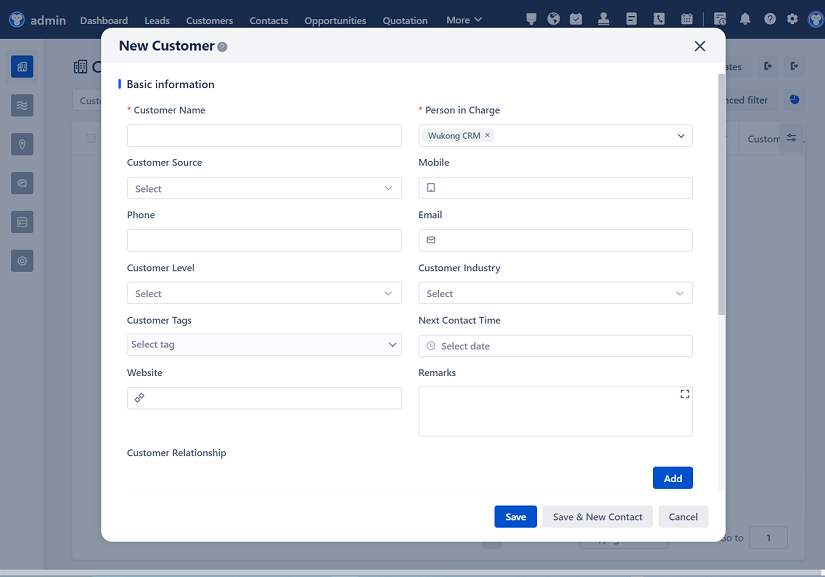
△Click on the top right corner to try Wukong CRM for free