
△Click on the top right corner to try Wukong CRM for free
You know, when I first started learning about CRM systems, I thought they were just fancy contact lists—like digital Rolodexes with a few extra bells and whistles. But the more I dug into it, the more I realized how wrong I was. Modern CRM systems are way more than that—they’re powerful tools that shape how businesses interact with customers, manage relationships, and even predict future behavior. And honestly, if you want to understand what makes them tick, you’ve got to look at their design principles and architecture.
So let me walk you through this like we’re having a coffee chat. Imagine you're building a CRM from scratch. Where would you even start? Well, first things first—you’d need some solid design principles. These aren’t just random ideas; they’re the foundation of everything. One of the big ones is user-centric design. Think about it: who’s actually using the CRM every day? Sales reps, customer service agents, marketing teams. If the system isn’t intuitive for them, they’ll either avoid it or make mistakes. So the interface has to be clean, logical, and easy to navigate. No one wants to click through five menus just to update a customer note.
Free use of CRM system: Free CRM
Then there’s scalability. You don’t want your CRM falling apart when your company grows from 50 to 5,000 customers. It needs to handle increasing loads without slowing down or crashing. That means designing it with modular components and efficient data handling. Oh, and integration! Can’t forget that. A CRM doesn’t live in a vacuum. It has to talk to email platforms, social media, ERP systems, maybe even your accounting software. So interoperability is key. APIs—those little bridges between systems—are absolutely essential.
Security is another huge deal. I mean, you’re storing sensitive customer data—names, emails, purchase history, sometimes even payment info. If that gets leaked, not only do you lose trust, but you could face legal trouble too. So encryption, role-based access control, regular audits—these aren’t optional extras. They’re must-haves.
Now, let’s talk about architecture. This is where things get a bit technical, but stick with me. Most modern CRMs use a layered architecture. Picture it like a sandwich. On the bottom, you’ve got the data layer—the database where all the customer info lives. Then above that, the business logic layer, which handles rules and workflows. Like, “If a lead hasn’t been contacted in 7 days, send a reminder.” And on top, the presentation layer—that’s what users see on their screens.
But here’s the cool part: many CRMs today are cloud-based. That means instead of installing software on each computer, everything runs on remote servers. You just log in through a browser. It’s way more flexible, easier to update, and usually cheaper to maintain. Plus, your team can access it from anywhere—super helpful if people are working remotely.

And speaking of flexibility, microservices architecture is becoming super popular. Instead of one giant monolithic program, the CRM is broken into smaller, independent services. One handles leads, another manages support tickets, another deals with analytics. Each can be updated or scaled separately. So if your marketing team suddenly needs more power during a campaign, you don’t have to touch the sales module. Pretty smart, right?
Oh, and real-time processing! That’s a game-changer. Customers expect quick responses these days. If someone fills out a form on your website, you don’t want that lead sitting in a queue for hours. Modern CRMs use event-driven architectures to trigger actions instantly—like sending a welcome email or assigning a rep—without anyone manually clicking buttons.
Let’s not overlook customization. Every business is different. A small e-commerce shop doesn’t need the same features as a multinational bank. So good CRM systems let you tweak workflows, add custom fields, create personalized dashboards. Some even offer low-code or no-code tools so non-tech folks can build automations themselves. That’s empowering.
Data consistency is another thing I’ve come to appreciate. Imagine two salespeople updating the same customer record at the same time. Without proper concurrency control, you could end up with conflicting info. So CRMs use techniques like optimistic locking or versioning to keep everything in sync. It’s like having a referee making sure everyone plays fair.
Analytics and AI are also baked into modern CRMs now. It’s not just about storing data—it’s about making sense of it. Predictive lead scoring, sentiment analysis on customer emails, churn prediction models—these aren’t sci-fi anymore. They’re standard features. And they help teams focus on what really matters instead of guessing.

But here’s something people don’t always think about: performance. A slow CRM is a frustrating CRM. Nobody likes waiting three seconds for a page to load. So developers optimize queries, use caching, and sometimes even pre-load data based on user behavior. It’s all about reducing friction.
And deployment models matter too. While most companies go with SaaS (Software as a Service), some still prefer on-premise solutions—especially in industries with strict data regulations. Others use hybrid models, keeping sensitive data in-house while using cloud tools for less critical functions. There’s no one-size-fits-all.
User adoption is a sneaky challenge. Even the best-designed CRM fails if people don’t use it. That’s why training, change management, and ongoing support are so important. It’s not enough to just install the software—you’ve got to get buy-in from the team. Show them how it makes their lives easier, not harder.
Mobile access is another big factor. Salespeople are on the road, customer service agents might be working from home—everyone needs access on their phones or tablets. So responsive design and dedicated mobile apps are crucial. Being able to update a deal or check a customer’s history from your phone? That’s productivity gold.
Let’s talk about data quality. Garbage in, garbage out, right? If your CRM is full of outdated emails or duplicate entries, it’s not helping anyone. That’s why modern systems include data cleansing tools, deduplication features, and validation rules. Some even use AI to suggest corrections or flag inconsistencies.
Workflow automation is another favorite feature of mine. How many times have you seen tasks fall through the cracks because someone forgot to follow up? With automation, you can set up triggers and actions—like automatically assigning a ticket when a new complaint comes in, or sending a survey after a support call. It reduces human error and saves time.
Integration with communication channels is also huge. Your CRM should connect with email, phone systems, live chat, social media—even SMS. That way, every interaction gets logged automatically. No more “Did I already reply to that email?” moments.

Personalization is expected now. Customers don’t want generic messages. They want to feel understood. So CRMs help track preferences, past purchases, communication history—all so you can tailor your outreach. And with segmentation tools, you can group customers by behavior, location, or value, then target them with relevant offers.
One thing I’ve noticed is that modern CRMs are shifting from being just operational tools to strategic assets. They’re not just for logging calls anymore—they’re used for forecasting, planning, and decision-making. Executives rely on CRM dashboards to spot trends, measure performance, and adjust strategies in real time.
And let’s not forget about compliance. With laws like GDPR and CCPA, you can’t just collect and store data willy-nilly. CRMs need built-in tools to manage consent, handle data deletion requests, and audit access logs. It’s not glamorous, but it’s necessary.
Looking ahead, I think AI will play an even bigger role. Imagine a CRM that listens to sales calls, summarizes them, and suggests next steps—all automatically. Or one that predicts which customers are most likely to upgrade and recommends the perfect offer. We’re already seeing glimpses of that, and it’s exciting.
But with all these features, complexity can become a problem. That’s why simplicity in design is so important. Just because you can add ten different modules doesn’t mean you should. The best CRMs balance power with usability.
Another trend I’m watching is open ecosystems. Instead of locking you into one vendor’s tools, modern CRMs encourage third-party integrations through marketplaces. Need a better email marketing tool? Plug it in. Want advanced reporting? Add it seamlessly. It gives businesses freedom to choose what works best.
Finally, feedback loops. The best CRMs learn from usage. They collect input from users, monitor performance, and evolve over time. It’s not a “set it and forget it” tool—it’s a living system that improves with use.
So yeah, designing a modern CRM isn’t just about coding and databases. It’s about understanding people—both the users and the customers. It’s about balancing functionality with ease of use, security with accessibility, innovation with reliability. When done right, a CRM becomes the central nervous system of a business, connecting departments, streamlining processes, and ultimately helping build stronger customer relationships.
It’s kind of amazing when you think about it. What started as a simple address book has turned into an intelligent, interconnected platform that drives growth and loyalty. And as technology keeps evolving, I can’t wait to see what’s next.
FAQs (Frequently Asked Questions):
Q: What exactly is a CRM system?
A: A CRM—Customer Relationship Management—system is a software tool that helps businesses manage interactions with current and potential customers. It stores customer data, tracks communications, automates tasks, and provides insights to improve relationships and drive sales.
Q: Why is user-centric design so important in CRM?
A: Because if the people using the CRM find it confusing or frustrating, they won’t use it properly—or at all. A user-friendly interface increases adoption, reduces errors, and makes daily tasks faster and more efficient.
Q: Are cloud-based CRMs better than on-premise ones?
A: It depends. Cloud CRMs are usually easier to deploy, update, and scale, and they allow remote access. But some organizations prefer on-premise for greater control over data and security, especially in regulated industries.
Q: How do modern CRMs handle data security?
A: They use encryption (both in transit and at rest), multi-factor authentication, role-based permissions, audit trails, and regular security updates. Many also comply with standards like GDPR, HIPAA, or SOC 2.

Q: Can small businesses benefit from modern CRMs?
A: Absolutely! Many CRM platforms offer affordable, scalable plans tailored for small businesses. Even basic versions can help organize contacts, automate follow-ups, and improve customer service.
Q: What role does AI play in CRM systems today?
A: AI helps with predictive analytics (like lead scoring), chatbots for customer service, sentiment analysis, automated data entry, and personalized marketing recommendations. It makes CRMs smarter and more proactive.
Q: How do CRMs integrate with other business tools?
A: Through APIs (Application Programming Interfaces) and pre-built connectors. This allows seamless data flow between CRM and tools like email, calendars, marketing platforms, e-commerce sites, and ERP systems.
Q: Is data migration difficult when switching to a new CRM?
A: It can be, but many CRM providers offer migration tools and support. The key is cleaning your existing data first—removing duplicates and outdated info—to ensure a smooth transition.
Q: Can a CRM really improve customer satisfaction?
A: Yes! By giving teams a complete view of each customer, CRMs help deliver faster, more personalized service. When customers feel understood and valued, satisfaction and loyalty go up.
Q: What should I look for when choosing a CRM?
A: Consider ease of use, scalability, integration options, mobile access, customization, security features, and customer support. Most importantly, pick one that fits your specific business needs and workflows.
Related links:
Free trial of CRM
Understand CRM software
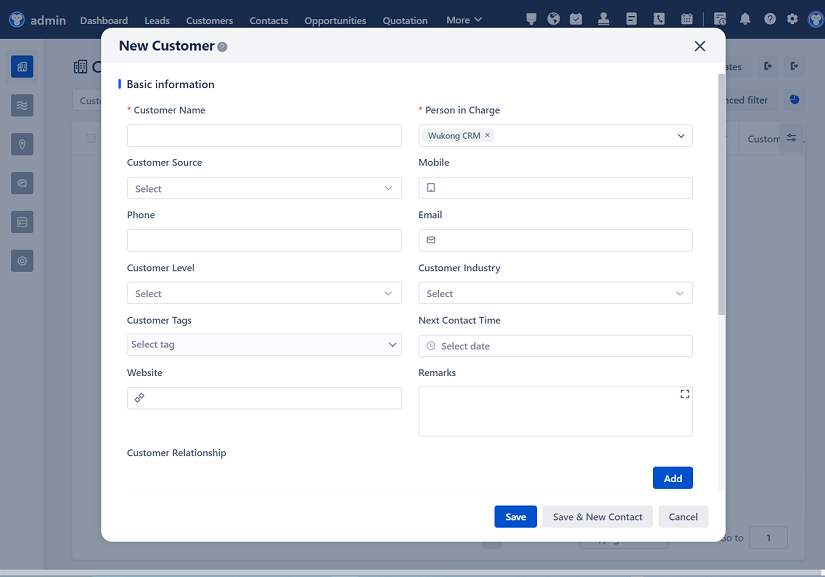
△Click on the top right corner to try Wukong CRM for free