
△Click on the top right corner to try Wukong CRM for free
So, you know, when people talk about CRM systems—Customer Relationship Management—they’re usually thinking about some fancy software that helps companies keep track of their customers. But honestly, it’s way more than just a digital address book. I mean, sure, it stores contact info, but the real magic happens in how all the pieces work together to make businesses smarter and more connected with their customers.

Free use of CRM system: Free CRM
Let me break it down for you—CRM systems aren’t just one big chunk of code. They’re actually made up of several key components that each play a specific role. Think of it like building a house: you’ve got the foundation, the walls, the roof, the plumbing—all working together so you can actually live in it comfortably. A CRM is kind of like that. It needs different parts to function properly.
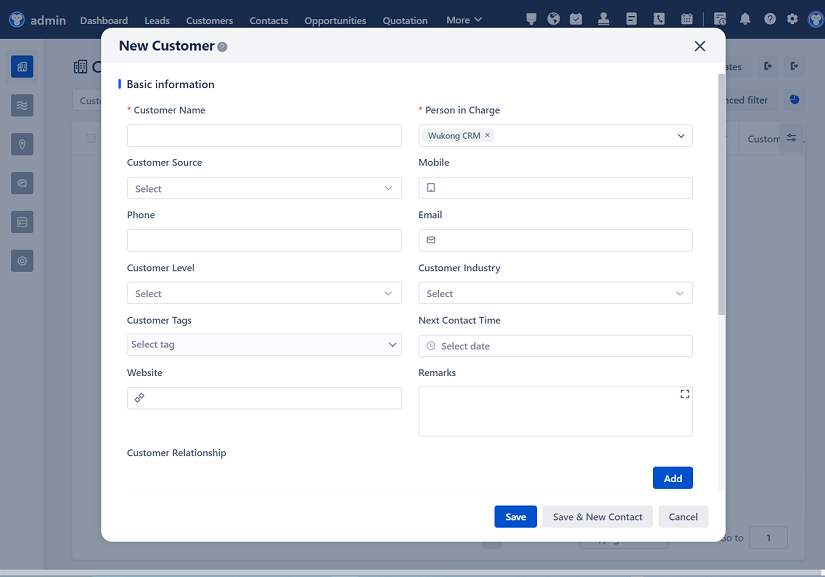
First off, there’s the contact management module. This is probably the most basic part, but don’t underestimate it. It’s where all your customer data lives—names, emails, phone numbers, job titles, company info, even notes from past conversations. Honestly, without this, the whole system would fall apart. It’s like the backbone. And the cool thing? Most modern CRMs let you import contacts from email, social media, or even scanned business cards. So it’s not just manual entry anymore.
Then you’ve got the sales force automation (SFA) component. Now, this is where things start getting exciting for sales teams. Imagine being able to track every lead, every call, every meeting, and every deal stage—all in one place. That’s what SFA does. It helps sales reps manage their pipelines, set follow-up reminders, and even forecast revenue based on current deals. I’ve seen teams go from chaotic spreadsheets to super organized workflows just by using this feature. It’s a game-changer.
But wait—what about marketing? Yeah, CRM systems have a marketing automation piece too. This part lets companies run targeted campaigns, track email open rates, segment audiences, and measure ROI. For example, if you’re launching a new product, you can use the CRM to send personalized emails to specific customer groups and then see who clicked, who opened, and who converted. It’s like having a personal assistant who also happens to be really good at analytics.

And then there’s customer service and support. This module is all about helping companies respond faster and smarter to customer inquiries. Whether it’s through phone, email, chat, or social media, the CRM logs every interaction. So if a customer calls in with an issue, the agent can pull up their entire history instantly—no more “Can you repeat that?” moments. Plus, many CRMs now include ticketing systems, knowledge bases, and even AI-powered chatbots. It makes support feel seamless, which customers totally appreciate.
Now, here’s something people often overlook—the analytics and reporting engine. This isn’t just about pretty charts; it’s about turning raw data into real insights. You can generate reports on sales performance, customer satisfaction, campaign effectiveness—you name it. And because everything’s integrated, the data is accurate and up-to-date. I remember talking to a manager once who said they cut their monthly reporting time from three days to just two hours after switching to a proper CRM. That’s huge.
Oh, and we can’t forget integration capabilities. A CRM doesn’t live in a vacuum. It has to connect with other tools—like email platforms, calendars, ERP systems, e-commerce sites, and even accounting software. Most modern CRMs offer APIs or pre-built connectors so data flows smoothly between systems. Otherwise, you’d end up with silos again, and nobody wants that. Trust me, I’ve seen it happen.
So, those are the main components. But how do they all fit together? That’s where architecture comes in. Let’s talk about that.
Most CRM systems today are built on a client-server model, especially the cloud-based ones. The client side is what users interact with—the web browser or mobile app. The server side handles data storage, processing, and security. It’s kind of like ordering food online: you pick what you want on your phone (client), and the kitchen (server) prepares and delivers it.
And speaking of cloud-based—yeah, that’s the norm now. Instead of installing bulky software on every computer, companies subscribe to CRM services hosted online. Salesforce, HubSpot, Zoho—they’re all cloud-based. It means lower upfront costs, easier updates, and access from anywhere. I mean, imagine checking your sales pipeline from a coffee shop in Lisbon. That’s the kind of flexibility we’re talking about.
Under the hood, CRM architectures usually follow a three-tier structure: presentation layer, application layer, and data layer. The presentation layer is the user interface—buttons, menus, dashboards. The application layer runs the business logic—like calculating commissions or triggering automated emails. And the data layer? That’s where all the customer records, interactions, and settings are stored, usually in a relational database.
What’s neat is how modular these systems are. You don’t have to use every component at once. A small business might start with just contact and sales management, then add marketing automation later as they grow. That scalability is one of the biggest advantages. It’s not a one-size-fits-all deal.
Security is another big deal in CRM architecture. I mean, you’re storing sensitive customer data—emails, phone numbers, purchase history. So encryption, role-based access, multi-factor authentication—these aren’t optional. Good CRMs build security right into the design. Admins can control who sees what, so a sales rep won’t accidentally access HR records or financial data.
And let’s not ignore mobile access. These days, people expect to use CRM apps on their phones or tablets. So the architecture has to support responsive design and offline functionality. Like, what if your salesperson is on a train with no signal? They should still be able to update a deal stage or log a note, and it syncs automatically when they’re back online. That’s built into most modern CRM designs.
Customization is another key aspect. No two businesses are exactly alike, so CRMs need to be flexible. You can usually customize fields, create custom workflows, set up approval processes, or even build mini-apps within the system. Some platforms, like Salesforce with its Lightning Platform, let developers extend functionality using code. It’s powerful, but honestly, most companies stick to point-and-click customization unless they have specific needs.
Integration-wise, APIs are the glue. REST APIs are common because they’re lightweight and easy to use. They allow the CRM to talk to other systems—like syncing customer data from Shopify to your CRM, or pushing leads from a landing page into your sales queue. Without APIs, you’d be stuck copying and pasting data all day. No thanks.
Now, here’s something interesting—AI is becoming a bigger part of CRM architecture. Tools like predictive lead scoring, chatbots, and sentiment analysis are being baked right in. For example, some CRMs can analyze past behavior and predict which leads are most likely to convert. Or they can scan support tickets and route urgent ones to the right agent. It’s not sci-fi anymore—it’s standard in many platforms.
But—and this is important—a CRM is only as good as the data you put in. Garbage in, garbage out, right? If your team skips updating records or enters incomplete info, the system becomes useless. That’s why user adoption is critical. The best CRM in the world won’t help if people don’t use it consistently. Training, clear processes, and leadership buy-in make a huge difference.
Also, implementation matters. You can’t just flip a switch and expect everything to work perfectly. There’s data migration, user training, workflow setup, testing—it takes time. I’ve seen companies rush this and regret it later. Taking a phased approach usually works better. Start small, get feedback, then expand.
Another thing—cloud CRMs usually follow a multi-tenant architecture. That means multiple customers share the same infrastructure, but their data is kept separate and secure. It’s cost-effective for providers and users alike. Updates roll out automatically, so everyone benefits from new features without extra effort.

On the flip side, some large enterprises prefer on-premise CRM systems, where everything runs on their own servers. It gives them more control over security and customization, but it’s way more expensive and harder to maintain. Most companies are moving away from this unless they have strict compliance requirements.
Finally, user experience (UX) plays a huge role in how effective a CRM is. If the interface is clunky or confusing, people won’t use it. The best CRMs focus on simplicity—clean layouts, intuitive navigation, smart defaults. Some even use AI to suggest next steps or highlight overdue tasks. It’s like having a helpful coworker whispering in your ear.
So, to sum it all up, CRM systems are made up of several interconnected components—contact management, sales automation, marketing tools, service support, analytics, and integration features. They’re built on scalable, secure architectures, mostly cloud-based, with layers that handle presentation, logic, and data. And when implemented well, they transform how businesses engage with customers.
It’s not just about technology, though. It’s about people, processes, and data working together. A CRM can’t fix broken sales strategies or poor customer service on its own. But when used right, it amplifies good practices and helps teams work smarter.

Honestly, I think CRMs are one of the most impactful tools in modern business. They turn random customer interactions into meaningful relationships. And in a world where customer experience is everything, that’s priceless.
FAQs (Frequently Asked Questions):
Q: What’s the most important component of a CRM system?
A: That’s tough, but I’d say contact management is the foundation. Without accurate customer data, the rest of the system can’t function properly.
Q: Can small businesses benefit from CRM systems?
Absolutely! In fact, many CRMs offer affordable plans tailored for small teams. It helps them stay organized and professional, even with limited resources.
Q: Do I need technical skills to use a CRM?
Not really. Most modern CRMs are designed for non-tech users. Sure, advanced customization might require IT help, but day-to-day use is usually straightforward.
Q: How do CRMs improve customer service?
By giving support teams instant access to customer history, preferences, and past issues. This means faster resolutions and more personalized service.
Q: Are cloud-based CRMs safe?
Yes, reputable providers invest heavily in security—encryption, backups, compliance certifications. Often, they’re more secure than on-premise systems managed in-house.
Q: Can a CRM integrate with my email?
Definitely. Most CRMs sync with Gmail, Outlook, and other email platforms. You can log emails, schedule meetings, and track opens directly from your inbox.
Q: What happens if my team doesn’t use the CRM consistently?
The system loses value fast. Data becomes outdated, reports are inaccurate, and collaboration breaks down. Leadership should encourage adoption through training and accountability.
Q: Is AI really useful in CRM systems?
Yeah, it’s becoming essential. From automating routine tasks to predicting customer behavior, AI helps teams focus on high-value activities instead of manual work.
Q: How long does it take to implement a CRM?
It varies. Simple setups might take a few weeks; complex ones with lots of data and integrations could take months. Planning and phased rollout help avoid chaos.
Q: Can I customize a CRM to fit my business needs?
Most definitely. Whether it’s adding custom fields, creating workflows, or building dashboards, CRMs are designed to adapt to your unique processes.
Related links:
Free trial of CRM
Understand CRM software
△Click on the top right corner to try Wukong CRM for free