
△Click on the top right corner to try Wukong CRM for free
So, you know how frustrating it can be when you have to log in to five different systems just to do your job? Yeah, I’ve been there too. I remember working with our sales team last year, and they were constantly switching between CRM, email, project management tools, and internal databases—each with its own login, password, and two-factor authentication. Honestly, it was a mess. People were writing passwords on sticky notes, re-entering credentials every time they switched tabs, and wasting so much time just trying to get into the systems they needed. That’s when we started thinking: there’s got to be a better way.
And that’s how we landed on implementing a unified login functionality in our CRM system. Now, I know that sounds super technical, but let me break it down in plain English. Basically, unified login means users only have to sign in once, and then they can access all the connected systems without logging in again. It’s kind of like using your Google account to sign into YouTube, Gmail, and Drive—all at once, no extra steps. That’s what we wanted for our CRM ecosystem.
Free use of CRM system: Free CRM
At first, I wasn’t sure if it was even possible. I mean, our CRM was built on one platform, our HR system on another, and our marketing tools were cloud-based with different security protocols. How could we possibly make them all talk to each other securely? But then I sat down with our IT lead, and he explained that we could use something called Single Sign-On, or SSO. It’s not magic, but it might as well be. SSO uses identity providers—like Okta, Azure AD, or even Google Workspace—to authenticate users once and then pass that authentication across multiple apps.
So we decided to go for it. We started by mapping out all the systems that needed to be connected. That was step one. We made a list: CRM, email, document management, internal wiki, time tracking, and a few others. Then we checked which ones supported SSO protocols like SAML or OAuth. Most modern platforms do, but a couple of our older tools didn’t. That was a problem. But instead of giving up, we worked with the vendors to see if they could update their systems or if there were workarounds. Turns out, most of them were happy to help because they knew SSO is becoming a standard.
Now, here’s the thing—security was a huge concern. I mean, if you’re letting one login open the door to everything, you’ve got to make sure that door is locked tight. So we didn’t just slap SSO on and call it a day. We added multi-factor authentication (MFA) right into the login process. So even if someone steals a password, they still can’t get in without the second factor—like a code from their phone or a biometric scan. That gave everyone a lot more peace of mind.
Another big challenge was user adoption. You’d think people would love not having to remember ten passwords, right? But some folks were nervous. They asked, “What if I get locked out of everything at once?” Fair question. So we made sure to build in backup access methods and clear recovery procedures. We also ran training sessions—short, simple ones—where we showed people how it worked and walked them through common scenarios. And honestly, once they tried it, they loved it. One sales rep told me, “I used to spend 15 minutes a day just logging in and out. Now I don’t even think about it.”
The rollout wasn’t perfect, though. We had a few hiccups. On day one, one of the integrations failed because of a misconfigured certificate. That meant a handful of users couldn’t access the CRM. Panic? A little. But our team jumped on it fast, fixed the config, and within 30 minutes, everything was back up. We learned that testing in a staging environment is non-negotiable. Now we test every integration thoroughly before going live.
Another thing we realized early on was the importance of user feedback. After the first week, we sent out a quick survey asking people how the new login experience was going. Some said the login page looked different and confused them. So we tweaked the design to make it more familiar. Others wanted the option to stay logged in longer on their personal devices. We adjusted the session timeout settings accordingly. It wasn’t about making everyone happy—it was about listening and improving.
From a technical standpoint, the backend setup took some serious coordination. We had to configure the identity provider, set up trust relationships between systems, map user attributes (like email and role), and ensure that permissions were synced correctly. For example, if someone was a manager in the HR system, they should automatically have manager-level access in the CRM. That required some custom scripting and a lot of testing, but once it worked, it saved us hours of manual user management every week.
And let’s talk about the benefits—because there are so many. First, productivity went up. People weren’t wasting time resetting passwords or juggling tabs. One study we found said the average employee spends about 10 hours a year just dealing with password issues. Multiply that by 200 employees, and that’s over 2,000 hours a year. With unified login, we’ve cut that down to almost zero.

Security improved too. Before, we had tons of weak passwords and people reusing credentials across systems. Now, with centralized authentication and enforced MFA, we’ve reduced the risk of breaches. Our IT team can also disable access for a departing employee across all systems with one click. No more worrying that someone still has access to the CRM after they’ve left.
Support tickets dropped dramatically. Our help desk used to get flooded with “I forgot my password” requests—sometimes 30 a week. Now? Maybe two or three a month. That’s freed up our IT staff to work on more strategic projects instead of password resets.
And the best part? It made our CRM feel like the central hub it was supposed to be. Instead of being just another tool, it became the starting point for the day. Log in once, and boom—you’re connected to everything you need. Sales reps can pull up customer data, check emails, update tasks, and access documents without ever leaving the CRM interface. It’s seamless.
We also noticed something unexpected: better data consistency. Because user identities are now synchronized across systems, we don’t have mismatched records or duplicate profiles. That’s made reporting way more accurate. When we run a sales performance report, we know it’s pulling from the right accounts because everyone is logged in under a single, verified identity.
Of course, this wasn’t a one-and-done project. We’re still adding new integrations. Just last month, we connected our customer support chat tool to the SSO system. Next up is the training platform. The goal is to have every business-critical app under the unified login umbrella.
One thing I’d tell anyone thinking about doing this: start small. Don’t try to connect everything at once. Pick your most used systems—like CRM and email—and get those working smoothly. Once you’ve proven it works and people see the value, expanding becomes much easier.
Also, communication is key. Keep your team in the loop. Let them know what’s changing, why it matters, and how it’ll make their lives easier. When people understand the “why,” they’re way more likely to embrace the change.

And don’t forget about mobile. A lot of our team works remotely or on the go, so we made sure the unified login works perfectly on phones and tablets. That meant testing the mobile apps, optimizing the login flow, and making sure MFA works smoothly on smaller screens. It’s easy to overlook mobile, but it’s just as important as desktop access.
Looking back, I’m really proud of what we accomplished. It wasn’t just a tech upgrade—it changed how people work every day. It reduced friction, boosted security, and made our tools feel more connected. And honestly, it’s one of those things that once you have it, you can’t imagine going back.
So if your team is still juggling multiple logins, I’d say: look into unified login. It might seem like a big project, but trust me, the payoff is worth it. Start with a pilot, get buy-in from leadership, involve your users, and take it step by step. You’ll save time, reduce headaches, and make your systems work better together.
And hey, if you’re worried about cost or complexity, talk to your vendors. A lot of them offer SSO as a standard feature now, and the setup is way easier than it used to be. Plus, when you factor in the time and money saved from fewer support tickets and higher productivity, it usually pays for itself pretty quickly.
At the end of the day, technology should make life easier, not harder. Unified login in CRM systems is one of those quiet upgrades that doesn’t get a lot of fanfare—but once it’s in place, you wonder how you ever lived without it.
FAQs (Frequently Asked Questions):
Q: What exactly is unified login in a CRM system?
A: It’s a setup where users log in once—usually through a central identity provider—and gain access to the CRM and other connected systems without needing to log in again.
Q: Is unified login secure?
Absolutely. In fact, it’s often more secure than multiple separate logins because it allows for stronger authentication methods like MFA and reduces password reuse.
Q: Can we use unified login with older or legacy systems?
Sometimes. It depends on whether the system supports modern authentication protocols. If not, you might need middleware or consider upgrading the system.
Q: What happens if the identity provider goes down?
That’s a valid concern. Most organizations set up redundancy or backup access methods to ensure critical systems remain available during outages.

Q: Do users need special training to use unified login?
Not really. The process is usually very simple—log in once and go. But a quick orientation helps reduce confusion during rollout.
Q: Will unified login work on mobile devices?
Yes, as long as the apps support SSO. Most modern CRM and business apps do, especially when integrated with platforms like Okta or Azure AD.
Q: How long does it take to implement unified login?
It varies. A simple setup with two systems might take a few weeks. A full enterprise rollout with multiple integrations could take a few months, depending on complexity.

Q: Can we control who has access to what after login?
Yes. You can set up role-based access controls (RBAC) so that users only see the data and tools relevant to their job, even within a unified system.
Q: What’s the difference between SSO and unified login?
They’re often used interchangeably, but unified login is a broader concept. SSO is a technical method (like SAML or OAuth) used to achieve unified login.
Q: Will this work if we use multiple cloud providers?
Yes. As long as your identity provider can integrate with the different platforms—like AWS, Google Cloud, or Microsoft 365—you can still achieve unified access.
Related links:
Free trial of CRM
Understand CRM software
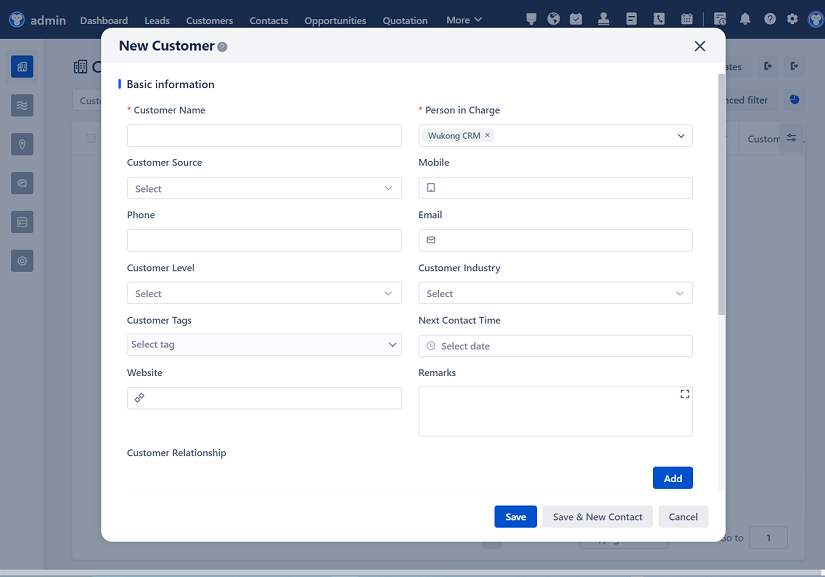
△Click on the top right corner to try Wukong CRM for free