
△Click on the top right corner to try Wukong CRM for free
So, let me tell you something I’ve been thinking about lately—CRM systems. You know, those tools companies use to manage customer relationships? Yeah, those. I’ve been diving into how they’re actually built, and honestly, it’s way more interesting than I thought it’d be. I mean, sure, on the surface, a CRM just looks like a fancy contact book with some extra features. But when you start peeling back the layers, you realize it’s actually a pretty complex piece of software with a lot going on under the hood.
Let me break it down for you. At its core, a CRM system is made up of different component modules—kind of like building blocks. Each one handles a specific function, and together, they create this whole ecosystem that helps businesses keep track of their customers, sales, marketing efforts, and support. It’s not just one big blob of code; it’s carefully structured, and that structure is super important.
Free use of CRM system: Free CRM
Take the contact management module, for example. That’s usually the heart of any CRM. It stores all the customer data—names, emails, phone numbers, company info, you name it. But here’s the thing: it’s not just about storing data. It’s about organizing it in a way that makes sense and is easy to access. I’ve seen some CRMs where finding a single contact feels like a treasure hunt, and that’s usually because the module wasn’t designed well.
Then there’s the sales automation module. This one’s all about helping sales teams do their jobs more efficiently. It tracks leads, manages pipelines, sets reminders for follow-ups, and even predicts when a deal might close. Honestly, I think this is where a lot of companies see the biggest ROI. It cuts down on manual work, reduces human error, and keeps everyone on the same page. I remember talking to a sales manager once who said their team went from missing half their follow-ups to hitting 95% of them—just by using this module properly.
Marketing automation is another big piece. This module handles email campaigns, lead scoring, social media integration, and analytics. It’s kind of like the brain behind the marketing strategy. You can set up automated workflows so that when someone downloads a whitepaper, they automatically get added to a nurture sequence. It’s pretty cool when you see it in action. And the best part? You can measure everything. Open rates, click-throughs, conversions—you name it. That kind of data is gold for marketers.
Now, customer service and support—that’s handled by yet another module. This one manages tickets, live chat, knowledge bases, and even customer feedback. I’ve used CRMs where support agents can pull up a customer’s entire history in seconds. That means they don’t have to ask, “So, what was your issue again?” which, let’s be honest, is a huge win for customer experience. Plus, with AI-powered chatbots now integrated into some of these modules, companies can offer 24/7 support without hiring an army of agents.
But here’s the thing—none of these modules work in isolation. They’re all connected. That’s where the architecture comes in. The way these components are designed and how they communicate with each other makes or breaks the whole system. I’ve seen CRMs that are so clunky because the modules don’t talk to each other well. Like, the sales team enters a deal, but it doesn’t show up in the marketing dashboard. That kind of disconnect drives people crazy.
So, what does good architecture look like? Well, most modern CRMs use a layered approach. You’ve got the presentation layer—that’s the user interface, the part you see and interact with. Then there’s the application layer, where all the business logic lives. This is where the rules are defined: how leads are scored, when emails are sent, how data is processed. And finally, there’s the data layer, which stores everything in databases. These layers need to be clearly separated but well-integrated. It’s like having different departments in a company—they each have their own job, but they still need to collaborate.
And let’s not forget about APIs. Oh man, APIs are a game-changer. They allow the CRM to connect with other systems—like email platforms, accounting software, or even e-commerce sites. I worked with a company once that synced their CRM with their Shopify store. Every time someone made a purchase, the CRM automatically created a customer profile and tagged them with their buying behavior. That kind of automation saves so much time and makes personalization way easier.

Scalability is another big deal. You don’t want a CRM that works great for 100 customers but crashes when you hit 10,000. A well-designed architecture can handle growth. That usually means using cloud-based infrastructure, load balancing, and modular design so you can add new features without rebuilding the whole thing. I’ve seen startups start with a basic CRM and then scale up as they grow—all because the architecture was flexible from the beginning.
Security? Yeah, that’s non-negotiable. You’re dealing with sensitive customer data, so the system has to be locked down. Role-based access control is a must—meaning not everyone sees everything. A sales rep shouldn’t have access to financial records, and a support agent shouldn’t be able to edit pricing. Plus, encryption, regular audits, and compliance with regulations like GDPR or CCPA? All essential. I once heard about a company that got fined because their CRM wasn’t compliant. Not a good look.
Now, here’s something people don’t always think about—customization. Not every business is the same, so the CRM needs to be adaptable. Some systems let you create custom fields, workflows, and dashboards. That’s huge. I’ve seen companies tweak their CRM so it fits their exact sales process, from lead capture to closing. It’s like tailoring a suit instead of buying off the rack—just fits better.

Integration with third-party tools is another thing. Most businesses use a bunch of different apps—Slack, Google Workspace, Zoom, you name it. A good CRM plays nice with those. I’ve used CRMs where I can log a call from Zoom directly into a customer’s record with one click. That kind of seamless integration makes life so much easier.
And let’s talk about user experience. No matter how powerful the backend is, if the interface is confusing, people won’t use it. I’ve seen teams resist adopting a CRM simply because it felt clunky. But when the design is intuitive—clean menus, smart search, mobile-friendly—adoption rates go way up. It’s not just about functionality; it’s about how it feels to use.
Oh, and mobile access! Can’t forget that. Salespeople are on the go, support agents work from home, managers check in from their phones. A CRM that doesn’t have a solid mobile app is kind of useless these days. I’ve used CRMs where I could update a deal status while waiting in line for coffee. That’s the kind of convenience that keeps teams engaged.
Analytics and reporting—those are part of the architecture too. You need dashboards that show real-time data, customizable reports, and forecasting tools. I’ve seen executives make strategic decisions based on CRM reports. It’s not just about tracking what happened; it’s about predicting what’s next. And when the data is accurate and easy to understand, it becomes a powerful decision-making tool.
Now, here’s a thought: the best CRMs aren’t just tools—they’re platforms. They evolve. They learn. Some even use AI to suggest next steps, like who to call next or which offer to send. I’ve used a CRM that analyzed past interactions and recommended the best time to follow up with a lead. It actually worked—my response rates went up.
But building all this isn’t easy. It takes careful planning, skilled developers, and constant testing. You can’t just slap modules together and hope they work. The architecture has to be thought through from day one. I’ve seen projects fail because they skipped the design phase and jumped straight into coding. Big mistake.
And maintenance? Yeah, that’s ongoing. Software needs updates, bugs get fixed, new features get added. A good CRM provider doesn’t just sell you the system and disappear. They support it, improve it, listen to feedback. I’ve been part of user groups where we’d suggest features, and sometimes—get this—they’d actually build them.
So, to wrap this up, CRM systems are way more than just digital Rolodexes. They’re complex, interconnected systems made up of specialized modules, all held together by smart architecture. When done right, they transform how businesses interact with customers. They save time, reduce errors, and help teams work smarter. But it all hinges on how well the components are designed and how well they fit together.
I guess what I’m saying is—don’t underestimate the power of good design. Whether you’re building a CRM or choosing one, pay attention to the modules, the architecture, the integrations, and the user experience. Because at the end of the day, a CRM is only as good as the thought that went into it.
FAQs (Frequently Asked Questions):
Q: What are the main component modules in a CRM system?
A: The main modules usually include contact management, sales automation, marketing automation, customer service/support, analytics/reporting, and sometimes e-commerce or project management integrations.

Q: Why is architecture important in CRM design?
A: Good architecture ensures that modules work together smoothly, the system is scalable, secure, and easy to maintain. It also supports integration and customization.
Q: Can small businesses benefit from CRM modules?
A: Absolutely! Even small teams can use basic CRM modules to organize contacts, track leads, and automate follow-ups. Many CRMs offer affordable, scalable plans.
Q: How do CRM modules communicate with each other?
A: They usually communicate through APIs, shared databases, and event-driven triggers within the system’s architecture.
Q: What role does cloud computing play in CRM architecture?
A: Cloud computing enables remote access, scalability, automatic updates, and better integration with other cloud-based tools.

Q: Is it possible to customize CRM modules?
A: Yes, most modern CRMs allow customization of fields, workflows, dashboards, and automation rules to fit specific business needs.
Q: How does AI fit into CRM modules?
A: AI can power features like lead scoring, chatbots, predictive analytics, and personalized recommendations based on customer data.
Q: What should I look for when choosing a CRM?
A: Look at the available modules, ease of use, integration options, mobile support, security features, scalability, and customer support.
Q: Are open-source CRM systems a good option?
A: They can be, especially if you have technical resources to customize and maintain them. But they may require more effort than hosted solutions.
Q: How often should a CRM system be updated?
A: Regular updates are important for security, performance, and new features. Many cloud CRMs update automatically in the background.
Related links:
Free trial of CRM
Understand CRM software
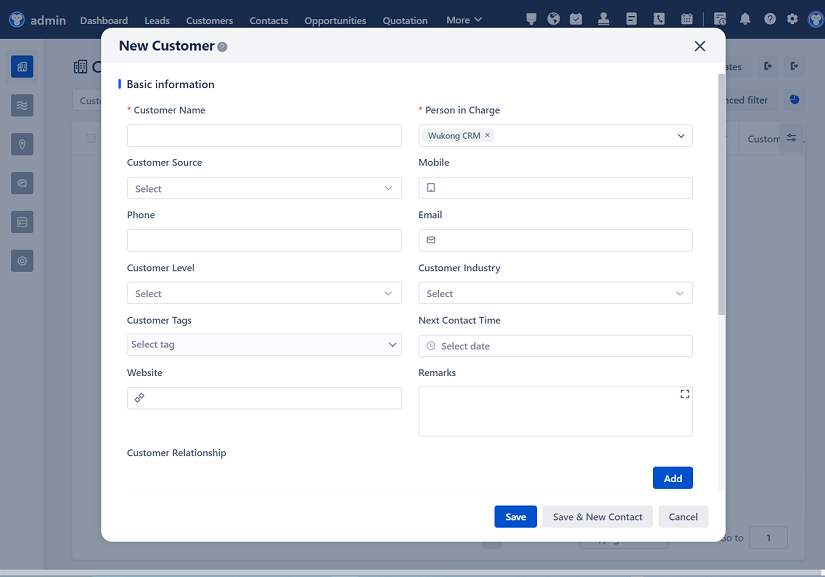
△Click on the top right corner to try Wukong CRM for free