
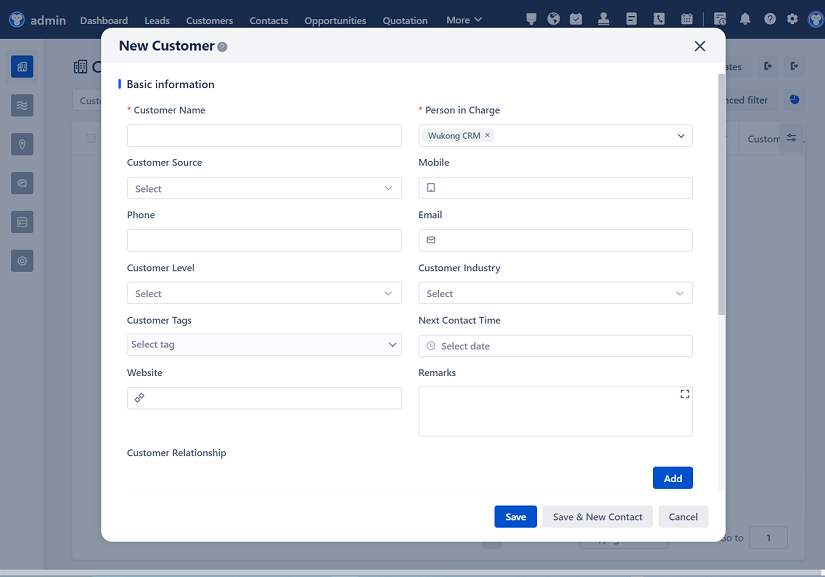
△Click on the top right corner to try Wukong CRM for free
So, you know, I’ve been thinking a lot lately about why CRM service calls sometimes just… fail. Like, you’re sitting there, trying to help a customer, everything seems to be going smoothly, and then—bam—something goes wrong. The call drops, the system freezes, or the agent just doesn’t have the right info. It’s frustrating, right? I mean, not just for the customer, but for the support team too. They want to do a good job, but sometimes the tools they’re using just don’t cooperate.
Let me tell you, it’s not always the agent’s fault. Honestly, a lot of times, it’s deeper than that. There are real, technical, and even cultural reasons behind why CRM service calls fail. And if we don’t understand those reasons, we’ll keep spinning our wheels, fixing symptoms instead of the actual problems.
Free use of CRM system: Free CRM
First off, one of the biggest issues I’ve seen is poor CRM integration. You’ve got your CRM system, sure, but is it actually talking to your phone system? Or your email platform? Or your billing software? A lot of companies think they’ve got a CRM in place, but it’s just sitting there like a fancy digital Rolodex—looks good, but doesn’t really do much. So when a customer calls, the agent has to jump between three different screens just to get basic info. That’s not only inefficient, it’s a recipe for mistakes.
And you know what happens then? The customer has to repeat themselves. Over and over. “Hi, I’m calling about my account…” and then five minutes later, “Wait, can you tell me your name and account number again?” Ugh. That’s not a good experience. People don’t want to feel like they’re talking to a robot—or worse, like they’re not being listened to.
Another thing—data quality. I can’t stress this enough. If your CRM is full of outdated, duplicated, or just plain wrong information, it doesn’t matter how good your agents are. They’re working with bad intel. Imagine trying to give directions using a map from 1995. That’s what it’s like when your CRM data hasn’t been cleaned in years. Customers change phone numbers, update email addresses, switch plans—life happens. If your system doesn’t reflect that, you’re setting yourself up for failure.
And then there’s the training aspect. I’ve seen companies spend thousands on a shiny new CRM system, then give their team a two-hour crash course and say, “Good luck!” Come on. That’s like buying a sports car and expecting someone to race it without knowing how to drive stick shift. Agents need proper training—not just on how to click buttons, but on how to use the CRM to actually solve problems. They need to understand workflows, know where to find critical info, and feel confident navigating the system under pressure.
Oh, and let’s talk about system performance. Nothing kills a service call faster than a slow or crashing CRM. You’re in the middle of helping someone, and suddenly the screen freezes. Or it takes 30 seconds just to load a customer profile. That’s not just annoying—it’s unprofessional. Customers notice. They start thinking, “If this company can’t keep their systems running, how can I trust them with my business?”
And here’s something people don’t always consider: user experience. Just because a CRM has a million features doesn’t mean it’s user-friendly. If the interface is clunky, confusing, or buried under layers of menus, agents are going to avoid using it properly. They’ll take shortcuts, write notes in sticky pads, or just wing it. That leads to inconsistent service and missed follow-ups.
Now, let’s not forget about the human side of things. Agents are under pressure. They’re measured on call time, resolution rates, customer satisfaction—sometimes all at once. When the CRM isn’t helping, they’re forced to choose between speed and accuracy. And guess which one usually wins? Speed. Because if they take too long, their numbers suffer. So they rush, make assumptions, and sometimes just miss important details.
And here’s a big one: lack of real-time updates. Imagine two agents working on the same customer issue, but neither knows what the other is doing because the CRM isn’t syncing in real time. One promises a callback, the other schedules a refund—total confusion. The customer gets mixed messages, and trust starts to erode. That’s not just a technical glitch; that’s a breakdown in communication.
So, what can we actually do about all this? Well, first, we need to stop treating CRM as just a software purchase. It’s not a one-and-done deal. It’s an ongoing process. You have to maintain it, improve it, and make sure it’s actually serving the people who use it every day.
Start with integration. Make sure your CRM talks to everything it needs to—phone systems, email, support tickets, billing, you name it. Use APIs, middleware, whatever it takes. The goal is a single, unified view of the customer. When an agent picks up the phone, they should see everything—past calls, open tickets, recent purchases—right there on one screen. No hunting, no guessing.
Next, clean your data. Regularly. Set up rules for data entry, enforce validation, and schedule quarterly clean-up campaigns. Get rid of duplicates, update outdated info, and make sure every field has a purpose. Garbage in, garbage out—simple as that.
Training? Make it ongoing. Don’t just train people when they start. Offer refreshers, advanced sessions, and peer mentoring. Let agents share tips and tricks. Create a culture where using the CRM well is celebrated, not just tolerated.

And for the love of customer service, optimize performance. Monitor system speed, fix bugs quickly, and scale your infrastructure as needed. If your CRM slows down during peak hours, that’s a problem. Invest in better hosting, caching, or whatever your tech team recommends. Your agents—and customers—will thank you.
User experience matters too. Involve your frontline staff in CRM design decisions. Ask them what’s working and what’s driving them crazy. Small changes—like reordering fields, adding shortcuts, or improving search—can make a huge difference in daily use.
Real-time sync is non-negotiable. Use cloud-based systems if you can, or at least ensure your CRM updates instantly across all devices and locations. No more “I thought you handled that” moments. Everyone should be on the same page, literally.
And here’s a thought: empower your agents. Give them the authority to make small decisions without jumping through hoops. If the CRM shows a loyal customer had a bad experience, let the agent offer a goodwill gesture without needing manager approval. That kind of trust goes a long way—in both employee morale and customer satisfaction.

Also, use analytics. Most CRMs come with reporting tools. Use them. Track call failure rates, average handle time, first-contact resolution, and customer feedback. Look for patterns. Are certain agents struggling? Are specific issues causing repeated failures? Data doesn’t lie. Use it to make smart changes.
And don’t forget feedback loops. Talk to your agents. Really listen. They’re the ones on the front lines. They know where the CRM falls short. Hold regular meetings, send out surveys, create a suggestion box—whatever works. Then act on what you hear. Nothing kills morale faster than giving feedback and seeing nothing change.
Finally, remember that technology is only part of the solution. Culture matters just as much. If your company values speed over service, or blames agents for system failures, you’ll never fix the root problems. Leadership needs to model the behavior they want to see—patience, empathy, and a commitment to continuous improvement.

Look, CRM service call failures aren’t inevitable. They’re fixable. But it takes more than just buying new software or firing a few underperforming agents. It takes a real, honest look at your systems, your people, and your processes. It takes investment—time, money, and attention.
But here’s the good news: when you get it right, the payoff is huge. Faster resolutions, happier customers, more engaged agents, and better business outcomes. It’s not magic—it’s just doing the work.
So, if you’re dealing with CRM call failures, don’t just patch the surface. Dig deeper. Fix the integration, clean the data, train your team, and make the system work for people, not the other way around. Because at the end of the day, customer service is about people helping people. The CRM should make that easier—not harder.
FAQs (Frequently Asked Questions)
Q: How do I know if my CRM is the cause of service call failures?
A: Great question. Start by asking your agents what frustrates them most during calls. If they’re constantly switching apps, waiting for screens to load, or can’t find customer info, your CRM is likely part of the problem. Also, check metrics like average handle time and first-call resolution—if they’re dropping, it’s worth investigating.
Q: Can poor training really cause CRM failures?
Absolutely. Even the best CRM won’t help if people don’t know how to use it. Think of it like giving someone a high-end camera but not teaching them how to focus or adjust settings. They might get a blurry photo—not because the camera’s bad, but because they don’t know how to use it.
Q: What’s the quickest win to reduce CRM-related call failures?
Probably cleaning up your data and improving integration. Getting accurate info in one place can immediately reduce call time and errors. It’s not flashy, but it works.
Q: Should we switch to a different CRM if ours keeps failing?
Not necessarily. Sometimes the issue isn’t the CRM itself, but how it’s set up or used. Before jumping to a new system, audit your current setup, talk to users, and explore customization or add-ons. A full migration is expensive and disruptive—only do it if you’ve ruled out other fixes.
Q: How often should we review our CRM performance?
I’d say quarterly at minimum. But honestly, keep an eye on key metrics monthly. If something starts trending in the wrong direction—like more dropped calls or lower satisfaction—dig into it right away. Don’t wait for the quarterly review.
Q: Can AI help reduce CRM service call failures?
Yeah, actually. AI-powered features like smart search, auto-populated fields, or predictive suggestions can save time and reduce errors. But only if your data is clean and your system is stable. AI isn’t a magic fix—it’s a tool that works best on a solid foundation.
Q: What role does company culture play in CRM success?
Huge. If leadership doesn’t prioritize good customer service or support agent feedback, even the best CRM will underperform. Culture shapes how people use tools. So, fix the tech, yes—but also make sure your values support great service.
Related links:
Free trial of CRM
Understand CRM software
△Click on the top right corner to try Wukong CRM for free