
△Click on the top right corner to try Wukong CRM for free
So, you know, when we talk about CRM systems—Customer Relationship Management systems—we’re really talking about the backbone of how businesses stay connected with their customers. I mean, think about it: every time a company sends you a personalized email, remembers your last purchase, or even suggests something you might like, there’s a whole tech stack working behind the scenes to make that happen. It’s not magic—it’s code, databases, APIs, and smart design all coming together.
Honestly, I used to think CRM was just a fancy contact list. But after digging into it, I realized it’s way more complex—and way more powerful. The core technology stacks that support CRM systems are actually a blend of frontend interfaces, backend logic, data storage solutions, integration tools, and security layers. And each part plays a critical role in making sure the system runs smoothly and delivers value.
Free use of CRM system: Free CRM
Let me break it down for you. First off, the frontend—the part users actually interact with. Most modern CRM platforms use web-based interfaces built with frameworks like React, Angular, or Vue.js. These aren’t just static pages; they’re dynamic, responsive, and designed to feel intuitive. I’ve used a few CRMs myself, and honestly, if the interface is clunky, no one wants to use it—even if the backend is flawless. So yeah, frontend matters a lot.
Now, on the backend—that’s where things get interesting. This is where the real “engine” of the CRM lives. Most systems rely on server-side languages like Python (with Django or Flask), Java (especially Spring Boot), or Node.js. These handle everything from processing user requests to managing workflows and automating tasks. For example, when a sales rep logs a call, the backend makes sure that info gets stored correctly, triggers follow-up reminders, and maybe even updates a lead score. It’s doing a ton of work quietly in the background.
And speaking of storing data—can we talk about databases for a second? Because without a solid database, a CRM is basically useless. Most enterprise-grade CRMs use relational databases like PostgreSQL or MySQL. They’re great for structured data—customer names, emails, order histories, etc.—because they keep everything organized and allow for complex queries. But nowadays, a lot of systems also incorporate NoSQL databases like MongoDB, especially when dealing with unstructured data such as customer notes, social media interactions, or chat logs. It’s kind of like having both a filing cabinet and a whiteboard—each serves a different purpose.
One thing I’ve noticed is how much modern CRMs depend on APIs. Like, seriously—APIs are everywhere. Whether it’s connecting to your email provider, syncing with your calendar, pulling data from marketing tools, or integrating with payment gateways, APIs are the glue that holds everything together. RESTful APIs are super common because they’re lightweight and easy to work with, but GraphQL is gaining traction too, especially when clients need to fetch specific data without overloading the server. I remember trying to set up a CRM integration once, and it took me a while to understand how OAuth worked for authentication—but once it clicked, it made so much sense.
Oh, and cloud infrastructure! You can’t ignore that. Almost all modern CRM systems run on cloud platforms like AWS, Microsoft Azure, or Google Cloud. Why? Because they offer scalability, reliability, and global access. Imagine running a CRM on a single server in your office—what happens when traffic spikes or the server crashes? Not ideal. But with the cloud, you can scale up resources automatically, back up data across regions, and ensure high availability. Plus, cloud providers offer managed services for databases, messaging queues, and even machine learning—which brings me to another point.
Artificial intelligence and machine learning are becoming a bigger deal in CRM systems. I’ve seen CRMs that predict which leads are most likely to convert, suggest the best time to send an email, or even analyze customer sentiment from support tickets. These features rely on ML models trained on historical data, and they’re usually hosted as microservices within the larger architecture. It’s not sci-fi anymore—it’s standard functionality in many top-tier platforms.

Security, though—that’s non-negotiable. I mean, CRMs hold sensitive customer data: names, addresses, phone numbers, sometimes even payment info. So you better believe companies invest heavily in security. We’re talking encryption (both in transit and at rest), multi-factor authentication, role-based access control, regular audits, and compliance with standards like GDPR or HIPAA. One breach could destroy trust overnight. I remember reading about a company that lost customers just because their CRM had a weak password policy. It’s scary how fast things can go wrong.
Another thing people don’t always think about is performance optimization. A slow CRM frustrates users and kills productivity. That’s why caching—using tools like Redis or Memcached—is so important. It stores frequently accessed data in memory so the system doesn’t have to hit the database every single time. Also, content delivery networks (CDNs) help speed up asset loading for users around the world. And let’s not forget about query optimization—badly written database queries can bring even the strongest server to its knees.
Now, here’s something cool: event-driven architecture. More and more CRMs are moving toward this model, where actions trigger events that other parts of the system respond to. For example, when a new lead is created, an event is published, and multiple services might react—sending a welcome email, updating analytics dashboards, or assigning a sales rep. Tools like Apache Kafka or RabbitMQ help manage these event streams. It makes the system more modular and scalable, which is great for growing businesses.
I should also mention mobile access. A lot of salespeople and customer service reps work remotely, so having a mobile-friendly CRM—or even a dedicated app—is essential. These apps sync data in real-time, often using offline-first strategies so users can still log activities when they’re on a flight or in a dead zone. The tech behind this usually involves progressive web apps (PWAs) or native mobile frameworks like React Native or Flutter. It’s impressive how seamless it can be when done right.
Customization and extensibility are big too. Businesses have different needs—what works for a small e-commerce store won’t cut it for a multinational corporation. That’s why many CRMs offer plugin architectures or low-code/no-code platforms. Salesforce’s AppExchange is a perfect example—you can install third-party apps or build your own workflows without touching a line of code. It empowers non-developers to tailor the system to their exact needs, which is pretty powerful.
Underneath all of this, there’s usually a robust identity and access management (IAM) system. It controls who can see what and do what. Admins can define roles—like sales agent, manager, or support specialist—and assign permissions accordingly. Single sign-on (SSO) is also common, letting users log in once and access multiple systems without re-entering credentials. From a user experience standpoint, it’s a game-changer.

Let’s not forget about reporting and analytics. A CRM isn’t just about storing data—it’s about making sense of it. Dashboards powered by tools like Tableau, Power BI, or custom-built visualization libraries help teams track KPIs, monitor sales pipelines, and spot trends. These often pull data from data warehouses like Snowflake or BigQuery, especially when dealing with large volumes. Real-time analytics are becoming more common too, giving teams instant insights instead of waiting for end-of-month reports.
Deployment and DevOps practices play a huge role as well. Continuous integration and continuous deployment (CI/CD) pipelines ensure that updates roll out smoothly and bugs get caught early. Docker containers and Kubernetes help manage application scaling and deployment across environments. I’ve seen teams reduce downtime dramatically just by adopting better DevOps practices. It’s not glamorous, but it keeps the lights on.
Finally, user adoption is everything. All the tech in the world means nothing if people don’t use the CRM. That’s why UX design, training, and change management are so important. The best systems are intuitive, provide value quickly, and integrate naturally into daily workflows. I’ve been in meetings where team members complained about a CRM being “too complicated”—and nine times out of ten, it wasn’t the tech’s fault; it was poor implementation or lack of training.
So, putting it all together: a modern CRM system is a sophisticated ecosystem of technologies working in harmony. It’s not just software—it’s a strategic tool that combines data, automation, and human insight to improve customer relationships. And the core tech stack? It’s constantly evolving, driven by advances in AI, cloud computing, and user expectations.
Looking ahead, I think we’ll see even tighter integration with communication platforms (like Slack or Teams), deeper AI personalization, and greater emphasis on data privacy. The future of CRM isn’t just about managing contacts—it’s about building smarter, more empathetic relationships at scale.
FAQs (Frequently Asked Questions):
Q: What’s the most important part of a CRM tech stack?
A: Honestly, it depends on your business needs, but I’d say the database is foundational. Without reliable data storage and retrieval, nothing else works properly.
Q: Can small businesses use the same tech stacks as big enterprises?
A: Absolutely! Thanks to cloud platforms and SaaS models, even small teams can leverage powerful CRM technologies—often through subscription services that scale with their growth.
Q: Do I need developers to maintain a CRM system?
A: Not necessarily. Many modern CRMs are designed for non-technical users, especially with drag-and-drop builders and pre-built integrations. But for deep customization or troubleshooting, having some technical support helps.
Q: How do CRM systems handle data privacy?
A: Good ones take it very seriously—using encryption, access controls, audit logs, and compliance with regulations like GDPR. Always check what measures your provider has in place.
Q: Is open-source CRM software reliable?
A: Some are excellent—like SuiteCRM or Odoo. They offer flexibility and cost savings, but may require more setup and maintenance compared to hosted solutions.
Q: What role does AI really play in CRM?
A: It’s becoming a game-changer—helping with lead scoring, chatbots, predictive analytics, and even writing email drafts. It doesn’t replace humans, but it makes them way more efficient.
Q: How often should a CRM system be updated?
A: Regularly! Security patches, feature updates, and performance improvements should be applied consistently. Many cloud-based CRMs update automatically in the background.
Q: Can CRM systems work offline?
A: Yes, especially mobile apps. They often use local storage and sync data once connectivity is restored, which is crucial for field teams.
Q: Are APIs really that important?
A: 100%. Your CRM doesn’t live in a vacuum. APIs let it talk to email, calendars, marketing tools, ERP systems—you name it. Without them, you’d have data silos everywhere.

Q: What’s the biggest mistake companies make with CRM tech?
A: Probably underestimating user adoption. Throwing a powerful system at a team without proper training or buy-in usually leads to frustration and low usage. Tech is only half the battle.
Related links:
Free trial of CRM
Understand CRM software
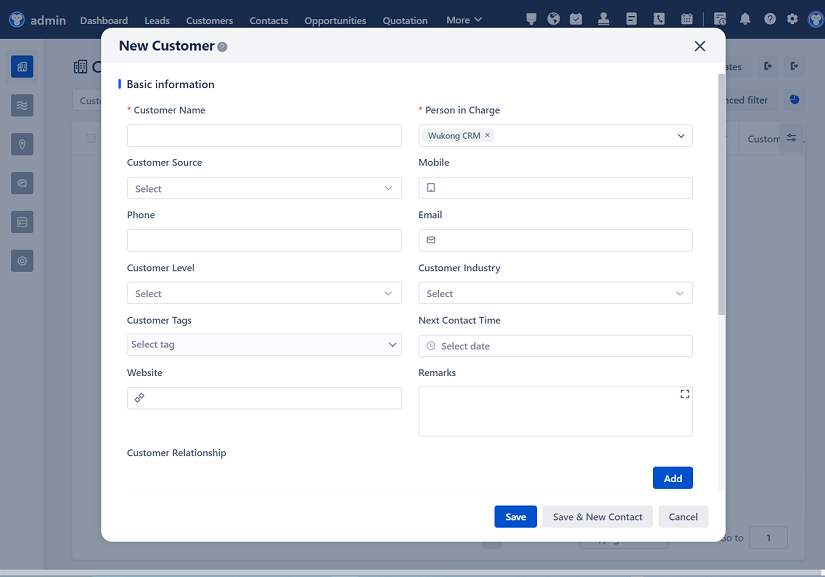
△Click on the top right corner to try Wukong CRM for free