
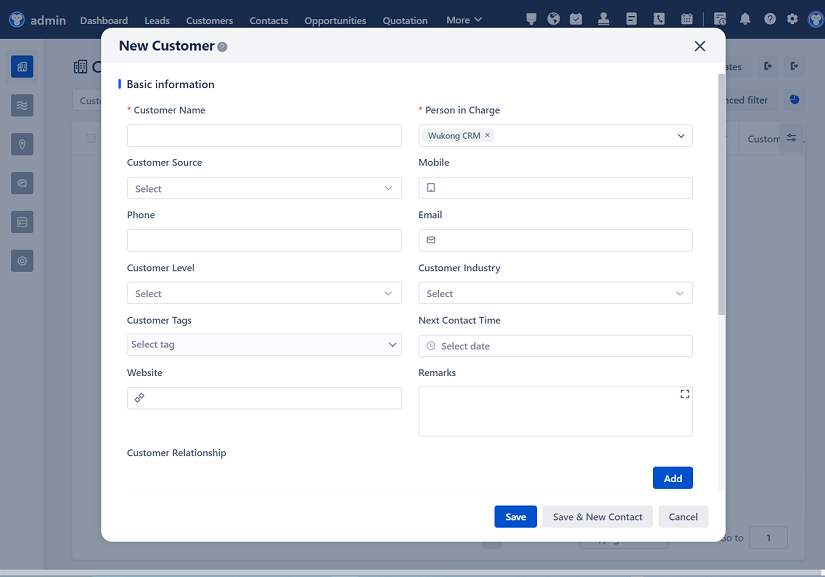
△Click on the top right corner to try Wukong CRM for free
You know, when I first started looking into the world of Customer Relationship Management—CRM for short—I honestly didn’t realize just how much it’s evolved over the past few years. I mean, sure, I knew CRM was about managing customer interactions, but I had no idea how deeply it’s now woven into every part of a business, from sales and marketing to customer service and even product development.
Let me tell you something: companies today aren’t just using CRM systems to store contact info anymore. That’s so 2010. Now, they’re using them to predict customer behavior, personalize experiences at scale, and even automate entire sales pipelines. It’s kind of mind-blowing when you think about it.
Free use of CRM system: Free CRM
And because CRM has become so powerful and central to business success, the demand for skilled professionals in this field has skyrocketed. Like, seriously—everywhere I look, there are job postings asking for CRM specialists, analysts, administrators, and consultants. It’s not just big tech companies either; small businesses, nonprofits, healthcare providers—they all need people who can manage and make sense of their CRM data.

But here’s the thing: it’s not enough to just know how to click around in Salesforce or HubSpot. Employers want people who really understand the strategy behind CRM, not just the software. They want folks who can look at customer data and say, “Hey, I see a pattern here—let’s adjust our outreach,” or “This segment is under-engaged; we should try a different approach.”
So what exactly are companies looking for? Well, from what I’ve seen, technical skills are definitely important. You’ve got to be comfortable with CRM platforms—Salesforce is still the big one, but Microsoft Dynamics, HubSpot, Zoho, and others are gaining ground. Knowing how to set up workflows, build reports, customize dashboards, and integrate CRM with other tools like email marketing platforms or ERP systems—that’s table stakes.
But—and this is a big but—it’s not just about knowing where the buttons are. Companies want people who can actually use those tools to solve real business problems. For example, can you design a lead scoring model that helps the sales team prioritize prospects? Can you create automated nurture campaigns that reduce manual work for marketing? That’s the kind of thinking they’re after.

And let’s talk about data. Oh man, data is huge in CRM. I’ve talked to hiring managers who told me they’d rather hire someone with strong analytical skills and basic CRM knowledge than someone who knows the software inside out but can’t interpret what the numbers mean. Being able to pull insights from customer data—like identifying churn risks or spotting upsell opportunities—is becoming a must-have skill.
That means knowing your way around Excel is still useful, but more and more, employers want people who can work with SQL, or use BI tools like Tableau or Power BI to visualize CRM data. Some even expect knowledge of basic Python for automation or advanced analysis. It’s not that everyone needs to be a data scientist, but you do need to be data-literate.
Now, here’s something interesting: soft skills matter just as much, if not more. Think about it—CRM isn’t just a tool; it’s about relationships. So you’ve got to be able to communicate clearly with sales teams, understand what marketing needs, and collaborate with customer support. If you can’t explain a complex report in simple terms or get buy-in from stakeholders, your technical skills won’t take you very far.
I remember talking to a CRM manager at a mid-sized company who said her biggest challenge wasn’t the technology—it was getting departments to actually use the system consistently. People were entering data haphazardly, or worse, keeping customer info in spreadsheets outside the CRM. So she spent a lot of time training, coaching, and even negotiating with team leads to improve adoption. That takes emotional intelligence, patience, and leadership—not things you learn in a software tutorial.
Another thing I’ve noticed is that CRM roles are becoming more strategic. It’s not just about maintaining the database anymore. Companies want CRM professionals who can help shape customer experience strategies, advise on digital transformation, or even contribute to product roadmaps based on customer feedback collected through the CRM.
For instance, some organizations now have “CRM Architects” or “Customer Data Strategists”—roles that focus on designing the overall CRM ecosystem, ensuring data quality, and aligning the system with long-term business goals. These aren’t entry-level jobs, but they show where the field is headed.

And speaking of entry-level, if you’re just starting out, don’t panic. You don’t need 10 years of experience to break into CRM. A lot of people start in sales operations, marketing coordination, or IT support and gradually move into CRM roles. What helps a ton is getting certified. Salesforce offers free training through Trailhead, and earning certifications like Administrator or Consultant can really boost your credibility.
I’ve seen people transition from completely unrelated fields—like teaching or hospitality—into CRM by learning the basics, volunteering to help with CRM tasks at their current job, and building a portfolio of small projects. It’s totally doable if you’re curious and willing to put in the work.
One thing that surprised me is how much change management comes into play. Implementing or upgrading a CRM system isn’t just a tech project—it’s a cultural shift. Employees resist change, especially if they feel the new system makes their jobs harder. So CRM professionals often end up being change agents, helping teams adapt, addressing concerns, and showing people how the tool actually saves them time in the long run.
That’s why project management skills are increasingly valuable. Knowing how to plan a rollout, set milestones, manage timelines, and handle stakeholder communication can make or break a CRM initiative. Agile methodologies are popping up in CRM projects too, which means familiarity with tools like Jira or Trello can be a nice bonus.
Another trend I’ve picked up on is the growing importance of privacy and compliance. With regulations like GDPR and CCPA, companies can’t just collect and use customer data however they want. CRM professionals need to understand data governance—things like consent management, data retention policies, and secure access controls. Mess this up, and you could land your company in legal trouble.
So now you’ve got to balance usability with security, personalization with privacy. It’s tricky, but also kind of fascinating. The best CRM setups I’ve seen are the ones that respect customer boundaries while still delivering relevant, timely experiences.
Oh, and integration—can’t forget that. Modern CRM systems don’t live in isolation. They connect with websites, mobile apps, social media, e-commerce platforms, call centers—you name it. So understanding APIs, middleware, and integration platforms like Zapier or MuleSoft is becoming more common in job descriptions.
It’s not always expected that you build the integrations yourself (that’s often an IT or developer role), but you do need to understand how they work and be able to troubleshoot when something breaks. Like, if leads aren’t syncing from the website to Salesforce, you should be able to figure out whether it’s a form issue, a mapping error, or an API timeout.
Looking ahead, I think AI is going to reshape CRM even more. We’re already seeing features like predictive lead scoring, chatbots for customer service, and AI-powered email suggestions. In the near future, CRM systems might proactively suggest next steps, draft personalized messages, or flag at-risk customers before they even complain.
That doesn’t mean human CRM professionals will become obsolete—far from it. In fact, I think their role will become more strategic. Instead of spending hours on data entry or report generation, they’ll focus on interpreting AI insights, refining automation rules, and ensuring the technology enhances, rather than replaces, human connection.

So what does all this mean for someone thinking about a career in CRM? First, stay curious. The tools and best practices evolve fast, so you’ve got to keep learning. Follow industry blogs, join user groups, attend webinars. Salesforce Saturday events, HubSpot User Groups—there are tons of communities out there.
Second, develop a mix of technical, analytical, and interpersonal skills. Don’t silo yourself. Be the person who can bridge the gap between IT and marketing, or sales and customer service.
Third, get hands-on experience. Volunteer for CRM-related tasks, take on small improvement projects, or even set up a sandbox environment to practice. Real-world experience—even if it’s not paid—goes a long way.
And finally, remember that CRM is ultimately about people. Yes, there’s a lot of tech involved, but the goal is to build better relationships, deliver value, and make customers feel understood. If you keep that front and center, you’ll do well in this field.
Honestly, I think CRM is one of the most dynamic and impactful areas you can work in today. It touches every part of the business, combines tech with psychology, and offers real opportunities to drive growth and improve customer satisfaction. Whether you’re a natural problem-solver, a data geek, or a people person, there’s probably a CRM role that fits your strengths.
So if you’ve been wondering whether to dive into CRM, my advice is: go for it. Start small, stay consistent, and don’t be afraid to ask questions. The community is pretty welcoming, and there’s always someone willing to help.
FAQs (Frequently Asked Questions):
Q: Do I need a degree to work in CRM?
A: Not necessarily. While some roles may prefer a business or IT degree, many employers care more about skills, certifications, and experience. You can absolutely break into CRM through self-learning and practical projects.
Q: Is Salesforce the only CRM platform worth learning?
A: No, though it’s the most widely used. Learning HubSpot, Microsoft Dynamics, or Zoho can also open doors, especially in smaller companies or specific industries. But Salesforce is a great starting point due to its market dominance.
Q: Can I transition into CRM from a non-tech background?
A: Absolutely. Many CRM professionals come from sales, marketing, or customer service. Your understanding of customer needs and business processes can actually be a big advantage.
Q: How long does it take to become proficient in CRM?
A: It depends, but with focused effort, you can gain foundational skills in 3–6 months. Earning a certification like Salesforce Administrator typically takes 2–3 months of part-time study.
Q: Are CRM jobs remote-friendly?
A: Yes, many CRM roles—especially administration, analysis, and consulting—can be done remotely. The nature of the work is digital, so location isn’t always a barrier.
Q: Will AI replace CRM jobs?
A: Unlikely. AI will automate repetitive tasks, but the strategic, creative, and human aspects of CRM—like relationship-building and decision-making—will still require skilled professionals.
Q: What’s the average salary for CRM roles?
A: It varies by location and experience, but CRM Administrators in the U.S. typically earn
Related links:
Free trial of CRM
Understand CRM software
△Click on the top right corner to try Wukong CRM for free