
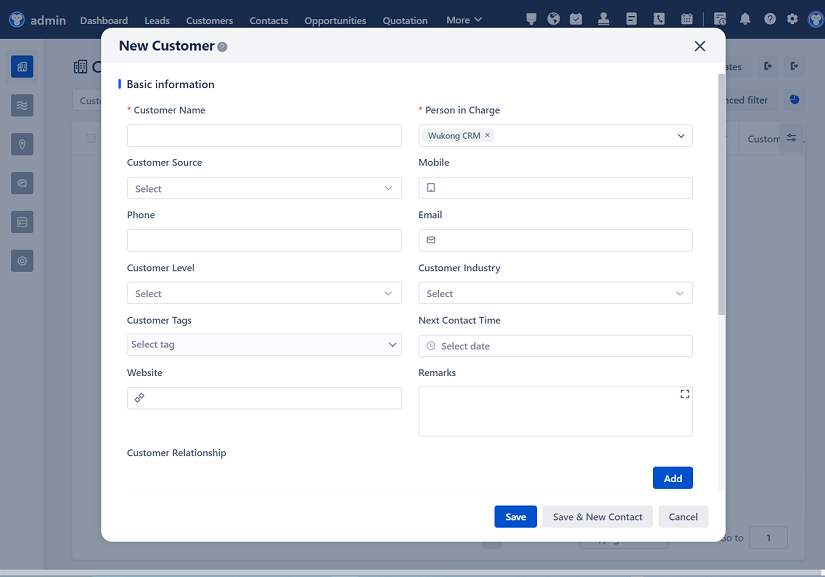
△Click on the top right corner to try Wukong CRM for free
So, you know when you're trying to figure out how a CRM system actually works behind the scenes? Like, not just what buttons you click, but how it's all put together? Yeah, that’s where system architecture comes in. Honestly, it’s kind of like building a house—you need a solid foundation, strong walls, and everything has to connect properly so the whole thing doesn’t fall apart. And with CRM systems, it’s no different. You’ve got users, data, integrations, security—all these pieces have to work together smoothly.
Let me tell you, designing the system architecture for a CRM isn’t something you just wing. I mean, sure, you could throw some servers up and call it a day, but if you want something that scales, performs well, and actually helps your sales or customer service teams, you’ve gotta plan it right. From my experience, the first thing you need to think about is what kind of CRM you’re building. Is it cloud-based? On-premise? Or maybe hybrid? That choice alone shapes almost every other decision you’ll make.
Free use of CRM system: Free CRM
Take cloud-based CRMs, for example. They’re super popular now—think Salesforce, HubSpot, Zoho. The big advantage here is flexibility. Your team can access the system from anywhere, updates are handled automatically, and scaling up usually just means upgrading your subscription. But—and this is a big but—you’re relying on someone else’s infrastructure. So uptime, security, and performance depend heavily on your provider. That’s why choosing a reliable cloud platform is critical.
Now, if you go the on-premise route, you’re basically hosting everything in your own data center. This gives you full control over the environment, which some companies love, especially those in highly regulated industries. But let’s be real—it also means you’re responsible for maintenance, backups, upgrades, and all that fun stuff. It’s more expensive and requires a dedicated IT team. Not everyone wants that headache.
Then there’s hybrid. Some companies use a mix—core data stays on-premise for security, but they use cloud tools for things like marketing automation or mobile access. It’s a compromise, really. Gives you some control while still offering modern features. But honestly, hybrid setups can get messy fast if you don’t design the integration layer carefully.
Speaking of integration, that’s another huge piece of CRM architecture. Your CRM doesn’t live in a vacuum. It needs to talk to email systems, ERP software, marketing platforms, maybe even legacy databases. So you’ve got to build APIs—application programming interfaces—that allow smooth data flow between systems. REST APIs are pretty standard these days because they’re lightweight and easy to work with. But you’ve still got to handle authentication, rate limiting, error handling… it’s not as simple as it sounds.

And then there’s the database. Oh man, the database is where everything lives. All your customer records, interactions, deals, notes—it’s all stored somewhere. Most modern CRMs use relational databases like PostgreSQL or MySQL because they handle structured data well and support complex queries. But if you’re dealing with massive amounts of unstructured data—like social media interactions or chat logs—some teams are starting to use NoSQL databases like MongoDB. It depends on your use case.
But here’s the thing: no matter what kind of database you pick, performance matters. Imagine your sales rep trying to pull up a client’s history during a call, and the system takes 10 seconds to load. That’s frustrating. So you’ve got to optimize queries, use indexing smartly, and maybe even implement caching with tools like Redis. Caching can make a huge difference—storing frequently accessed data in memory so it loads instantly.
Security? Yeah, that’s non-negotiable. You’re dealing with sensitive customer information—names, emails, phone numbers, sometimes even payment details. If that gets leaked, it’s not just a technical problem; it’s a legal and reputational disaster. So you’ve got to encrypt data both at rest and in transit. Use HTTPS everywhere. Implement role-based access control so employees only see what they need to. And don’t forget about regular security audits and penetration testing.

Authentication is another big deal. Most CRMs today support single sign-on (SSO) using protocols like OAuth or SAML. That way, users don’t have to remember yet another password, and IT can manage access centrally. Multi-factor authentication (MFA) is becoming standard too. It adds an extra layer of protection, even if someone steals a password.
Now, let’s talk about scalability. You might start small, but what happens when your user base grows from 50 to 5,000? Your system better be ready. That’s where microservices come in. Instead of building one giant monolithic application, you break the CRM into smaller, independent services—like user management, lead tracking, reporting, notifications. Each one can be developed, deployed, and scaled separately. It makes the system more flexible and easier to maintain.

Of course, microservices aren’t free. They add complexity. You need service discovery, load balancing, inter-service communication, and monitoring. Tools like Kubernetes and Docker help manage containers, but now you’re dealing with distributed systems, which brings its own challenges—like eventual consistency and network latency.
And speaking of monitoring, you can’t just set up a CRM and forget it. You need logging, alerting, and performance tracking. Tools like Prometheus, Grafana, or ELK stack help you see what’s happening in real time. If a server crashes or response times spike, you want to know immediately. Downtime costs money and damages trust.
User experience ties into architecture more than people realize. A beautifully designed front end won’t save you if the backend is slow or unreliable. That’s why frontend and backend teams need to collaborate closely. Modern CRMs often use a frontend framework like React or Angular, talking to backend APIs via JSON. The goal is responsiveness—users shouldn’t feel like they’re waiting.
Mobile access is another consideration. A lot of salespeople are on the road, so they need a mobile app or a responsive web interface. That means your API has to support mobile clients efficiently—small payloads, offline capabilities, sync when back online. You don’t want someone losing a whole day’s worth of notes because the app didn’t handle connectivity issues well.
Data consistency is tricky, especially in distributed systems. Let’s say two users edit the same customer record at the same time. Who wins? You need conflict resolution strategies—maybe last-write-wins, or merge logic, or even manual review. And don’t forget about data validation. Garbage in, garbage out. If your system allows bad data, reports become useless, and automation breaks.
Backup and disaster recovery? Super important. You’ve got to have automated backups running regularly, stored securely, preferably offsite. And you need a tested recovery plan. What if a database gets corrupted? How long will it take to restore? Minutes matter when your sales team can’t work.
Customization is a big selling point for many CRMs. Businesses want to tailor fields, workflows, dashboards. So your architecture should support extensibility—plugins, custom scripts, configuration layers. But you’ve got to balance that with stability. Too much customization can make upgrades a nightmare.
Oh, and analytics! People love dashboards. Sales managers want to see conversion rates, pipeline health, activity trends. So your system needs a reporting engine—either built-in or integrated with tools like Power BI or Tableau. That means aggregating data efficiently, maybe using a data warehouse or OLAP cube for faster queries.
Deployment strategy matters too. Are you doing continuous integration and continuous deployment (CI/CD)? That lets you release updates quickly and safely. Automated testing, staging environments, rollback plans—these aren’t luxuries; they’re essentials for maintaining quality.
And let’s not forget about compliance. Depending on where you operate, you might need to follow GDPR, CCPA, HIPAA, or other regulations. That affects how you store data, who can access it, and how long you keep it. Your architecture has to bake in privacy by design—not bolt it on later.
Finally, documentation. I can’t stress this enough. No matter how brilliant your system is, if no one understands how it works, it’s going to cause problems down the line. Good docs help new developers onboard, support teams troubleshoot, and stakeholders understand limitations.
So yeah, designing CRM system architecture is complex. It’s not just about technology—it’s about understanding business needs, user behavior, growth plans, and risk tolerance. You’ve got to balance performance, security, cost, and usability. There’s no one-size-fits-all solution. Every company has different priorities.
But when it’s done right? Man, it feels amazing. You see sales teams closing deals faster, customer service reps resolving issues quicker, marketing campaigns hitting the mark. That’s the power of a well-architected CRM. It’s not just software—it’s a strategic asset.
FAQs (Frequently Anticipated Questions):
Q: Why is system architecture so important for a CRM?
A: Because it determines how reliable, scalable, and secure your CRM is. A poor architecture leads to slow performance, data loss, and frustrated users—even if the features look great on paper.
Q: Should I choose a cloud or on-premise CRM?
A: It depends. Cloud is easier to manage and scale, great for most businesses. On-premise gives more control but needs more IT resources. Think about your budget, team size, and security needs.
Q: How do microservices improve CRM systems?
A: They make the system more modular and easier to update. If one part fails, others can keep running. Plus, you can scale specific features independently—like boosting reporting power without touching the messaging module.
Q: What’s the biggest security risk in CRM architecture?
A: Probably unauthorized access to customer data. That’s why encryption, MFA, and strict access controls are must-haves. Also, third-party integrations can introduce vulnerabilities if not vetted.

Q: Can a CRM work offline?
A: Yes, especially mobile versions. They cache data locally and sync changes when back online. But the backend needs to handle conflicts and ensure data consistency.
Q: How often should backups be done?
A: Daily at minimum. For high-transaction systems, even hourly backups might be necessary. And always test restores—knowing you can recover is different from proving it.
Q: What role does the database play in CRM performance?
A: Huge. It’s where all customer data lives. Poorly optimized queries or lack of indexing can slow everything down. Choosing the right type—relational vs. NoSQL—also impacts speed and flexibility.
Q: Is it hard to integrate a CRM with other tools?
A: It can be, especially with legacy systems. But modern CRMs use open APIs and pre-built connectors that make integration smoother. Still, planning and testing are key.
Q: How do you handle updates without disrupting users?
A: Use CI/CD pipelines, deploy during low-traffic hours, and have rollback plans. Canary releases—where you roll out updates to a small group first—help catch issues early.
Q: What’s the most overlooked part of CRM architecture?
A: Monitoring and logging. People focus on features but forget that without visibility into system health, you’re flying blind. Proactive monitoring prevents bigger problems later.
Related links:
Free trial of CRM
Understand CRM software
△Click on the top right corner to try Wukong CRM for free