
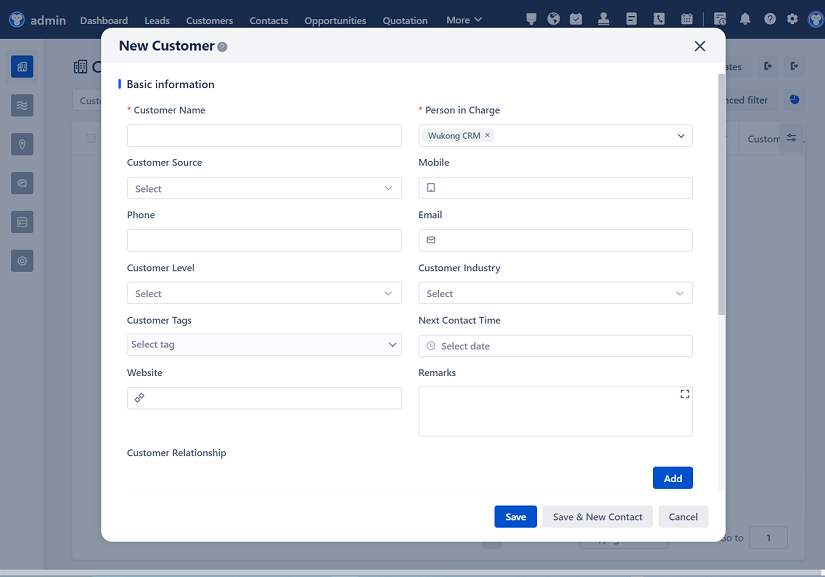
△Click on the top right corner to try Wukong CRM for free
So, you know, when we talk about CRM systems—Customer Relationship Management systems—we’re really talking about the backbone of how companies manage their interactions with customers. And honestly, a lot of people don’t think much about what’s going on behind the scenes, but let me tell you, the backend architecture? That’s where the magic happens. I mean, sure, the frontend is what users see—the nice dashboards, the contact lists, the sales pipelines—but if the backend isn’t solid, none of that matters. It’ll be slow, unreliable, or just plain break at the worst possible time.
I’ve worked with a few CRM platforms over the years, and one thing I’ve noticed is that not all backends are created equal. Some are built like tanks—scalable, modular, easy to maintain—while others feel like they were cobbled together in a weekend hackathon. And trust me, when your sales team is trying to close a big deal and the system freezes because someone ran a report, you realize just how important good backend design really is.
Free use of CRM system: Free CRM
Let’s start with the basics. Most modern CRM backends these days are built using a layered architecture. You’ve got your presentation layer (that’s the frontend), then the application layer (where business logic lives), followed by the data access layer, and finally the database itself. This separation makes things way easier to manage. For example, if you want to change how leads are scored, you don’t have to touch the database schema—you just tweak the logic in the application layer. Clean, right?
But here’s the thing: even within this standard structure, there’s a ton of variation. Some teams go full monolith—everything bundled into one big application. Others break it down into microservices. Now, I used to think microservices were overkill for CRMs, but after seeing how fast some companies scale, I’ve changed my mind. Imagine you’ve got separate services for contacts, deals, emails, notifications, and analytics. If the email service needs more resources during a marketing campaign, you can scale just that part without affecting everything else. Pretty smart, huh?

Of course, microservices come with their own headaches. You’ve got to manage inter-service communication, handle failures gracefully, and make sure data stays consistent across services. That’s where APIs come in—especially RESTful ones or, more recently, GraphQL. I personally prefer REST for most CRM functions because it’s simple and well-understood. But GraphQL? Man, it’s great when users want custom reports. Instead of fetching ten fields when they only need three, they can query exactly what they want. Less data, faster load times. Win-win.
Now, let’s talk databases. Most CRMs use relational databases like PostgreSQL or MySQL because you’ve got structured data—customers, accounts, opportunities—all with clear relationships. Foreign keys, joins, constraints… it’s a perfect fit. But—and this is a big but—some CRMs also bring in NoSQL databases like MongoDB for things like activity logs or unstructured customer notes. Why? Because sometimes you don’t know what kind of data you’ll get, and rigid schemas just get in the way.
And speaking of data, one thing that always trips people up is performance. As your CRM grows, so does your data. A few thousand records? No problem. But what about millions? That’s when indexing becomes your best friend. Without proper indexes, even a simple search for a customer name can take forever. I once saw a query that took 45 seconds because someone forgot to index the email field. Forty-five seconds! In a CRM? That’s basically an eternity.
Caching is another game-changer. Think about it: how many times do users view the same customer profile in a day? Instead of hitting the database every single time, why not store that data in something like Redis? Pull it once, cache it, serve it fast the next nine times. It’s such a simple trick, but it makes a huge difference in user experience.

Then there’s security. I can’t stress this enough—CRM systems hold some of the most sensitive data a company has. Customer names, emails, phone numbers, purchase history… it’s a goldmine for hackers. So your backend better have strong authentication, role-based access control, encryption at rest and in transit, and regular audits. I remember one client who didn’t enforce multi-factor authentication—big mistake. Someone got into a sales rep’s account and started emailing customers with fake discount offers. Total mess.
Oh, and don’t forget about integrations. These days, no CRM works in isolation. You’ve got to connect with email platforms, marketing tools, payment gateways, ERP systems—you name it. That means your backend needs robust APIs and webhooks. I’ve seen backends that treat integrations as an afterthought, and it shows. Sync delays, data mismatches, failed callbacks… it drives users crazy. A well-designed backend treats integrations as first-class citizens, with retry mechanisms, logging, and monitoring baked in.
Speaking of monitoring, observability is key. You can’t fix what you can’t see. That’s why tools like Prometheus, Grafana, and ELK stacks are so important. They help you track response times, error rates, database load, and more. When something goes wrong—and it will—you need to know fast. I once had a background job that was supposed to sync customer data every hour, but due to a bug, it stopped after two days. Nobody noticed until a sales manager complained that leads weren’t updating. With proper alerts, we could’ve caught it in minutes.
Another thing I’ve learned: asynchronous processing is your friend. Not everything needs to happen instantly. For example, when a user updates a contact, you don’t need to update every connected system right then and there. Queue it up with something like RabbitMQ or Kafka, and let background workers handle it. This keeps the UI snappy and prevents timeouts during heavy loads. Plus, if a service is down, the message stays in the queue until it comes back. Much more resilient.

Now, scalability—this is where backend architecture really proves its worth. Will your CRM handle 10x the users next year? What about global expansion? Good backends are designed with horizontal scaling in mind. That means you can add more servers as demand grows, and use load balancers to distribute traffic. Containerization with Docker and orchestration with Kubernetes make this even smoother. I’ve seen teams go from struggling with 500 users to handling 50,000 with minimal downtime, all because they planned their backend right.
But here’s a reality check: no matter how well you design it, tech debt creeps in. Maybe you rushed a feature launch, or made a quick fix that wasn’t so quick in the long run. That’s why ongoing refactoring and code reviews are essential. I’ve been in meetings where engineers groan about “that old module,” and yeah, it’s painful. But ignoring it only makes things worse. A healthy backend is maintained, not just built.
Testing, too, can’t be an afterthought. Unit tests, integration tests, end-to-end tests—they all play a role. I once deployed a change that accidentally broke lead assignment rules. No tests in place, and suddenly, half the sales team wasn’t getting new leads. Nightmare. Since then, I’ve pushed hard for automated testing pipelines. Catch bugs before they hit production, save everyone a headache.
Deployment strategy matters as well. Are you still doing manual deployments on Friday afternoons? Please don’t. Use CI/CD pipelines. Automate builds, run tests, deploy to staging, get approval, then push to production. Smaller, frequent releases are safer than big bang updates. And if something goes wrong, you can roll back quickly. I’ve seen teams reduce deployment time from hours to minutes just by automating the process.
Let’s not forget about data migration and backups. CRMs live and die by their data. If you lose it, you’re done. So regular backups, stored securely offsite, are non-negotiable. And when upgrading versions or moving to a new system, data migration has to be flawless. I’ve helped plan migrations where we tested the process five times before going live. Tedious? Yes. Worth it? Absolutely.

Finally, user feedback shapes backend decisions more than people realize. Sure, developers might love a fancy new framework, but if it slows down the system for end users, it’s not worth it. I’ve sat in on user interviews where someone said, “I just wish saving a note didn’t take three seconds.” That comment alone led us to optimize our API response time and cut latency in half. Real users, real pain points—it keeps you grounded.
So, wrapping this up: a strong CRM backend isn’t just about picking the right tech stack. It’s about thinking ahead—scaling, security, performance, reliability, and maintainability. It’s about balancing innovation with stability. And honestly, it’s about caring enough to build something that doesn’t just work today, but can evolve with the business tomorrow.
It’s not glamorous work. You won’t get applause for fixing a race condition or optimizing a database query. But when the system runs smoothly, when sales teams close deals without hiccups, when customer data stays safe and accessible—that’s the quiet victory of good backend architecture. And hey, maybe that’s enough.
Q&A Section
Q: Why is backend architecture so important in a CRM system?
A: Because the backend handles all the core operations—data storage, business logic, integrations, and security. If it’s poorly designed, the whole system becomes slow, unreliable, or insecure, no matter how nice the frontend looks.
Q: Should I use a monolithic or microservices architecture for my CRM?
A: It depends on your scale and team size. Monoliths are simpler to build and deploy for small to medium CRMs. Microservices offer better scalability and flexibility for large, complex systems but require more operational overhead.
Q: What database is best for a CRM backend?
A: Relational databases like PostgreSQL or MySQL are ideal for structured CRM data. But consider adding NoSQL options like MongoDB for flexible or unstructured data, such as customer notes or logs.
Q: How do I improve CRM backend performance?
A: Use indexing, caching (e.g., Redis), asynchronous processing, and efficient API design. Also, monitor performance regularly and optimize slow queries or bottlenecks.
Q: How can I ensure my CRM backend is secure?
A: Implement strong authentication (like OAuth or MFA), encrypt data at rest and in transit, enforce role-based access control, and conduct regular security audits and penetration testing.
Q: What role do APIs play in CRM backend architecture?
A: APIs enable communication between frontend and backend, support third-party integrations, and allow mobile apps or external tools to interact with the CRM. Well-designed APIs are crucial for flexibility and extensibility.
Q: How often should I refactor my CRM backend code?
A: Regularly. Set aside time for refactoring as part of your development cycle—especially after major features or when tech debt starts slowing you down. Aim for continuous improvement, not big rewrites.
Q: Can a CRM backend handle millions of records efficiently?
A: Yes, but only with proper design—partitioning databases, using read replicas, optimizing queries, and scaling infrastructure horizontally. Performance degrades without these strategies.
Q: What tools help monitor CRM backend health?
A: Tools like Prometheus (metrics), Grafana (visualization), ELK Stack (logging), and Sentry (error tracking) help monitor system performance, detect issues early, and troubleshoot problems.
Q: Is CI/CD necessary for CRM backend development?
A: Absolutely. Continuous Integration and Deployment reduce human error, speed up releases, and make rollbacks easier. They’re essential for maintaining a stable, evolving backend.
Related links:
Free trial of CRM
Understand CRM software
△Click on the top right corner to try Wukong CRM for free