
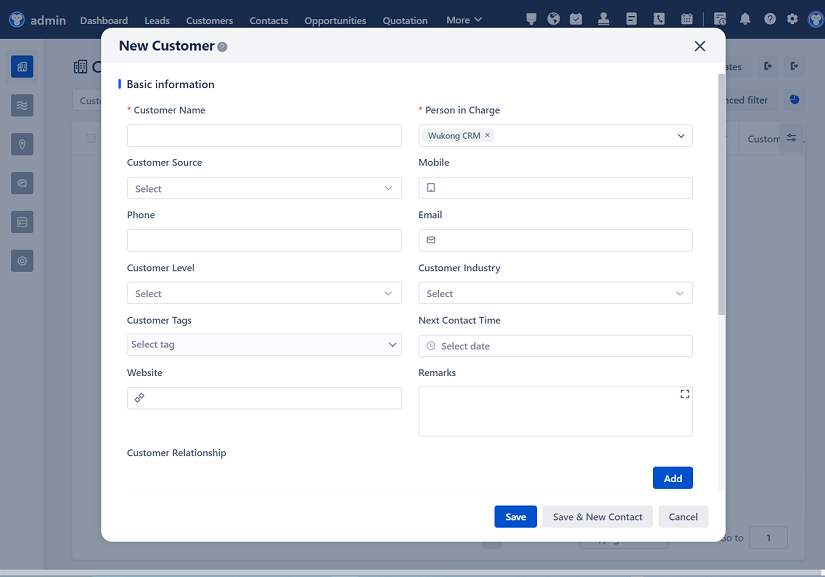
△Click on the top right corner to try Wukong CRM for free
So, let’s talk about CRM systems—because honestly, if you’re running a business these days, you’ve probably heard the term thrown around a lot. I mean, everyone’s saying you need a CRM, but when you actually start looking into it, it’s kind of overwhelming, right? There are so many brands out there, each claiming to be the best, and honestly, it’s hard to know where to even begin.

Free use of CRM system: Free CRM
I’ve been through this myself—trying to figure out which CRM actually fits what my team needs. It’s not just about picking the fanciest one or the cheapest one. It’s about finding something that actually works for your business, your team, and your customers. So, I thought I’d share what I’ve learned while comparing some of the most mainstream CRM platforms out there.

Let’s start with Salesforce. I know, I know—it’s kind of the big name in the CRM world. People talk about it like it’s the gold standard. And honestly, there’s a reason for that. Salesforce is powerful. It’s flexible. It can do just about anything you want it to do—if you have the time and resources to set it up properly.
But here’s the thing: Salesforce isn’t exactly beginner-friendly. If you’re a small team or you don’t have a dedicated IT person, it can feel like you’re trying to climb Mount Everest just to get basic features working. Plus, the pricing? Yeah, it adds up fast. Once you start adding on modules and integrations, your bill can skyrocket. So, while it’s great for larger companies with complex needs, it might be overkill for a small business just trying to keep track of customer interactions.
Then there’s HubSpot. Now, this one I actually really like—especially if you’re into marketing and sales alignment. HubSpot makes it super easy to manage leads, track emails, and even automate follow-ups. The interface is clean, intuitive, and honestly, kind of fun to use. You don’t need a degree in software engineering to figure it out.
One thing I appreciate about HubSpot is that they offer a genuinely useful free version. I mean, it’s limited, sure, but it’s enough to get started and see if it’s a good fit. And if you decide to upgrade, their pricing is pretty transparent. No hidden fees or surprise charges. That’s a big win in my book.
But—and there’s always a but—HubSpot starts to show its limits when your business grows. If you have a lot of custom workflows or need deep reporting, you might find yourself hitting a wall. Also, while their ecosystem is growing, it’s not as extensive as Salesforce’s when it comes to third-party integrations. So, it’s great for startups and mid-sized businesses, but maybe not the best long-term solution if you’re planning to scale aggressively.
Now, let’s talk about Zoho CRM. This one’s kind of the underdog, but don’t sleep on it. Zoho has been around for a while, and they’ve built a solid product. The pricing is super competitive—like, seriously affordable. You can get a lot of functionality for a fraction of what Salesforce or even HubSpot would charge.
I was surprised by how customizable Zoho is. You can tweak workflows, create custom fields, and even build your own automation rules without needing to code. And the mobile app? It’s actually good. I’ve used it on the go, and it works smoothly.

But here’s the catch: the user interface feels a little outdated. It’s functional, sure, but it doesn’t have that sleek, modern look that HubSpot or Salesforce offers. And while Zoho has a lot of features, some of them feel a bit buried or hard to find. You might spend more time navigating menus than actually using the tool. Plus, customer support can be hit or miss. I’ve had some frustrating experiences trying to get help when something wasn’t working.
Then there’s Microsoft Dynamics 365. If your company is already deep in the Microsoft ecosystem—like, you’re using Outlook, Teams, and Office 365—then Dynamics might be a no-brainer. It integrates seamlessly with all those tools, which is a huge plus. I’ve seen teams save hours every week just because their CRM talks directly to their email and calendar.
The reporting and analytics in Dynamics are also really strong. If you’re someone who loves data and wants to dive deep into customer behavior, this platform gives you a lot of power. And it scales well—so if you’re a mid-to-large business, it can grow with you.
But again, it’s not perfect. The learning curve is steep. It’s not as intuitive as HubSpot, and setting it up properly usually requires some technical know-how or even hiring a consultant. And the pricing? It’s on the higher side, especially once you start adding on modules. So, while it’s powerful, it’s definitely not the most budget-friendly option.
Another one worth mentioning is Pipedrive. This CRM is built specifically for sales teams, and it shows. The whole interface is designed around the sales pipeline—literally. You see your deals moving from stage to stage, and it’s super visual. I’ve used it with sales teams, and they love how easy it is to track progress and forecast revenue.
Pipedrive is also really user-friendly. It doesn’t overwhelm you with features you don’t need. It focuses on the essentials: managing leads, logging calls, and following up. And the mobile app is solid—great for salespeople who are always on the road.
But here’s the downside: it’s not as strong in marketing automation or customer service. If you’re looking for an all-in-one solution that covers sales, marketing, and support, Pipedrive might leave you wanting more. It’s best for sales-heavy businesses that want a simple, focused tool.
So, after all this comparing, how do you actually choose?
Well, first, think about your team size. If you’re a small startup, something like HubSpot or Pipedrive might be perfect. They’re easy to use, affordable, and get you up and running quickly. But if you’re a larger organization with complex processes, you might need the power of Salesforce or Dynamics.
Next, consider your budget. I know, nobody likes talking about money, but it’s important. Some CRMs look cheap at first, but then you add on features and integrations, and suddenly you’re paying way more than expected. Be honest about what you can afford—not just now, but in the long run.
Also, think about integration. Does your CRM need to work with your email, calendar, marketing tools, or accounting software? If so, make sure the platform you choose plays well with others. Nothing’s more frustrating than having to manually export and import data every day.
And don’t forget about scalability. Will this CRM still work for you in two years? Five years? Or will you outgrow it and have to switch again? That kind of migration is a headache you don’t want to deal with twice.
User experience matters too. If your team hates using the CRM, they won’t use it. And if they don’t use it, it’s useless. So, pick something that’s intuitive and actually enjoyable to use. A tool is only as good as the people using it.
Based on everything I’ve seen, here’s my personal recommendation: if you’re just starting out, go with HubSpot. It’s affordable, easy to learn, and covers most of what small to mid-sized businesses need. If you’re more sales-focused and want a clean pipeline view, Pipedrive is a great choice. For larger companies with complex needs and IT support, Salesforce or Microsoft Dynamics are worth the investment. And if you’re on a tight budget but still want solid functionality, Zoho CRM is a smart pick.
But here’s the truth: there’s no one-size-fits-all CRM. What works for one company might be a disaster for another. So, don’t rush into a decision. Take advantage of free trials. Let your team test it out. See how it feels in real-world use.
And remember, a CRM isn’t just software—it’s a tool to help you build better relationships with your customers. So, choose one that helps you do that, not one that just looks good on a brochure.
At the end of the day, the best CRM is the one your team actually uses and that makes your life easier. Everything else is just noise.

FAQs (Frequently Asked Questions)
Q: Is Salesforce really worth the high price?
A: It depends. If you’re a large company with complex sales processes and you need deep customization, then yes, it can be worth it. But for smaller teams, it’s often overkill and too expensive.
Q: Can I switch CRMs later if I don’t like the one I chose?
A: Yes, but it’s not fun. Data migration can be messy and time-consuming. That’s why testing with a free trial first is so important.
Q: Do I need a CRM if I only have a few customers?
A: Even small businesses benefit from a CRM. It helps you stay organized, remember follow-ups, and build stronger relationships—even with just a handful of clients.
Q: Which CRM has the best customer support?
A: HubSpot and Salesforce are known for strong support, but Zoho and Pipedrive can be hit or miss. Always check reviews and maybe even call their support line before committing.
Q: Are free CRM tools reliable?
A: Some are! HubSpot’s free CRM is actually really solid. But free versions usually limit features or the number of contacts. Still, they’re great for testing and small teams.
Q: Can a CRM help with marketing?
A: Absolutely. Tools like HubSpot and Salesforce have strong marketing automation features—email campaigns, lead scoring, analytics—you name it.
Q: How long does it take to set up a CRM?
A: It varies. Simple ones like Pipedrive or HubSpot can be up in a day. More complex systems like Salesforce or Dynamics might take weeks or even months, especially with customization.
Q: Should I get a CRM that includes customer service tools?
A: Only if you need them. If you’re handling support tickets, yes. But if you’re just managing sales, a simpler CRM might be better.
Q: Can I use a CRM on my phone?
A: Most modern CRMs have mobile apps. HubSpot, Salesforce, and Pipedrive all have solid mobile experiences.
Q: What’s the biggest mistake people make when choosing a CRM?
A: Picking one based on features alone without thinking about ease of use or team adoption. If your team won’t use it, it doesn’t matter how powerful it is.
Related links:
Free trial of CRM
Understand CRM software
△Click on the top right corner to try Wukong CRM for free