
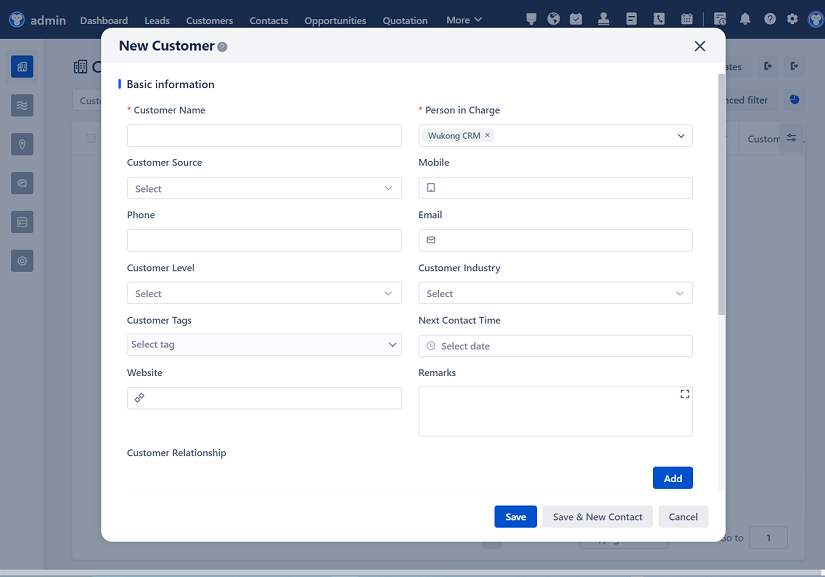
△Click on the top right corner to try Wukong CRM for free
So, you know how businesses these days are all about understanding their customers better? I mean, it’s not just about selling stuff anymore — it’s about knowing who’s buying, why they’re buying, and what makes them come back. That’s where CRM customer segmentation models come into play. Honestly, if you’re running a business without some kind of segmentation, you’re kind of flying blind.

Free use of CRM system: Free CRM
Let me break it down for you. Customer segmentation is basically the process of dividing your customer base into groups that share similar characteristics. It could be based on age, location, spending habits, how often they buy, or even how they interact with your brand online. The idea is simple: treat different customers differently because, well, they are different.
Now, when we talk about CRM systems — Customer Relationship Management platforms — they’re supposed to help companies manage interactions with current and potential customers. But here’s the thing: most CRMs collect tons of data, but if you don’t organize that data smartly, it’s just noise. That’s why building solid segmentation models inside your CRM is so important.
I remember working with a retail client a while back. They had this huge database of customers, but everyone got the same email promotions. No wonder their open rates were terrible. Once we started segmenting them — like grouping frequent buyers, occasional shoppers, high spenders, bargain hunters — everything changed. Suddenly, their campaigns made sense. People actually opened the emails because the offers felt relevant.
So how do you actually build these models? Well, there are a few common approaches. One popular method is RFM analysis — that stands for Recency, Frequency, Monetary value. It’s pretty straightforward: how recently did the customer buy? How often do they buy? And how much do they spend? You score each customer on these three factors, and boom — you’ve got segments like “loyal customers,” “at-risk customers,” or “new prospects.”
But honestly, RFM isn’t the only way. Some companies use demographic segmentation — things like age, gender, income level. Others go behavioral: what products do they look at? Do they abandon carts? Are they active on mobile or desktop? Then there’s psychographic segmentation, which dives into lifestyle, values, interests. That one’s trickier to measure, but super powerful when done right.
And let’s not forget about predictive modeling. With machine learning, you can actually predict future behavior — like who’s likely to churn, or who might respond to a discount. It sounds fancy, but once you get the data pipeline set up, it’s totally doable, even for mid-sized companies.
But here’s the real challenge: making sure your CRM can actually support all this. A lot of CRMs have basic tagging features, but they’re clunky. You need a tag system that’s flexible, scalable, and easy for your team to use. Otherwise, no matter how good your models are, nobody’s going to apply them consistently.
So how do you design a good tag system? First, keep it simple. Don’t go overboard with hundreds of tags — that just confuses people. Start with broad categories: customer type (e.g., new, returning, VIP), behavior (e.g., cart abandoner, newsletter subscriber), lifecycle stage (e.g., prospect, active, dormant). Then, layer in more specific tags as needed.
I worked with a SaaS company that had over 200 tags. No joke. Their sales team barely used any of them because it was overwhelming. We cleaned it up, cut it down to about 30 core tags, and organized them into hierarchies. Suddenly, everyone knew where to find what they needed.
Another tip: make tags dynamic whenever possible. Instead of manually tagging someone as “high spender,” set up rules so the system auto-tags them when they hit a certain purchase threshold. Same with engagement — if someone hasn’t logged in for 60 days, automatically tag them as “dormant.” Automation saves time and reduces human error.
And please, for the love of data, document everything. What does each tag mean? Who owns it? When should it be applied or removed? Without clear definitions, your team will start using tags inconsistently, and your segmentation falls apart.
You also gotta think about integration. Your CRM doesn’t live in a vacuum. It needs to pull data from your website, email platform, ad tools, maybe even your support system. If your tag system can sync across platforms, you get a unified view of the customer. That’s gold.
One thing I always tell clients: segmentation isn’t a one-and-done project. People change. Behaviors shift. A loyal customer today might become inactive next month. So your models and tags need to be reviewed regularly — quarterly, at least. Update your scoring, refine your categories, retire outdated tags.

And don’t forget testing. Try out different segmentation strategies on small groups before rolling them out widely. See what drives better engagement, higher conversion, lower churn. Use A/B testing to compare segmented campaigns vs. generic ones. The results usually speak for themselves.
Oh, and personalization — that’s the whole point, right? Once you’ve got clean segments and a solid tag system, you can personalize communications like never before. Imagine sending a birthday discount to a high-value customer, or a re-engagement offer to someone who hasn’t bought in months. That kind of relevance builds loyalty.
But here’s a reality check: none of this works if your data is messy. Duplicate records, missing info, inconsistent formatting — it all screws up your segmentation. So invest time in data hygiene. Clean your database, standardize inputs, deduplicate records. It’s boring work, but absolutely necessary.
Also, involve your teams early. Sales, marketing, customer support — they all interact with customers differently. Get their input on what segments would be most useful. Maybe marketing cares about campaign response, while support wants to flag frustrated users. Build a system that serves everyone.
And don’t underestimate training. Just because you’ve built a beautiful tag system doesn’t mean people will use it correctly. Run workshops, create cheat sheets, assign tag champions in each department. Make adoption part of your culture.
Now, let’s talk about privacy. With all this data collection and tracking, you’ve got to stay compliant with regulations like GDPR or CCPA. Be transparent with customers about how you use their data. Give them control. Not only is it the law, but it builds trust.
One last thing — start small. You don’t need a perfect system on day one. Pick one segmentation model, like RFM, implement it, test it, learn from it. Then expand. Rome wasn’t built in a day, and neither is a great CRM strategy.
At the end of the day, customer segmentation and tag design aren’t just technical exercises. They’re about empathy. They force you to see your customers as individuals, not just entries in a database. And when you treat people like real humans — with personalized messages, relevant offers, timely support — they notice. They stay. They spend more. They refer friends.
So yeah, it takes effort. But trust me, it’s worth it. I’ve seen companies double their retention rates just by cleaning up their CRM tags and applying smart segmentation. That’s not magic — that’s just doing the basics really well.

If you’re feeling overwhelmed, just take it step by step. Define your goals. Audit your current data. Pick a model. Design simple, meaningful tags. Automate what you can. Train your team. Test, learn, improve. Keep iterating.

And remember: the goal isn’t to have the fanciest CRM in the world. It’s to understand your customers better so you can serve them better. Everything else is just details.
FAQs (Frequently Asked Questions)
Q: What’s the difference between customer segmentation and tagging?
A: Great question! Segmentation is the overall strategy of grouping customers based on shared traits. Tagging is a tactical tool within your CRM that helps label and organize those segments — like putting sticky notes on customer profiles.
Q: Can I use multiple segmentation models at once?
Absolutely. In fact, you probably should. For example, you might use RFM for behavior and demographics for targeting. Just make sure your tag system can handle overlapping categories without confusion.
Q: How often should I update my customer segments?
Ideally, your segments should update dynamically — especially if you’re using automated rules. But you should review the overall model every quarter to ensure it still aligns with your business goals.
Q: What if my team resists using the tag system?
That’s common. Usually, it’s because the system is too complex or poorly explained. Simplify the tags, provide training, and show them how it makes their jobs easier — like finding leads faster or writing better emails.
Q: Are AI and machine learning necessary for good segmentation?
Not at all. While AI can enhance predictions, basic models like RFM work incredibly well for most businesses. Start simple, prove value, then consider advanced tools later.
Q: How do I avoid creating too many tags?
Focus on usefulness. Ask: “Will this tag drive a specific action?” If not, skip it. Also, use parent-child hierarchies — like having “Behavior” as a main category with sub-tags like “Clicked Email” or “Viewed Product.”
Q: Can segmentation help reduce customer churn?
Definitely. By identifying at-risk customers early — say, through declining activity — you can proactively reach out with special offers or support, improving retention.
Q: Should I segment B2B and B2C customers the same way?
Not exactly. B2B segmentation often includes company size, industry, or decision-maker role, while B2C leans more on personal behavior and demographics. Tailor your approach to your audience.
Q: What’s the biggest mistake companies make with CRM tagging?
Hands down, inconsistency. If two people apply tags differently, your data becomes unreliable. That’s why clear definitions and automation are so important.
Q: How do I measure the success of my segmentation?
Look at metrics like email open rates, conversion rates, average order value, and churn rate — compare segmented campaigns to non-segmented ones. If segmentation works, the numbers will show it.
Related links:
Free trial of CRM
Understand CRM software
△Click on the top right corner to try Wukong CRM for free