
△Click on the top right corner to try Wukong CRM for free
You know, when people hear the term CRM—Customer Relationship Management—they often think it’s just some fancy software salespeople use to keep track of contacts. But honestly, that couldn’t be further from the truth. I’ve seen firsthand how powerful a well-implemented CRM system can be across different industries. It’s not just about storing names and emails; it’s about building real relationships, understanding customer behavior, and making smarter business decisions.
Let me tell you about a retail company I once consulted for. They were struggling with customer retention—people would buy once, then disappear. Sound familiar? We implemented a CRM platform that integrated their online store, in-store POS systems, and email marketing tools. Within six months, they started seeing patterns in customer behavior. For example, they noticed that customers who bought hiking boots in winter were more likely to purchase camping gear in spring. So what did they do? They set up automated email campaigns with personalized product recommendations based on past purchases. The result? A 35% increase in repeat purchases. That’s not luck—that’s smart CRM use.
And it’s not just retail. Think about healthcare. I remember talking to a clinic manager who was drowning in paperwork and missed patient follow-ups. Their old system was basically a stack of folders and Excel sheets. We brought in a CRM tailored for healthcare providers. Suddenly, appointment reminders went out automatically, patient histories were instantly accessible, and doctors could see trends—like which patients were overdue for checkups. Not only did patient satisfaction go up, but no-show rates dropped by nearly half. Imagine that—a tool designed for sales actually improving patient care.
Now, let’s talk about hospitality. I stayed at this boutique hotel last year, and honestly, the experience blew me away. When I checked in, the front desk agent greeted me by name and mentioned my preference for a room facing the garden—something I’d only noted during a previous booking. How did they remember? Their CRM. It tracked guest preferences, special requests, even past complaints. After my stay, I got a personalized thank-you email with a discount for next time. That kind of attention makes you want to come back. And guess what? Their return guest rate is now over 60%. That’s the magic of using CRM to create emotional connections.
But here’s something people don’t always realize: CRM isn’t just for big companies with huge budgets. I worked with a small nonprofit focused on literacy programs. They had limited staff and resources, but they needed to manage donor relationships, volunteer sign-ups, and event planning. We set them up with a lightweight, cloud-based CRM. Now, instead of chasing down spreadsheets, they can track donor history, send targeted fundraising appeals, and measure campaign success—all in one place. Last quarter, they raised 40% more than the same time the previous year. And the best part? The team actually has time to focus on their mission instead of admin work.
Sales teams, of course, are where CRM really shines. I’ve seen reps go from overwhelmed to overachieving just by using CRM properly. One sales director told me his team used to waste hours every week manually updating deal stages and chasing leads through disjointed tools. After implementing a unified CRM, everything changed. Leads were scored automatically, tasks were assigned based on priority, and managers could see real-time dashboards showing pipeline health. The average sales cycle shortened by 22%, and win rates improved. It wasn’t because the reps suddenly became superstars—it was because the CRM gave them clarity and structure.
Customer service is another area where CRM makes a massive difference. Picture this: You call a support line, get transferred three times, and have to repeat your issue each time. Frustrating, right? A telecom company I advised had that exact problem. Customers hated calling because no one knew their history. We integrated their CRM with their call center software. Now, when a customer calls, the agent sees their entire interaction history—past tickets, payments, even social media mentions. Resolutions are faster, and agents feel more empowered. Customer satisfaction scores jumped from 3.2 to 4.6 out of 5 in just four months. That’s not just a number—that’s real people having better experiences.
What’s interesting is how CRM helps with cross-department collaboration. I remember sitting in a meeting with marketing, sales, and customer success teams who were all blaming each other for low conversion rates. Marketing said sales wasn’t following up. Sales said leads were low quality. Customer success said onboarding was broken. We pulled up the CRM data, and boom—there it was. Leads were being passed without context, follow-ups were inconsistent, and onboarding tasks weren’t tracked. Once everyone started using the same CRM system, visibility improved, accountability increased, and alignment happened naturally. Conversions went up by 18% in two quarters. Sometimes, the biggest obstacle isn’t process—it’s lack of shared information.
Another cool example comes from education. A university I collaborated with was losing prospective students during the application process. Too many fell through the cracks. They implemented a CRM to track student inquiries from first contact through enrollment. Advisors received alerts when a prospect hadn’t responded in a week, and automated workflows sent helpful info—like scholarship deadlines or campus tour invites. They even used CRM analytics to identify which outreach methods worked best. Enrollment increased by 12% the next cycle. And students felt supported, not just processed.
Let’s not forget field service businesses. I spoke with an HVAC company owner who was tired of technicians showing up without the right parts or customer history. Scheduling was a mess, and customers were annoyed. We introduced a mobile-friendly CRM with GPS routing and job history access. Technicians could pull up past service records on their tablets, order parts on the go, and update job statuses in real time. Dispatchers could reassign jobs dynamically. Customer wait times dropped, first-time fix rates improved, and the owner finally got accurate reports on technician performance. He told me, “I feel like I’m running a real business now, not just putting out fires.”

One thing I’ve learned is that CRM success isn’t just about the technology—it’s about adoption. I’ve seen companies spend thousands on a top-tier CRM only to have employees resist using it. Why? Because they weren’t involved in the process, or the system was too complicated. So now, whenever I help implement a CRM, I start with training and change management. We run workshops, create simple guides, and appoint internal champions. People are more likely to use a tool if they understand how it makes their lives easier. One rep told me, “I used to hate data entry, but now I see how this helps me close more deals. I actually look forward to updating it.”

Integration is another key factor. A CRM that sits in isolation is barely useful. I helped an e-commerce brand connect their CRM with their Shopify store, email platform, and even their accounting software. Now, when someone buys a product, the CRM logs it, tags them with relevant categories, and triggers a post-purchase survey. If the customer responds positively, they’re added to a VIP list for exclusive offers. If they complain, a service agent gets an alert. This seamless flow means nothing falls through the cracks. And revenue from repeat customers grew by 50% in a year.
Analytics within CRM systems are also game-changers. I worked with a B2B SaaS company that had no idea why some customers churned while others stayed for years. We dove into their CRM data and found patterns—customers who attended onboarding webinars and used the help center had much higher retention. So they redesigned their onboarding process to include mandatory training sessions and proactive check-ins. Churn dropped by 30%. That insight came straight from the CRM. Without it, they’d still be guessing.
And let’s talk about scalability. A startup founder once told me, “We’re growing fast, but our processes are breaking.” They were using Google Sheets to track clients. I recommended a scalable CRM early on. As they expanded to new markets, the CRM handled thousands of contacts, automated localization emails, and provided regional performance reports. It grew with them instead of holding them back. That foresight saved them months of painful migration later.
Of course, CRM isn’t a magic fix. It won’t solve bad products or poor service. But when used right, it amplifies good strategies. It turns random interactions into meaningful relationships. It helps companies see the full picture of their customers—not just as transactions, but as people with needs, preferences, and stories.
Honestly, the most rewarding part for me is seeing how CRM empowers employees. I’ve watched overwhelmed customer service agents become confident problem-solvers. I’ve seen salespeople go from stressed to strategic. Managers gain insights they never had before. It’s not just about efficiency—it’s about dignity in work. When people have the right tools, they do better work and feel more valued.
So if you’re thinking about CRM, don’t just buy software. Think about your goals. What relationships matter most to your business? Where are the gaps in communication? How can technology help you listen better, respond faster, and care more deeply? Start small, involve your team, and focus on real outcomes—not just features.
Because at the end of the day, CRM isn’t about managing customers. It’s about understanding them. And when you truly understand someone, you can serve them in ways that matter. That’s where loyalty is built. That’s where businesses thrive.
FAQs (Frequently Asked Questions):
Q: Is CRM only useful for big companies?
A: Not at all. Small businesses and nonprofits benefit hugely from CRM—sometimes even more than large enterprises because they often lack dedicated teams for tracking relationships.

Q: How long does it take to see results after implementing a CRM?
A: It varies, but many companies see improvements in efficiency within weeks. Real impact on sales or retention usually shows up in 3–6 months, especially if adoption is strong.
Q: Can CRM help with social media customer interactions?
Yes, absolutely. Modern CRMs can integrate with platforms like Facebook, Twitter, and Instagram, so all customer messages and comments are logged alongside other interactions.
Q: Do I need IT support to run a CRM?
Not necessarily. Many cloud-based CRMs are user-friendly and require minimal technical knowledge. However, having someone tech-savvy on your team helps with setup and troubleshooting.
Q: What’s the biggest mistake companies make with CRM?
Probably treating it as just a database. The real power comes from using it to drive actions—follow-ups, personalization, forecasting—not just storing data.
Q: Can CRM improve teamwork between departments?
Definitely. When marketing, sales, and service all use the same CRM, everyone sees the same customer story, reducing silos and miscommunication.
Q: Is CRM expensive?
There are options for every budget. Some free or low-cost CRMs work great for small teams, while enterprise systems cost more but offer deeper functionality.
Q: How do I get my team to actually use the CRM?
Start with clear communication about why it matters. Provide training, recognize early adopters, and show how it makes their daily work easier—not harder.
Related links:
Free trial of CRM
Understand CRM software
AI CRM Systems
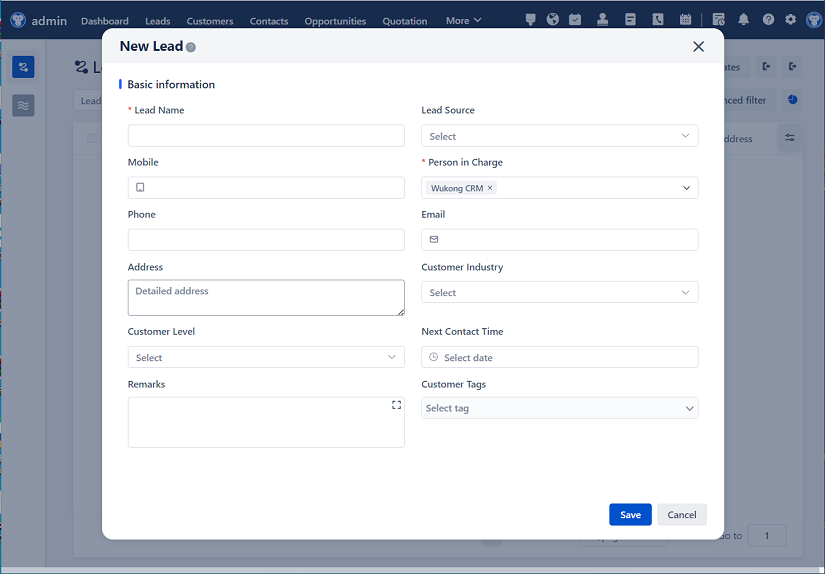
△Click on the top right corner to try Wukong CRM for free