
△Click on the top right corner to try Wukong CRM for free
So, let’s talk about on-premise CRM systems—because honestly, if you’re running a business and trying to manage customer relationships, this is something you’ve probably thought about. I mean, it’s not just about storing contact info anymore; it’s about how you interact with your customers, track sales, and keep everything organized. And when it comes to CRM, one of the big decisions you face is whether to go with an on-premise setup or cloud-based. Today, I want to walk you through the pros and cons of on-premise CRM systems—just like we’re having a real conversation over coffee.
First off, what exactly do we mean by “on-premise”? Well, it means the CRM software is installed and runs on your company’s own servers and computers. You own the hardware, you control the data, and you’re responsible for maintaining everything. It’s kind of like owning a house versus renting an apartment—you have more control, but also more responsibility.

Now, one of the biggest advantages people talk about with on-premise CRM is control. Yeah, I know that sounds obvious, but hear me out. When your CRM is hosted in-house, you’re not relying on a third-party provider to keep things running. That means you can customize the system exactly how you want it. Want to tweak the backend code? Go ahead. Need to integrate it deeply with other internal systems? No problem. You call the shots.
And then there’s data security. Look, I get it—data breaches are scary, and no one wants their customer information leaked. With on-premise CRM, your data stays within your own network. You decide who has access, how it’s encrypted, and where it’s stored. For industries like finance, healthcare, or legal services, that level of control can be a huge relief. You’re not sending sensitive data over the internet to some server farm you’ve never seen.
Another thing I’ve heard from businesses using on-premise CRM is that they feel more confident about compliance. If you’re dealing with regulations like HIPAA, GDPR, or SOX, having full oversight of your data environment helps you meet those requirements more easily. You can audit your systems whenever you want, make sure logs are kept properly, and show regulators exactly where everything is.

Performance is another point worth mentioning. Since the CRM runs on your local network, it can be faster—especially if you have a lot of users accessing it at once. There’s no lag from connecting to a remote server, no dependency on internet speed. Everything happens internally, so response times are usually quicker. That’s a big deal if your sales team is constantly pulling up customer records during calls.
But—and this is a big but—it’s not all sunshine and rainbows. Because with all that control comes a ton of responsibility. Think about it: you’re now in charge of updates, patches, backups, and server maintenance. That means you need IT staff—or at least someone tech-savvy—on hand to handle it. And if something goes wrong at 2 a.m.? Yeah, it’s on you to fix it.
And speaking of costs, let’s talk money. On-premise CRM usually has a higher upfront cost. You’ve got to buy the software licenses, set up servers, maybe even upgrade your network infrastructure. Plus, ongoing expenses for maintenance, support, and staffing add up fast. Cloud CRM might charge a monthly fee per user, but with on-premise, you’re making a big investment right out of the gate.
Then there’s scalability. Let’s say your business grows quickly—awesome, right? But now you need to scale your CRM to handle more users, more data, more everything. With on-premise, that means buying more hardware, expanding storage, possibly upgrading software licenses. It’s not as simple as clicking a button like it is with cloud solutions. So if you’re a fast-growing startup or expect rapid changes, this could be a headache.
Another thing people don’t always think about is mobility. These days, everyone’s working remotely or on the go. Sales reps need to access customer info from their phones, tablets, or laptops while traveling. With on-premise CRM, that can be tricky. Sure, you can set up remote access, but it often requires extra configuration, virtual private networks (VPNs), and security measures. And sometimes, it just doesn’t work as smoothly as a cloud-based system that’s designed for mobile access from day one.
Updates are another pain point. With cloud CRM, the provider pushes updates automatically—new features, bug fixes, security patches—all handled for you. But with on-premise? You have to install updates manually. That means scheduling downtime, testing compatibility, and hoping nothing breaks. And let’s be honest, nobody likes system downtime during business hours.
Integration with other tools can be a mixed bag too. On one hand, because you have full access to the system, you can integrate it deeply with your ERP, accounting software, or custom apps. But on the other hand, doing that integration often requires custom development work, which takes time and money. With cloud platforms, many offer pre-built connectors and APIs that make integration way easier.
Let’s also talk about disaster recovery. If your server crashes or there’s a fire in your office, what happens to your CRM data? With on-premise, you better have a solid backup strategy in place. That means regular backups, offsite storage, and a tested recovery plan. Cloud providers usually include redundancy and disaster recovery as part of their service—something you’d have to build yourself with on-premise.
And here’s something else: vendor lock-in isn’t really the issue with on-premise, but long-term flexibility might be. Once you’ve invested in a specific CRM platform and built all these customizations, switching later becomes a massive undertaking. You’re tied to that system, and migrating years’ worth of data and workflows to a new platform? That’s a project nobody looks forward to.
But despite all these challenges, some companies still swear by on-premise CRM. Why? Because for them, the benefits outweigh the drawbacks. They value control, security, and performance more than convenience and low upfront costs. They have the IT resources to manage it, and they’re not planning to scale rapidly or change direction often.
I’ve talked to a manufacturing company that uses on-premise CRM, and they love it. Their entire production, sales, and support teams are in one location, so network speed is great, and they don’t need much remote access. They’ve customized the system to track everything from customer orders to machine maintenance schedules. For them, it works perfectly.
On the flip side, I’ve seen small businesses try to go the on-premise route and struggle. They didn’t realize how much IT support they’d need, and when a server failed, they lost days of data because backups weren’t configured right. They ended up switching to a cloud solution just to save time and reduce stress.
So, what’s the bottom line? On-premise CRM isn’t inherently better or worse—it depends on your situation. Ask yourself: Do you have the technical expertise in-house? Are you comfortable managing servers and updates? Is data sovereignty a top priority? How important is remote access to your team?
If you’re a large enterprise with strict compliance needs and a dedicated IT department, on-premise might make sense. But if you’re a small or mid-sized business looking for flexibility, ease of use, and lower initial costs, cloud CRM is probably the smarter choice.
And hey, it’s not always black and white. Some companies actually use a hybrid approach—running core CRM functions on-premise while using cloud tools for mobile access or specific departments. That way, they get some of the control they want without sacrificing too much convenience.
At the end of the day, choosing a CRM system isn’t just about technology—it’s about your people, your processes, and your priorities. Take the time to evaluate what matters most to your business. Talk to your team. Consider your budget. And don’t be afraid to ask for demos or trial versions before making a decision.
Because honestly, the best CRM is the one your team will actually use—and that fits the way you work, not the other way around.
FAQs (Frequently Asked Questions):
Q: Is on-premise CRM more secure than cloud CRM?
A: Not necessarily. While on-premise gives you more direct control over your data, cloud providers often have stronger security measures, like advanced encryption, multi-factor authentication, and dedicated security teams. The key is how well you manage your system, regardless of where it’s hosted.
Q: Can I access an on-premise CRM from outside the office?
A: Yes, but it requires setup. You’ll need remote access tools like a VPN or remote desktop software. It’s possible, but it’s usually less seamless than logging into a cloud CRM from any device with an internet connection.

Q: How much does an on-premise CRM typically cost?
A: It varies widely, but you’re looking at software licensing fees (often per user), server hardware, installation, IT staffing, maintenance, and upgrades. Initial costs can range from tens of thousands to hundreds of thousands of dollars, depending on size and complexity.
Q: What happens if my on-premise CRM server fails?
A: That’s why backups are critical. If you have a proper disaster recovery plan, you can restore data from backups. Without one, you risk losing valuable customer information and business continuity.
Q: Can I switch from on-premise to cloud CRM later?
A: Yes, but it’s a complex process. You’ll need to migrate data, reconfigure workflows, retrain staff, and ensure compatibility. It’s doable, but it takes time, planning, and often external help.
Q: Do on-premise CRMs require constant IT support?
A: Pretty much, yes. You’ll need someone to handle updates, troubleshoot issues, manage user access, monitor performance, and maintain security. If you don’t have in-house IT, this can become a major burden.
Q: Are there any industries where on-premise CRM is strongly recommended?
A: Yes—industries with strict data regulations, like healthcare (HIPAA), government, defense, or financial services, often prefer on-premise solutions to maintain tighter control over data residency and compliance.
Related links:
Free trial of CRM
Understand CRM software
AI CRM Systems
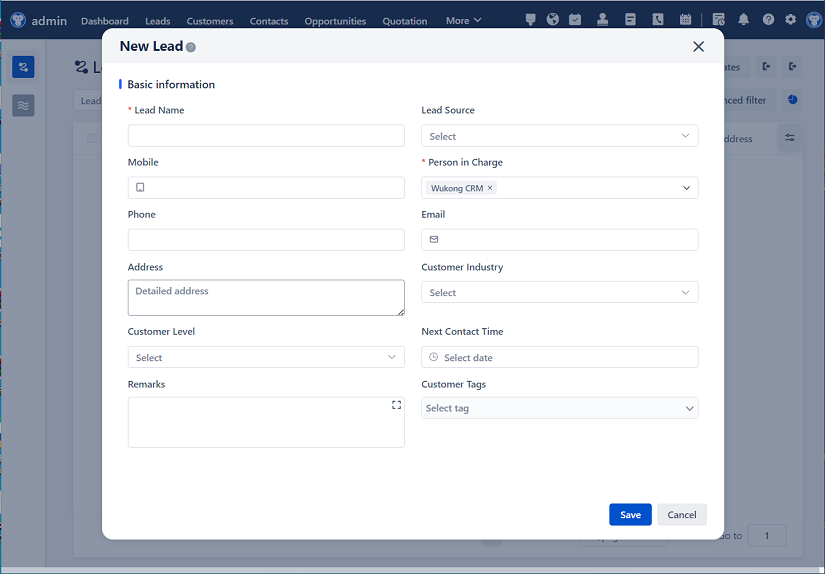
△Click on the top right corner to try Wukong CRM for free