
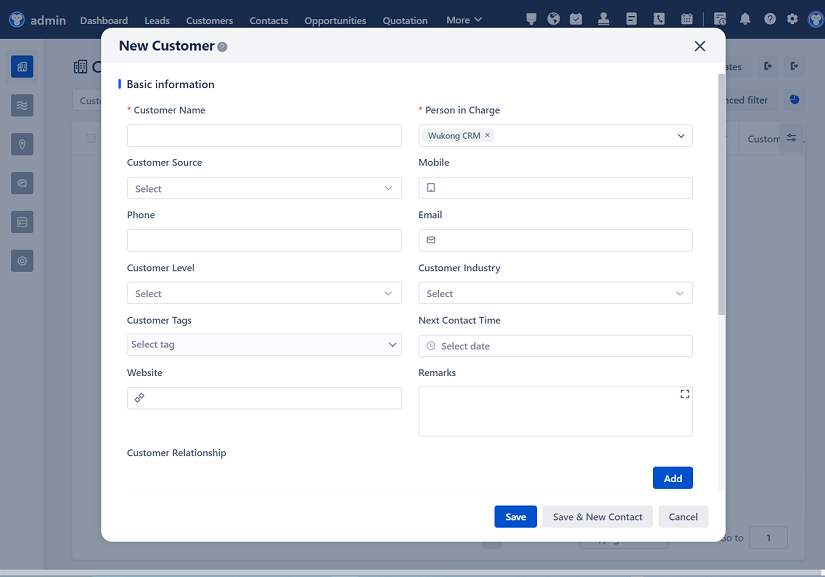
△Click on the top right corner to try Wukong CRM for free
Hey there! So, you're curious about what solutions are out there for CRM systems in the building materials industry, huh? Well, you've come to the right place. Let me break it down for you in a way that's easy to understand and, hopefully, a bit fun too.
First things first, let's talk about why CRM (Customer Relationship Management) systems are such a big deal in the building materials industry. You see, this industry is all about relationships—whether it's with your suppliers, your customers, or even your competitors. A good CRM system can help you keep track of all these connections, making sure you don't miss a beat. It's like having a super-smart assistant who remembers everything for you, so you don't have to.
Now, when it comes to choosing a CRM solution, there are a few key players in the market that you might want to check out. One of the most popular ones is Salesforce. I mean, who hasn't heard of Salesforce, right? It's like the Beyoncé of CRM systems. With Salesforce, you get a ton of features that can be customized to fit the specific needs of the building materials industry. For example, you can manage your sales pipeline, track customer interactions, and even integrate with other tools you might be using, like your accounting software or project management tools. It's pretty much a one-stop shop for all your CRM needs.
But, hey, not everyone is a fan of the big names, and that's totally okay. There are some more specialized CRM solutions out there that are specifically designed for the building materials industry. One of these is Epicor. Now, Epicor is a bit different from Salesforce because it's not just a CRM; it's an entire ERP (Enterprise Resource Planning) system. This means it can handle not only your customer relationships but also your inventory, supply chain, and even your financials. It's like having a Swiss Army knife for your business. If you're looking for something that can do it all, Epicor might be the way to go.
Another option you might want to consider is Microsoft Dynamics 365. This is another big player in the CRM world, and it's got a lot going for it. One of the things I really like about Dynamics 365 is how well it integrates with other Microsoft products, like Office 365 and Azure. If you're already using a lot of Microsoft stuff, this could be a great choice. Plus, it's got some really cool AI features that can help you analyze customer data and make better decisions. It's like having a crystal ball that tells you what your customers want before they even know it themselves.
Now, if you're a smaller company or just starting out, you might not need all the bells and whistles that come with the big CRM systems. In that case, you might want to look at something a bit more lightweight, like Zoho CRM. Zoho is known for being user-friendly and affordable, which is great if you're on a budget. It still has a lot of the core CRM features you'd expect, like contact management, lead tracking, and sales forecasting. And, if you ever need to scale up, Zoho can grow with you. It's like having a pair of shoes that fits perfectly now but can stretch as your feet get bigger.
Of course, no discussion of CRM solutions would be complete without mentioning HubSpot. HubSpot is a bit of a hybrid—it's not just a CRM, but also a marketing and sales platform. This means you can use it to manage your customer relationships, but also to run your email campaigns, create landing pages, and even do some basic SEO. It's like having a marketing guru and a sales manager all rolled into one. If you're looking to streamline your marketing and sales efforts, HubSpot could be a great choice.
So, those are some of the main CRM solutions out there for the building materials industry. But, before you jump in and choose one, there are a few things you should think about. First, what are your specific needs? Do you need a full-blown ERP system, or will a simpler CRM do the trick? Second, what's your budget? Some of these systems can get pretty pricey, especially if you start adding on extra features. Third, how tech-savvy are you and your team? Some of these systems are easier to use than others, and you don't want to end up with something that's too complicated to figure out.
Once you've thought about these things, you might want to take a closer look at each of the options I mentioned. Most of them offer free trials, so you can test them out and see which one feels right for you. It's kind of like trying on clothes—you want to make sure it fits well and looks good before you buy it.
Alright, I hope that gives you a good overview of what's out there. CRM systems can be a game-changer for businesses in the building materials industry, and with the right one, you can take your customer relationships to the next level. Just remember, the best CRM is the one that works for you and your team, so take your time and find the perfect fit.
Now, I bet you've got some questions, so let me try to answer a few of them:
Q: What if I'm not sure which CRM system is right for my business? A: That's totally normal! The best thing to do is to list out your specific needs and then try out a few different systems. Most CRM providers offer free trials, so you can test them out and see which one feels the most intuitive and useful for your team.
Q: Can I customize these CRM systems to fit my specific needs? A: Absolutely! Most CRM systems are highly customizable. You can add or remove features, set up custom workflows, and even integrate with other tools you're already using. If you're not sure how to do this, many CRM providers offer support and training to help you get started.
Q: How long does it usually take to implement a new CRM system? A: It depends on the complexity of the system and how much customization you need. Simple setups can be done in a matter of days, while more complex implementations might take a few weeks or even months. The key is to plan ahead and make sure you have the right resources in place.

Q: Are there any hidden costs I should be aware of? A: Good question! While most CRM providers are upfront about their pricing, there can be additional costs for things like integrations, customizations, and training. Make sure to ask about these upfront so you can budget accordingly.
Q: Can I migrate my existing data to a new CRM system? A: Yes, most CRM systems have tools and services to help you migrate your existing data. It's a good idea to work with the CRM provider or a third-party consultant to ensure a smooth transition. They can help you clean up your data, map it to the new system, and make sure everything is set up correctly.
I hope that helps! If you have any more questions, feel free to reach out. Good luck with your CRM journey!

Related links:
Free trial of CRM
Understand CRM system
AI CRM Systems
△Click on the top right corner to try Wukong CRM for free