
△Click on the top right corner to try Wukong CRM for free
Hey there! So, you've heard the term "enterprise CRM management system" thrown around and are wondering what it's all about? Well, let me break it down for you in a way that feels like we're just chatting over coffee.
First off, CRM stands for Customer Relationship Management. It's kind of like having a super-smart assistant who helps you keep track of all your customer interactions, from the first time they visit your website to when they become loyal, repeat customers. Imagine if you had a magic notebook that could remember every little detail about your customers—what they like, what they don't, when they last bought something, and even what they might be interested in next. That's what a CRM does, but on a much bigger scale, especially for large companies.
Now, why would a big company need something like this? Well, think about it: as a business grows, so does the number of customers, and keeping track of all those relationships can get pretty overwhelming. An enterprise CRM system is like a digital brain that helps manage all these connections, making sure no one falls through the cracks. It’s not just about remembering names and faces; it’s about understanding each customer's journey and tailoring your approach to make them feel special.
So, what exactly can an enterprise CRM do? Let me give you a rundown. First, it can help you collect and organize all sorts of data about your customers. This includes their contact information, purchase history, preferences, and even how they interact with your marketing campaigns. It’s like having a detailed dossier on each person, but in a way that respects their privacy and keeps everything organized.

But wait, there's more! A good CRM system also helps you communicate with your customers in a more personalized way. For example, if you know that a customer has been looking at a particular product, you can send them a special offer or a reminder. It’s like being able to whisper in their ear, “Hey, I noticed you were interested in this. How about a little discount?” And trust me, people love that kind of attention.
Another cool thing about CRMs is that they can help you automate a lot of the tedious stuff. You know, the repetitive tasks that no one really enjoys doing, like sending out follow-up emails or updating contact lists. With a CRM, you can set up workflows that handle these things automatically, freeing up your team to focus on more important stuff, like building relationships and closing deals.
And speaking of teams, a CRM is also great for collaboration. Imagine you have a sales team, a marketing team, and a customer support team, all working with the same customers. Without a CRM, it’s easy for things to get messy, with everyone stepping on each other’s toes. But with a CRM, everyone can see the same information, share notes, and work together seamlessly. It’s like having a shared workspace where everyone knows what’s going on, and no one is left in the dark.
Now, let’s talk about some of the specific functions of an enterprise CRM. One of the most important ones is lead management. This is all about tracking potential customers from the moment they show interest in your company. The CRM helps you score leads based on their likelihood to buy, and then prioritize which ones to follow up with first. It’s like having a crystal ball that tells you which leads are hot and which ones are not.
Another key function is sales automation. This is where the CRM really shines. It can help your sales team manage their pipeline, track deals, and forecast future sales. It’s like having a personal coach who reminds you to follow up with a prospect, or who gives you a heads-up when a deal is about to close. And the best part? All of this is done in real-time, so you always have the most up-to-date information at your fingertips.

Marketing automation is another biggie. With a CRM, you can create and manage marketing campaigns, track their performance, and even segment your audience to send targeted messages. It’s like having a marketing wizard who can tell you exactly what’s working and what’s not, and who can help you tweak your strategy on the fly. Plus, you can integrate your CRM with other tools, like email marketing platforms and social media, to create a seamless, multi-channel experience for your customers.
Customer service is another area where a CRM can make a huge difference. By centralizing all customer interactions, you can provide better, faster support. If a customer calls in with an issue, the support agent can quickly pull up their entire history and see what’s been going on. It’s like having a cheat sheet that tells you everything you need to know to solve the problem right away. And if the issue needs to be escalated, the CRM makes it easy to pass it along to the right person, without any confusion or delays.
Analytics and reporting are also a big part of what a CRM does. With all that data at your fingertips, you can generate reports that show you how your business is performing, where you’re excelling, and where you might need to improve. It’s like having a dashboard that gives you a 360-degree view of your operations, so you can make informed decisions and stay ahead of the curve.
Now, let’s talk about some real-world applications. In the retail industry, for example, a CRM can help you understand your customers’ buying patterns and preferences, so you can stock the right products and offer personalized recommendations. In the healthcare sector, a CRM can help you manage patient records, schedule appointments, and even send reminders for follow-up visits. In the financial services industry, a CRM can help you track client investments, manage portfolios, and provide tailored advice. And in the tech world, a CRM can help you manage subscriptions, track usage, and provide proactive support.
But here’s the thing: a CRM is only as good as the people using it. It’s not a magic bullet that will solve all your problems overnight. To get the most out of it, you need to invest in training, set clear goals, and make sure everyone on your team is on board. It’s like getting a new car—you need to learn how to drive it, take care of it, and use it to its full potential.
So, there you have it—a quick and friendly rundown of what an enterprise CRM management system is, what it can do, and how it can help your business. I hope this chat has given you a better idea of what it’s all about. And if you have any more questions, well, I’m here to help!
Q: What is the main purpose of an enterprise CRM system? A: The main purpose of an enterprise CRM system is to help businesses manage and improve their relationships with customers by organizing and analyzing customer data, automating processes, and providing tools for communication and collaboration.
Q: Can a CRM system help with marketing efforts? A: Absolutely! A CRM system can help with marketing by allowing you to create and manage campaigns, track their performance, and segment your audience for targeted messaging. It’s like having a marketing sidekick that helps you reach the right people with the right message at the right time.
Q: Is a CRM system only useful for large enterprises? A: Not at all! While the term "enterprise CRM" often refers to systems designed for larger organizations, there are CRM solutions available for businesses of all sizes. Even small businesses can benefit from the features and functionalities of a CRM to better manage their customer relationships.

Q: How does a CRM system help with customer service? A: A CRM system helps with customer service by centralizing all customer interactions, providing a complete history of each customer, and making it easy to pass issues along to the right person. It’s like having a comprehensive record of every conversation, so you can provide fast and effective support.
Q: Can a CRM system be integrated with other tools? A: Yes, definitely! A CRM system can be integrated with a wide range of other tools, such as email marketing platforms, social media, and even accounting software. This integration allows for a seamless, multi-channel experience and helps you get a more complete picture of your customers.
Related links:
Free trial of CRM
Understand CRM system
AI CRM Systems
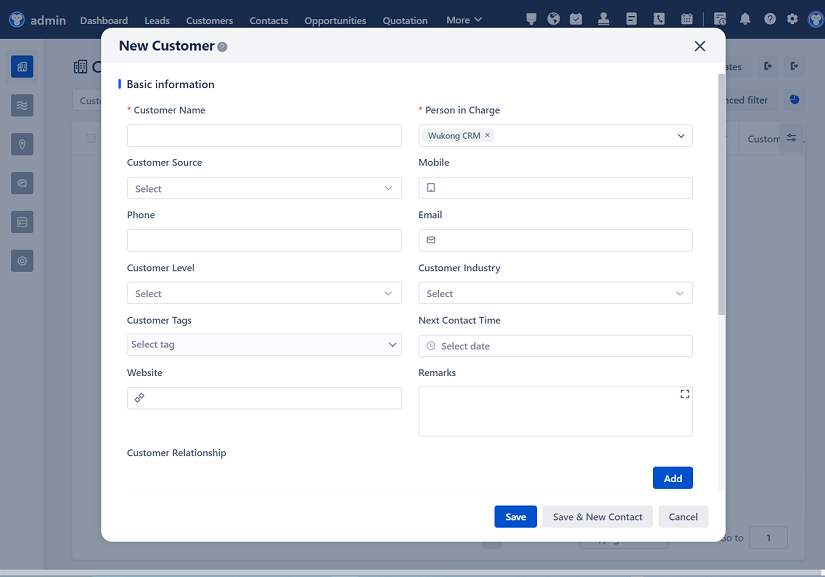
△Click on the top right corner to try Wukong CRM for free